**This is a personal fork of [3X-UI](https://github.com/MHSanaei/3x-ui)** — the advanced, open-source web control panel for [Xray-core](https://github.com/XTLS/Xray-core) — with one major addition: **native AmneziaWG support**, added as a first-class protocol alongside VLESS, VMess, Trojan, and the rest. Everything else 3X-UI already does (multi-protocol inbounds, per-client traffic accounting, subscriptions, multi-node, the Telegram bot) is unchanged and still works exactly as upstream.
This fork exists to run the author's own routers and servers; it isn't trying to replace or compete with the original project. If you're looking for the general-purpose panel, go to [MHSanaei/3x-ui](https://github.com/MHSanaei/3x-ui) — everything below only documents what's different here.
> [!IMPORTANT]
> This project is intended for personal use only. Please do not use it for illegal purposes or in a production environment.
## What's different in this fork: AmneziaWG
[AmneziaWG](https://github.com/amnezia-vpn/amneziawg-linux-kernel-module) is WireGuard with an added obfuscation layer (junk packets, randomized padding, magic-header rewriting) designed to defeat DPI-based protocol fingerprinting — the same tunnel, but one that doesn't look like a tunnel on the wire.
- **Native, not Docker.** AmneziaWG runs as a real kernel interface on the host, brought up and torn down with `awg-quick`/`awg` — the same DKMS kernel module approach as a native `wg0` interface. No privileged sidecar containers.
- **A first-class protocol.** An AmneziaWG inbound lives in the same `Inbound` table as everything else, so it gets bulk operations, the QR/config-download modal, and subscription links for free — nothing bespoke to learn.
- **Full AmneziaWG 2.0 obfuscation** — Jc/Jmin/Jmax (junk packets), S1–S4 (packet padding), H1–H4 (magic headers), and the I1 signature packet, all editable per-inbound with a one-click randomize button, plus a 1.x-compatible fallback for older clients.
- **`install.sh` installs the kernel module for you** on Ubuntu/Debian/Armbian (`ppa:amnezia/ppa`), with a fallback for other distros. One thing it can't do for you: **disable Secure Boot** on your VPS/VM first — a DKMS-built module is unsigned and the kernel won't load it while Secure Boot is enforced.
- Reconciled the same way [`internal/mtproto`](internal/mtproto) manages its `mtg` sidecar: a background job keeps the running interface in sync with what's saved in the database, hot-reloading peer changes via `awg syncconf` instead of bouncing the whole interface when it can.
Not done yet: IPv6/NDP proxying, per-client port-forwarding, and routing AmneziaWG traffic back through Xray (`RouteViaXray`) are still on the list.
## Features
- **Multi-protocol inbounds** — VLESS, VMess, Trojan, Shadowsocks, WireGuard, **AmneziaWG**, Hysteria2, HTTP, SOCKS (Mixed), Dokodemo-door / Tunnel, and TUN.
- **Modern transports & security** — TCP (Raw), mKCP, WebSocket, gRPC, HTTPUpgrade, and XHTTP, secured with TLS, XTLS, and REALITY.
- **Fallbacks** — serve multiple protocols on a single port (e.g. VLESS and Trojan on 443) using Xray's fallback support.
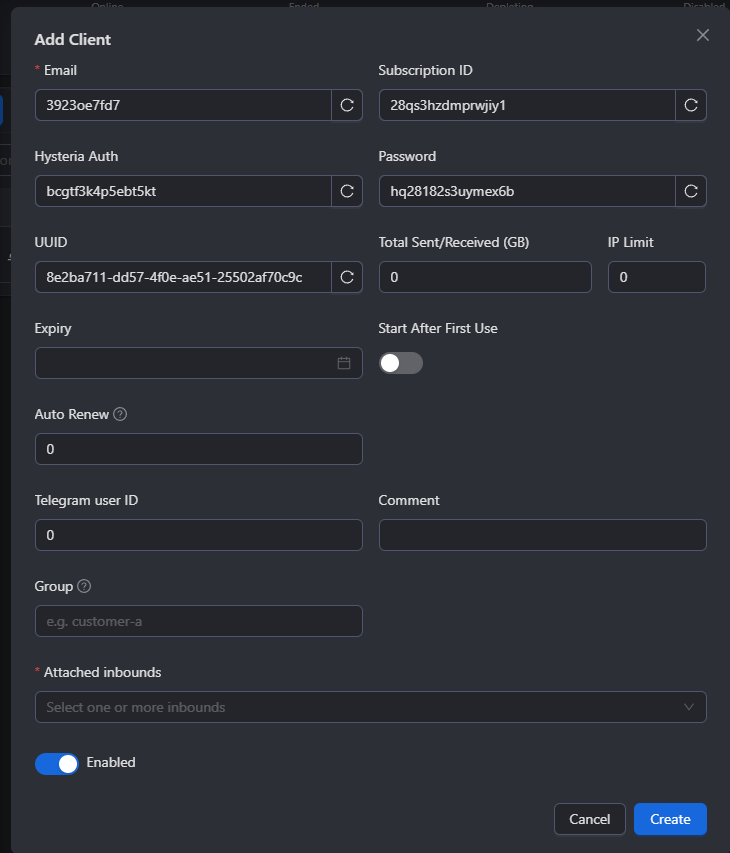
- **Per-client management** — traffic quotas, expiry dates, IP limits, live online status, and one-click share links, QR codes, and subscriptions.
- **Traffic statistics** — per inbound, per client, and per outbound, with reset controls.
- **Multi-node support** — manage and scale across multiple servers from a single panel.
- **Outbound & routing** — WARP, NordVPN, custom routing rules, load balancers, and outbound proxy chaining.
- **Built-in subscription server** with multiple output formats and [custom page templates](docs/custom-subscription-templates.md).
- **Telegram bot** for remote monitoring and management.
- **RESTful API** with in-panel Swagger documentation.
- **Flexible storage** — SQLite (default) or PostgreSQL.
- **13 UI languages** with dark and light themes.
- **Fail2ban integration** for enforcing per-client IP limits.
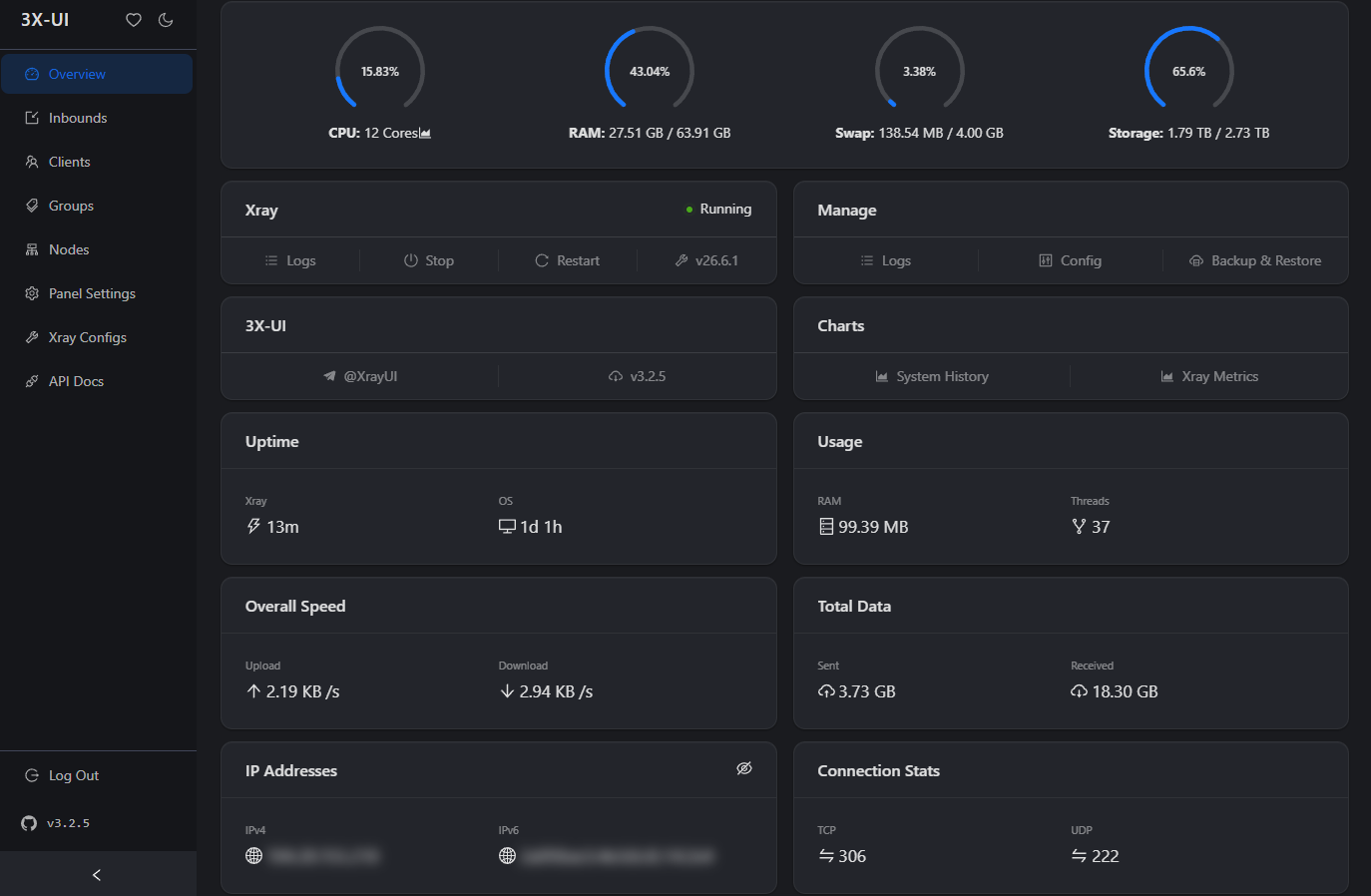
## Screenshots
Click to expand
## Quick Start
```bash
curl -fsSL https://raw.githubusercontent.com/Kuzz007/3x-ui/main/install.sh | bash -s dev
```
This fork only ever publishes the rolling **`dev-latest`** pre-release (rebuilt automatically on every push to `main`) — there's no tagged stable release yet, so `dev` is the only channel that currently resolves to anything.
During installation a random username, password, and access path are generated. After installation, run `x-ui` to open the management menu, where you can start/stop the service, view or reset your login credentials, manage SSL certificates, and more.
For general panel documentation beyond what's in this README, see the upstream [project Wiki](https://github.com/MHSanaei/3x-ui/wiki) — none of it is fork-specific, so it still applies.
### Unattended install
The installer also runs **non-interactively** for cloud-init.
Set `XUI_NONINTERACTIVE=1` (or pipe with no TTY) and it installs end-to-end with
zero prompts, generating random credentials and writing them to
`/etc/x-ui/install-result.env`. See [`deploy/`](deploy/) for:
- [Cloud-init user-data](deploy/cloud-init/) — unattended install on any cloud (Hetzner/AWS/DO/Vultr/GCP/Azure/Oracle)
- [Hetzner Cloud notes](deploy/marketplace/hetzner/) — cloud-init deployment on Hetzner
## Supported Platforms
**Operating systems:** Ubuntu, Debian, Armbian, Fedora, CentOS, RHEL, AlmaLinux, Rocky Linux, Oracle Linux, Amazon Linux, Virtuozzo, Arch, Manjaro, Parch, openSUSE (Tumbleweed / Leap), and Alpine. (Upstream also publishes a Windows build; this fork's CI doesn't — everything here targets Linux servers/routers, and AmneziaWG needs a Linux kernel module regardless.)
**Architectures:** `amd64` · `386` · `arm64` (aarch64) · `armv7` · `armv6` · `armv5` · `s390x`.
AmneziaWG specifically needs a real Linux kernel with the AmneziaWG DKMS module — it will not come up on Windows, and `install_amneziawg` only automates the kernel-module install on Ubuntu/Debian/Armbian today (see [What's different in this fork](#whats-different-in-this-fork-amneziawg)).
## Database Options
3X-UI supports two backends, chosen during the install:
- **SQLite** (default) — a single file at `/etc/x-ui/x-ui.db`. Zero setup, ideal for small and medium deployments.
- **PostgreSQL** — recommended for high client counts or multi-node setups. The installer can install PostgreSQL locally for you, or accept a DSN to an existing server.
At runtime the backend is selected via environment variables (the installer writes these to `/etc/default/x-ui` for you):
```
XUI_DB_TYPE=postgres
XUI_DB_DSN=postgres://xui:password@127.0.0.1:5432/xui?sslmode=disable
```
### Migrating an existing SQLite install to PostgreSQL
```bash
x-ui migrate-db --dsn "postgres://xui:password@127.0.0.1:5432/xui?sslmode=disable"
# then set XUI_DB_TYPE and XUI_DB_DSN in /etc/default/x-ui and restart:
systemctl restart x-ui
```
The source SQLite file is left untouched; remove it manually once you have verified the new backend.
### Docker
The default `docker compose up -d` keeps using SQLite. To run with the bundled PostgreSQL service, uncomment the two `XUI_DB_*` env lines in `docker-compose.yml` and start with the profile:
```bash
docker compose --profile postgres up -d
```
> [!NOTE]
> AmneziaWG inbounds need `awg-quick`/`awg` and the AmneziaWG kernel module on the **host** — that's the whole point of the no-Docker design in [What's different in this fork](#whats-different-in-this-fork-amneziawg). Running the panel itself in Docker still works for every other protocol, but an AmneziaWG inbound created from a containerized panel has nowhere to bring its interface up unless the container has host-level network/kernel access, which defeats the purpose. Run natively on the host if you plan to use AmneziaWG.
The image bundles Fail2ban (enabled by default) to enforce per-client **IP limits**. Fail2ban bans offenders with `iptables`, which requires the `NET_ADMIN` capability. `docker-compose.yml` already grants it via `cap_add`; if you start the container with `docker run` instead, add the capabilities yourself, otherwise bans are logged but never applied:
```bash
docker run -d --cap-add=NET_ADMIN --cap-add=NET_RAW ... ghcr.io/mhsanaei/3x-ui
```
## Environment Variables
| Variable | Description | Default |
| --- | --- | --- |
| `XUI_DB_TYPE` | Database backend: `sqlite` or `postgres` | `sqlite` |
| `XUI_DB_DSN` | PostgreSQL connection string (when `XUI_DB_TYPE=postgres`) | — |
| `XUI_DB_FOLDER` | Directory for the SQLite database file | `/etc/x-ui` |
| `XUI_DB_MAX_OPEN_CONNS` | Maximum open connections (PostgreSQL pool) | — |
| `XUI_DB_MAX_IDLE_CONNS` | Maximum idle connections (PostgreSQL pool) | — |
| `XUI_INIT_WEB_BASE_PATH` | The initial URI path for the web panel | `/` |
| `XUI_ENABLE_FAIL2BAN` | Enable Fail2ban-based IP-limit enforcement | `true` |
| `XUI_LOG_LEVEL` | Log verbosity (`debug`, `info`, `warning`, `error`) | `info` |
| `XUI_DEBUG` | Enable debug mode | `false` |
| `XUI_TUNNEL_HEALTH_MONITOR` | Enable the tunnel health monitor (probes a URL and restarts xray after repeated failures; a restart drops all clients) | `false` |
| `XUI_TUNNEL_HEALTH_PROXY` | Proxy the probe is sent through; point it at a local xray inbound so the probe tests the tunnel (e.g. `socks5://127.0.0.1:1080`). Empty means the probe only checks host connectivity | — |
| `XUI_TUNNEL_HEALTH_URL` | URL probed for tunnel health | `https://www.cloudflare.com/cdn-cgi/trace` |
| `XUI_TUNNEL_HEALTH_INTERVAL` | Interval between probes | `30s` |
| `XUI_TUNNEL_HEALTH_TIMEOUT` | Per-probe timeout | `10s` |
| `XUI_TUNNEL_HEALTH_FAILURES` | Consecutive failures before a restart is triggered | `3` |
| `XUI_TUNNEL_HEALTH_COOLDOWN` | Minimum delay between consecutive restarts | `5m` |
## Supported Languages
The panel UI is available in 13 languages:
English · فارسی · العربية · 中文(简体) · 中文(繁體) · Español · Русский · Українська · Türkçe · Tiếng Việt · 日本語 · Bahasa Indonesia · Português (Brasil)
## Developer notes
This is a personal fork and isn't looking for outside contributors, but [CONTRIBUTING.md](/CONTRIBUTING.md) still has accurate, useful local dev-setup instructions (Go/Node versions, the C compiler CGo needs, build/lint/test commands) if you're working on this codebase yourself.
## Credit
This fork is built entirely on top of [MHSanaei/3x-ui](https://github.com/MHSanaei/3x-ui) — all of the panel, the multi-protocol support, and the underlying architecture is their work; **AmneziaWG support is the only thing added here.** If you find the base project useful, the original author's support links are still the right place for it:
The native AmneziaWG implementation in this fork was ported from/inspired by:
- [MHSanaei/3x-ui#6086](https://github.com/MHSanaei/3x-ui/pull/6086) — the original AmneziaWG PR against upstream (Docker-sidecar approach); this fork reuses its frontend schema/UI structure but replaces the backend with a native, no-Docker manager.
- [coinman-dev/3ax-ui](https://github.com/coinman-dev/3ax-ui) — an independent fork already running native AmneziaWG in production; this fork's `awg-quick` process management, config generation, and AmneziaWG 2.0 obfuscation parameter generator are ported from its `awg/` package.
## Acknowledgment
- [alireza0](https://github.com/alireza0/)
- [Iran v2ray rules](https://github.com/chocolate4u/Iran-v2ray-rules) (License: **GPL-3.0**): _Enhanced v2ray/xray and v2ray/xray-clients routing rules with built-in Iranian domains and a focus on security and adblocking._
- [Russia v2ray rules](https://github.com/runetfreedom/russia-v2ray-rules-dat) (License: **GPL-3.0**): _This repository contains automatically updated V2Ray routing rules based on data on blocked domains and addresses in Russia._
## Community Tools
Tools and integrations built by the community around 3x-ui.
- [terraform-provider-3x-ui](https://github.com/batonogov/terraform-provider-threexui) (License: **MIT**): _Manage inbounds, clients, panel settings, and Xray configuration as code with Terraform / OpenTofu._






 The native AmneziaWG implementation in this fork was ported from/inspired by:
- [MHSanaei/3x-ui#6086](https://github.com/MHSanaei/3x-ui/pull/6086) — the original AmneziaWG PR against upstream (Docker-sidecar approach); this fork reuses its frontend schema/UI structure but replaces the backend with a native, no-Docker manager.
- [coinman-dev/3ax-ui](https://github.com/coinman-dev/3ax-ui) — an independent fork already running native AmneziaWG in production; this fork's `awg-quick` process management, config generation, and AmneziaWG 2.0 obfuscation parameter generator are ported from its `awg/` package.
## Acknowledgment
- [alireza0](https://github.com/alireza0/)
- [Iran v2ray rules](https://github.com/chocolate4u/Iran-v2ray-rules) (License: **GPL-3.0**): _Enhanced v2ray/xray and v2ray/xray-clients routing rules with built-in Iranian domains and a focus on security and adblocking._
- [Russia v2ray rules](https://github.com/runetfreedom/russia-v2ray-rules-dat) (License: **GPL-3.0**): _This repository contains automatically updated V2Ray routing rules based on data on blocked domains and addresses in Russia._
## Community Tools
Tools and integrations built by the community around 3x-ui.
- [terraform-provider-3x-ui](https://github.com/batonogov/terraform-provider-threexui) (License: **MIT**): _Manage inbounds, clients, panel settings, and Xray configuration as code with Terraform / OpenTofu._
The native AmneziaWG implementation in this fork was ported from/inspired by:
- [MHSanaei/3x-ui#6086](https://github.com/MHSanaei/3x-ui/pull/6086) — the original AmneziaWG PR against upstream (Docker-sidecar approach); this fork reuses its frontend schema/UI structure but replaces the backend with a native, no-Docker manager.
- [coinman-dev/3ax-ui](https://github.com/coinman-dev/3ax-ui) — an independent fork already running native AmneziaWG in production; this fork's `awg-quick` process management, config generation, and AmneziaWG 2.0 obfuscation parameter generator are ported from its `awg/` package.
## Acknowledgment
- [alireza0](https://github.com/alireza0/)
- [Iran v2ray rules](https://github.com/chocolate4u/Iran-v2ray-rules) (License: **GPL-3.0**): _Enhanced v2ray/xray and v2ray/xray-clients routing rules with built-in Iranian domains and a focus on security and adblocking._
- [Russia v2ray rules](https://github.com/runetfreedom/russia-v2ray-rules-dat) (License: **GPL-3.0**): _This repository contains automatically updated V2Ray routing rules based on data on blocked domains and addresses in Russia._
## Community Tools
Tools and integrations built by the community around 3x-ui.
- [terraform-provider-3x-ui](https://github.com/batonogov/terraform-provider-threexui) (License: **MIT**): _Manage inbounds, clients, panel settings, and Xray configuration as code with Terraform / OpenTofu._