Sanaei
6214ff4edc
Sanaei
6214ff4edc
* fix(mtproto): split the mtg fingerprint into structural and secrets parts

A reordered clients array in the stored settings used to read as a config
change because the fingerprint concatenated secrets in array order, and one
opaque fingerprint could not tell a restart-worthy change (bind address,
fronting, throttle) from a secret-set change a reload-capable mtg can absorb
in place. Sort the secret pairs so order stops mattering, and split the value
so the upcoming hot-reload path can decide between keeping, reloading, and
restarting the process.

* fix(mtproto): stop restarting mtg on every inbound edit

Saving an mtproto inbound tore down and respawned its mtg sidecar even when
nothing material changed, dropping every live Telegram connection: the update
path pushed DelInbound+AddInbound, and Remove deletes the manager's map entry,
so Ensure's fingerprint no-op gate could never fire. Route mtproto updates
through a single Ensure call so an edit that leaves the generated TOML alone
keeps the process, and only real config changes restart it.

Capturing the pre-edit protocol also fixes a latent leak: changing an
inbound's protocol away from mtproto never stopped the sidecar, because the
snapshot handed to the runtime already carried the new protocol and the
removal took the xray branch, leaving an orphaned mtg holding the port.

An mtproto push failure no longer requests an xray restart - xray cannot fix
the sidecar, and the 10s reconcile job self-heals it.

The regression test fakes mtg by re-executing the test binary, counting
spawns through a pid file: an unchanged save and a remark-only edit must keep
the process, a re-keyed secret must restart it.

* fix(mtproto): exclude depleted clients from the reconcile job to match the sync push

The 10s reconcile job derived mtg secret sets from raw inbound settings while
the interactive push filtered clients through buildRuntimeInboundForAPI, which
drops client_traffics-disabled (depleted or expired) clients. The two paths
therefore disagreed on the fingerprint - each disagreement one needless mtg
restart dropping live connections - and worse, the job kept serving depleted
clients' secrets indefinitely, so running out of traffic never actually cut an
mtproto client's access.

DesiredMtprotoInstances now builds the job's desired state with the same
depletion overlay the push uses (one bulk client_traffics query), drops
inbounds whose every secret is filtered away so their sidecar stops, and
AddInbound pushes the filtered payload too so an imported inbound carrying
disabled stats does not seed a fingerprint the next reconcile disagrees with.

* feat(mtproto): hot-reload mtg secrets in place instead of restarting

A client add, removal, re-key, or enable-toggle changes only the [secrets]
section of the generated config, yet the panel could apply it only by killing
and respawning the mtg sidecar, dropping every Telegram connection on that
inbound. Split the ensure decision three ways: an identical config is a no-op,
a secrets-only change rewrites the TOML on the same api port and asks mtg to
hot-swap it via POST /reload, and a structural change (or a failed reload)
falls back to the full stop-and-start.

The reload endpoint is served by the mhsanaei/mtg-multi fork; against an older
binary the POST 404s and the manager restarts exactly as before, so panel and
binary upgrades stay order-independent.

* feat(mtproto): apply single-client edits to the sidecar immediately

Client CRUD on an mtproto inbound was a runtime no-op, so an add, delete,
re-key, or enable-toggle only reached mtg on the next 10s reconcile. With the
sidecar now able to hot-reload, push the change straight after the edit commits:
applyLocalMtproto rebuilds the inbound's filtered client set and re-applies it,
so a new client works within a moment (and, on a reload-capable binary, without
disturbing the others) and deleting the last client stops the process.

The three interactive single-client paths (add, update, delete) call it; bulk
operations still ride the reconcile job, which converges to the same state.

* chore(mtproto): pin mtg-multi to the mhsanaei fork v1.13.3

The reload endpoint the panel now uses lives in the mhsanaei/mtg-multi fork, so
point the source-build pin (DockerInit.sh + both release.yml matrices) at it and
bump to v1.13.3. The install still produces the same mtg-multi binary name, so
the mtg-<os>-<arch> rename and everything downstream are unchanged. Docs and the
package comment note the hot-reload path and its restart fallback.

* feat(mtproto): apply live secret updates via the management API and add ad-tag

Two capabilities the mhsanaei/mtg-multi v1.13.3 fork exposes are now surfaced by
the sidecar manager.

Live updates go through PUT /secrets on the fork's management API instead of
POST /reload: the panel already holds the whole desired set per inbound, so it
sends secrets and the advertising tag as one JSON call that mtg applies
atomically, keeping every unchanged connection and closing only removed or
re-keyed ones. The config file is still written first so a restart or crash
recovery reproduces the state, and any non-200 (an older binary, a refused
connection) still falls back to a full restart.

Per-inbound ad-tag adds an optional 32-hex Telegram advertising tag plus
public-ipv4/public-ipv6 overrides. The ad-tag rides the reloadable secrets
fingerprint, so changing it hot-applies without dropping connections; the public
IPs are proxy-construction parameters and sit in the structural fingerprint, so a
change there restarts the process. Empty public IPs are omitted so mtg
auto-detects the reachable address.

* feat(inbounds): expose the mtproto ad-tag and public IP in the inbound form

Adds an Ad-tag field (validated as 32 hex characters) plus optional Public IPv4
and Public IPv6 overrides to the MTProto inbound form, backed by the same-named
settings the sidecar writes into the mtg config. The public IPs are optional —
left blank, mtg auto-detects the reachable address the ad-tag middle proxy needs.
English strings are added to every locale; the non-English ones carry the
English text until translated and fall back to it meanwhile.

* ci(mtproto): install mtg-multi from prebuilt release binaries

The fork now publishes release archives for every platform we package, so
download and unpack the matching mtg-multi-<ver>-<os>-<arch> binary instead of
compiling it from source with go install. Faster builds and no toolchain step,
and the archive's platform labels line up with our matrix; the produced
mtg-<os>-<arch> filenames are unchanged.

* i18n(mtproto): localize the ad-tag and public IP strings

The six mtgAdTag*/mtgPublicIp* keys shipped with English text in every locale as
a placeholder. Translate them into the twelve non-English locales (Arabic,
Spanish, Persian, Indonesian, Japanese, Portuguese-BR, Russian, Turkish,
Ukrainian, Vietnamese, and Simplified/Traditional Chinese); en-US is unchanged.

* retired goreportcard.com
10 KiB
English | فارسی | العربية | 中文 | Español | Русский | Türkçe





3X-UI is an advanced, open-source web control panel for managing Xray-core servers. It provides a clean, multi-language interface for deploying, configuring, and monitoring a wide range of proxy and VPN protocols — from a single VPS to multi-node deployments.
Built as an enhanced fork of the original X-UI project, 3X-UI adds broader protocol support, improved stability, per-client traffic accounting, and many quality-of-life features.
Important
This project is intended for personal use only. Please do not use it for illegal purposes or in a production environment.
Features
- Multi-protocol inbounds — VLESS, VMess, Trojan, Shadowsocks, WireGuard, Hysteria2, HTTP, SOCKS (Mixed), Dokodemo-door / Tunnel, and TUN.
- Modern transports & security — TCP (Raw), mKCP, WebSocket, gRPC, HTTPUpgrade, and XHTTP, secured with TLS, XTLS, and REALITY.
- Fallbacks — serve multiple protocols on a single port (e.g. VLESS and Trojan on 443) using Xray's fallback support.
- Per-client management — traffic quotas, expiry dates, IP limits, live online status, and one-click share links, QR codes, and subscriptions.
- Traffic statistics — per inbound, per client, and per outbound, with reset controls.
- Multi-node support — manage and scale across multiple servers from a single panel.
- Outbound & routing — WARP, NordVPN, custom routing rules, load balancers, and outbound proxy chaining.
- Built-in subscription server with multiple output formats and custom page templates.
- Telegram bot for remote monitoring and management.
- RESTful API with in-panel Swagger documentation.
- Flexible storage — SQLite (default) or PostgreSQL.
- 13 UI languages with dark and light themes.
- Fail2ban integration for enforcing per-client IP limits.
Screenshots
Click to expand


Quick Start
bash <(curl -Ls https://raw.githubusercontent.com/mhsanaei/3x-ui/master/install.sh)
To install a specific version, append its tag (e.g. v3.4.0):
bash <(curl -Ls https://raw.githubusercontent.com/mhsanaei/3x-ui/master/install.sh) v3.4.0
To install the rolling dev build (latest per-commit pre-release from main, not a stable release), pass dev-latest:
bash <(curl -Ls https://raw.githubusercontent.com/mhsanaei/3x-ui/master/install.sh) dev-latest
During installation a random username, password, and access path are generated. After installation, run x-ui to open the management menu, where you can start/stop the service, view or reset your login credentials, manage SSL certificates, and more.
For full documentation, please visit the project Wiki.
Unattended install
The installer also runs non-interactively for cloud-init.
Set XUI_NONINTERACTIVE=1 (or pipe with no TTY) and it installs end-to-end with
zero prompts, generating random credentials and writing them to
/etc/x-ui/install-result.env. See deploy/ for:
- Cloud-init user-data — unattended install on any cloud (Hetzner/AWS/DO/Vultr/GCP/Azure/Oracle)
- Hetzner Cloud notes — cloud-init deployment on Hetzner
Supported Platforms
Operating systems: Ubuntu, Debian, Armbian, Fedora, CentOS, RHEL, AlmaLinux, Rocky Linux, Oracle Linux, Amazon Linux, Virtuozzo, Arch, Manjaro, Parch, openSUSE (Tumbleweed / Leap), Alpine, and Windows.
Architectures: amd64 · 386 · arm64 (aarch64) · armv7 · armv6 · armv5 · s390x.
Database Options
3X-UI supports two backends, chosen during the install:
- SQLite (default) — a single file at
/etc/x-ui/x-ui.db. Zero setup, ideal for small and medium deployments. - PostgreSQL — recommended for high client counts or multi-node setups. The installer can install PostgreSQL locally for you, or accept a DSN to an existing server.
At runtime the backend is selected via environment variables (the installer writes these to /etc/default/x-ui for you):
XUI_DB_TYPE=postgres
XUI_DB_DSN=postgres://xui:password@127.0.0.1:5432/xui?sslmode=disable
Migrating an existing SQLite install to PostgreSQL
x-ui migrate-db --dsn "postgres://xui:password@127.0.0.1:5432/xui?sslmode=disable"
# then set XUI_DB_TYPE and XUI_DB_DSN in /etc/default/x-ui and restart:
systemctl restart x-ui
The source SQLite file is left untouched; remove it manually once you have verified the new backend.
Docker
The default docker compose up -d keeps using SQLite. To run with the bundled PostgreSQL service, uncomment the two XUI_DB_* env lines in docker-compose.yml and start with the profile:
docker compose --profile postgres up -d
The image bundles Fail2ban (enabled by default) to enforce per-client IP limits. Fail2ban bans offenders with iptables, which requires the NET_ADMIN capability. docker-compose.yml already grants it via cap_add; if you start the container with docker run instead, add the capabilities yourself, otherwise bans are logged but never applied:
docker run -d --cap-add=NET_ADMIN --cap-add=NET_RAW ... ghcr.io/mhsanaei/3x-ui
Environment Variables
| Variable | Description | Default |
|---|---|---|
XUI_DB_TYPE |
Database backend: sqlite or postgres |
sqlite |
XUI_DB_DSN |
PostgreSQL connection string (when XUI_DB_TYPE=postgres) |
— |
XUI_DB_FOLDER |
Directory for the SQLite database file | /etc/x-ui |
XUI_DB_MAX_OPEN_CONNS |
Maximum open connections (PostgreSQL pool) | — |
XUI_DB_MAX_IDLE_CONNS |
Maximum idle connections (PostgreSQL pool) | — |
XUI_INIT_WEB_BASE_PATH |
The initial URI path for the web panel | / |
XUI_ENABLE_FAIL2BAN |
Enable Fail2ban-based IP-limit enforcement | true |
XUI_LOG_LEVEL |
Log verbosity (debug, info, warning, error) |
info |
XUI_DEBUG |
Enable debug mode | false |
XUI_TUNNEL_HEALTH_MONITOR |
Enable the tunnel health monitor (probes a URL and restarts xray after repeated failures; a restart drops all clients) | false |
XUI_TUNNEL_HEALTH_PROXY |
Proxy the probe is sent through; point it at a local xray inbound so the probe tests the tunnel (e.g. socks5://127.0.0.1:1080). Empty means the probe only checks host connectivity |
— |
XUI_TUNNEL_HEALTH_URL |
URL probed for tunnel health | https://www.cloudflare.com/cdn-cgi/trace |
XUI_TUNNEL_HEALTH_INTERVAL |
Interval between probes | 30s |
XUI_TUNNEL_HEALTH_TIMEOUT |
Per-probe timeout | 10s |
XUI_TUNNEL_HEALTH_FAILURES |
Consecutive failures before a restart is triggered | 3 |
XUI_TUNNEL_HEALTH_COOLDOWN |
Minimum delay between consecutive restarts | 5m |
Supported Languages
The panel UI is available in 13 languages:
English · فارسی · العربية · 中文(简体) · 中文(繁體) · Español · Русский · Українська · Türkçe · Tiếng Việt · 日本語 · Bahasa Indonesia · Português (Brasil)
Contributing
Contributions are welcome. Please read the Contributing Guide before opening an issue or pull request.
A Special Thanks to
Acknowledgment
- Iran v2ray rules (License: GPL-3.0): Enhanced v2ray/xray and v2ray/xray-clients routing rules with built-in Iranian domains and a focus on security and adblocking.
- Russia v2ray rules (License: GPL-3.0): This repository contains automatically updated V2Ray routing rules based on data on blocked domains and addresses in Russia.
Community Tools
Tools and integrations built by the community around 3x-ui.
- terraform-provider-3x-ui (License: MIT): Manage inbounds, clients, panel settings, and Xray configuration as code with Terraform / OpenTofu.
Support project
If this project is helpful to you, you may wish to give it a🌟


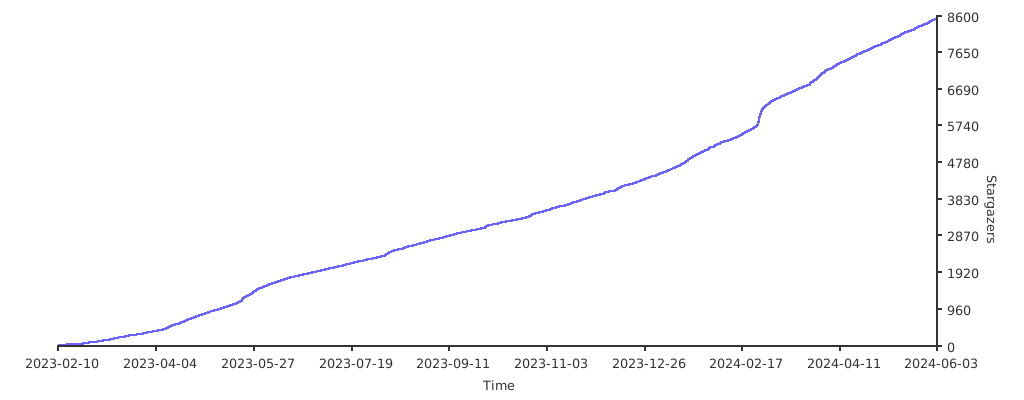
Stargazers over Time