mirror of
https://github.com/MHSanaei/3x-ui.git
synced 2026-07-06 04:44:21 +00:00
 Sanaei
41645255f1
Sanaei
41645255f1
* refactor(service): split client.go into focused files

client.go had grown to 4455 lines mixing ~10 responsibilities. Split it
verbatim into cohesive same-package files (no behavior change):

  client.go            foundation: ClientService, ClientWithAttachments,
                       ClientCreatePayload, ErrClientNotInInbound, sqlInChunk
  client_locks.go      inbound mutation locks, delete tombstones, compactOrphans
  client_lookup.go     read-only lookups (GetByID, List, EffectiveFlow, ...)
  client_link.go       inbound association sync (SyncInbound, DetachInbound, ...)
  client_crud.go       single-client CRUD + validation + protocol defaults
  client_inbound_apply.go  low-level inbound-settings mutators + by-email setters
  client_bulk.go       bulk attach/detach/adjust/delete/create + DelDepleted
  client_traffic.go    traffic-reset paths
  client_groups.go     client group management
  client_paging.go     paged listing, filtering, sorting, summary

Every declaration moved unchanged (verified: identical func/type/const/var
signature set before vs after). Imports redistributed per file via goimports.
go build ./..., go vet, and go test ./web/service/... all pass.

* refactor(service): split inbound.go into focused files

inbound.go was 4100 lines. Split it verbatim into cohesive same-package
files (no behavior change):

  inbound.go             core inbound CRUD + InboundService (keeps pkg doc)
  inbound_protocol.go    protocol / stream capability helpers
  inbound_node.go        node/runtime/remote coordination + online tracking
  inbound_traffic.go     traffic accounting, reset, client stats
  inbound_client_ips.go  per-client IP tracking
  inbound_clients.go     client lookups within inbounds + copy-clients
  inbound_disable.go     auto-disable invalid inbounds/clients
  inbound_migration.go   DB migrations
  inbound_sublink.go     subscription link providers
  inbound_util.go        generic slice/string helpers

Identical func/type/const/var signature set before vs after; package doc
comment preserved on inbound.go. Imports redistributed via goimports.
Build, vet, and go test ./web/service/... all pass.

* refactor(service): split tgbot.go into focused files

tgbot.go was 3738 lines dominated by a 1246-line answerCallback. Split it
verbatim into cohesive same-package files (no behavior change):

  tgbot.go           lifecycle, bot setup, caches, small utils
  tgbot_router.go    incoming update / command / callback dispatch
  tgbot_send.go      outbound messaging primitives
  tgbot_client.go    client views, actions, subscription links
  tgbot_inbound.go   inbound listing / pickers
  tgbot_report.go    server usage, exhausted, online, backups, notifications

Identical func/type/const/var signature set before vs after. Imports
redistributed via goimports. Build, vet, and go test ./web/service/... pass.

* refactor(client): dedupe single-field by-email setters

ResetClientIpLimitByEmail, ResetClientExpiryTimeByEmail, and
ResetClientTrafficLimitByEmail shared an identical ~50-line body that
resolves the inbound by email, confirms the client exists, rewrites a
single-client settings payload, and delegates to UpdateInboundClient.

Extract that into applyClientFieldByEmail(inboundSvc, email, mutate) and
reduce each setter to a 3-line wrapper. Behavior is unchanged: same checks
and error strings, same single-client payload contract, same totalGB guard.

SetClientTelegramUserID (resolves by traffic id, different error text) and
ToggleClientEnableByEmail/SetClientEnableByEmail (different return shape and
a pre-read of the old state) intentionally keep their own bodies.

* refactor(service): extract panel/ subpackage

Move the panel-administration leaf services out of the flat service
package into web/service/panel/ (package panel):

  user.go         UserService (auth / 2FA / LDAP)
  panel.go        PanelService (restart / self-update) + version helpers
  panel_other.go  non-unix RestartPanel
  panel_unix.go   unix RestartPanel
  api_token.go    ApiTokenService
  websocket.go    WebSocketService
  panel_test.go   version/shellQuote unit tests

These are leaves: they depend on core (SettingService, Release) but no
core file references them, so the extraction creates no import cycle.
Core references are now qualified (service.SettingService, service.Release);
callers in main.go, web/web.go, and web/controller/* updated to panel.*.
Build, vet, and go test ./web/... pass.

* refactor(service): extract integration/ subpackage

Move the external-provider integration leaves into web/service/integration/
(package integration):

  warp.go        WarpService (Cloudflare WARP)
  nord.go        NordService (NordVPN)
  custom_geo.go  CustomGeoService (custom geo asset management)
  *_test.go      custom_geo / panel-proxy tests

These depend on core (SettingService, ServerService, XraySettingService) but
no core file references them. xray_setting.go stays in core because it calls
the unexported SettingService.saveSetting. The shared isBlockedIP SSRF helper
(used by core url_safety.go and by custom_geo) now has a small copy in each
package rather than being exported. Core references qualified; callers in
web/web.go, web/job/*, and web/controller/* updated to integration.*.
Build, vet, and go test ./web/... pass.

* refactor(service): extract tgbot/ subpackage

Move the Telegram bot (6 files + test) into web/service/tgbot/ (package
tgbot). It is a leaf: it embeds five core services (Inbound/Client/Setting/
Server/Xray) and the core never references it, so no import cycle.

To support the package boundary without changing behavior:
  - core exposes XrayProcess() *xray.Process so tgbot keeps calling the
    exact same running-process methods it used via the package-level `p`;
  - three core methods tgbot calls are exported: ClientService.checkIs-
    EnabledByEmail -> CheckIsEnabledByEmail, InboundService.getAllEmails ->
    GetAllEmails (callers updated in-package);
  - tgbot's embedded-field types and the few core type refs (Status,
    ClientCreatePayload, SanitizePublicHTTPURL) are now service-qualified.

Callers in main.go, web/web.go, web/job/*, and web/controller/* updated to
tgbot.*. Build, vet, and go test ./web/... pass.

* refactor(service): extract outbound/ subpackage

OutboundService (outbound.go) imports only neutral packages (config,
database, model, xray) and its production code is referenced by no core or
sibling service file — only by web/controller/xray_setting.go and
web/job/xray_traffic_job.go. Move it to web/service/outbound/ (package
outbound); no core qualification needed inside. Callers updated to outbound.*.

The one coupling was a tiny pure test helper, outboundsContainTag, used by
both outbound.go and the core outbound_subscription_test.go; it now has a
small copy in that test file rather than being shared across the boundary.
Build, vet, and go test ./web/... pass.

* refactor(util): move wireguard into its own subpackage

util/wireguard.go was the lone file of the root `util` package (24 lines,
one exported func GenerateWireguardKeypair), while every other util concern
lives in a focused subpackage (util/common, util/crypto, util/netsafe, ...).
Move it to util/wireguard/ (package wireguard) for consistency; its only
importer, web/service/integration/warp.go, is updated. The root `util`
package no longer exists.

* refactor(sub): drop redundant sub prefix from filenames

Inside package sub the subXxx.go prefix just repeats the package name
(like client_*.go did inside service). Rename for consistency; content and
type names are unchanged:

  subController.go    -> controller.go
  subService.go       -> service.go
  subClashService.go  -> clash_service.go
  subJsonService.go   -> json_service.go
  (+ matching _test.go files)

* refactor(controller): rename xui.go -> spa.go

XUIController serves the panel's single-page-app shell; spa.go names that
role plainly (the other controller files are domain-named). File rename only
— the type stays XUIController. api_docs_test.go keys route base paths by
filename, so its "xui.go" case is updated to "spa.go".

* refactor: move backend packages under internal/

Adopt the idiomatic Go application layout: the backend packages now live
under internal/ (a boundary the toolchain enforces), signalling private
implementation instead of a library-style flat root. No runtime behavior
changes — only import paths and a few build/config paths move.

Moved: config, database, logger, mtproto, sub, util, web, xray -> internal/.
main.go stays at the repo root and tools/openapigen stays under tools/ (both
still import internal/* because the internal rule keys off the module root).
The module path github.com/mhsanaei/3x-ui/v3 is unchanged; 149 .go files had
their import prefix rewritten to .../internal/<pkg>.

Couplings the Go compiler can't see, updated to the new layout:
  - frontend i18n imports of web/translation (react.ts, setup.components.ts)
  - vite outDir + eslint/tsconfig ignore globs -> internal/web/dist
  - Dockerfile COPY paths for web/dist and web/translation
  - locale.go os.DirFS("web") disk fallback -> "internal/web"
  - .gitignore and ci.yml go:embed stub for internal/web/dist
  - api_docs_test.go repo-root relative walk (one level deeper)
  - tools/openapigen filesystem package paths; ApiTokenView repointed to the
    web/service/panel subpackage and codegen regenerated (clears a stale
    type the ci.yml codegen check was failing on)

Verified: go build/vet/test (all packages), and frontend typecheck, lint,
vitest (478 tests), and production build into internal/web/dist.

* fix(config): keep test runs from writing logs into the source tree

GetLogFolder() returns a CWD-relative "./log" on Windows. Under `go test`
the working directory is each package's own folder, so InitLogger (called by
tests in web/job, web/service, xray, web/websocket) created stray log/
directories scattered through the source tree (e.g. internal/web/job/log/).

Redirect to a shared temp folder when testing.Testing() reports a test run.
Production behavior is unchanged: Windows still uses ./log next to the binary
and Linux /var/log/x-ui. The log files were always gitignored (*.log) and
never committed; this just stops the noise at the source.

* docs: move subscription-template guide out of root into docs/

sub_templates/ was a top-level folder holding only a README and no actual
templates (3x-ui ships none by design), referenced nowhere and unlinked from
any doc — it read like an empty placeholder cluttering the repo root.

Move the guide to docs/custom-subscription-templates.md (a proper docs home),
reword its intro to read as documentation rather than a folder note, link it
from the Features list in README.md, and drop the empty sub_templates/ folder.

* fix: update stale web/ path references after the internal/ move

The internal/ migration rewrote Go import paths but left some references to
the old top-level layout in docs, comments, and a few runtime disk paths.

Functional (dev-mode only): the disk-serving fallbacks that read the Vite
build from disk when running from source still pointed at web/dist/, which
moved to internal/web/dist/ — so `os.DirFS`/`os.Stat`/`os.ReadFile` in
internal/web/web.go and internal/sub/{sub,controller}.go are corrected.
Production was unaffected (it serves the embedded FS; verified by the Docker
build), but `go run` with a live frontend build silently fell back to embed.

Docs/comments: frontend/README.md, CONTRIBUTING.md, the claude-issue-bot and
release workflows, the openapigen -root help text, and assorted Go comments
now reference internal/web, internal/database, internal/sub, internal/xray,
etc. Package-name mentions (the "web" package), root paths (main.go,
frontend/, install scripts, /etc/x-ui), routes (/panel/api/xray), and the
historical "web/assets no longer exists" note were intentionally left as-is.

* refactor(web): remove the legacy /xui -> /panel redirect middleware

RedirectMiddleware existed only for backward compatibility with the old
`/xui` URL scheme (301-redirecting /xui and /xui/API to /panel and
/panel/api). That cutover was long ago, so drop the middleware, its
registration in initRouter, and the now-inaccurate "URL redirection"
mention in the middleware package doc. Old /xui URLs now 404 like any other
unknown path. HTTPS auto-redirect and auth redirects are unrelated and stay.

* build: fix .dockerignore for internal/ layout and exclude runtime dir

- web/dist -> internal/web/dist: the embedded frontend moved under internal/,
  so the stale exclude no longer matched and the locally-built dist could be
  sent to the build context (the frontend stage rebuilds it fresh anyway).
- exclude x-ui/: the local runtime directory (SQLite db, geo .dat files, xray
  binaries, certs — ~150MB) was being shipped into the build context for no
  reason. Verified the pattern excludes only the directory and still keeps
  x-ui.sh, which the Dockerfile copies to /usr/bin/x-ui.
178 lines
8.9 KiB
Markdown
178 lines
8.9 KiB
Markdown
[English](/README.md) | [فارسی](/README.fa_IR.md) | [العربية](/README.ar_EG.md) | [中文](/README.zh_CN.md) | [Español](/README.es_ES.md) | [Русский](/README.ru_RU.md) | [Türkçe](/README.tr_TR.md)
|
|
|
|
<p align="center">
|
|
<picture>
|
|
<source media="(prefers-color-scheme: dark)" srcset="./media/3x-ui-dark.png">
|
|
<img alt="3x-ui" src="./media/3x-ui-light.png">
|
|
</picture>
|
|
</p>
|
|
|
|
<p align="center">
|
|
<a href="https://github.com/MHSanaei/3x-ui/releases"><img src="https://img.shields.io/github/v/release/mhsanaei/3x-ui" alt="Release"></a>
|
|
<a href="https://github.com/MHSanaei/3x-ui/actions"><img src="https://img.shields.io/github/actions/workflow/status/mhsanaei/3x-ui/release.yml.svg" alt="Build"></a>
|
|
<a href="#"><img src="https://img.shields.io/github/go-mod/go-version/mhsanaei/3x-ui.svg" alt="GO Version"></a>
|
|
<a href="https://github.com/MHSanaei/3x-ui/releases/latest"><img src="https://img.shields.io/github/downloads/mhsanaei/3x-ui/total.svg" alt="Downloads"></a>
|
|
<a href="https://www.gnu.org/licenses/gpl-3.0.en.html"><img src="https://img.shields.io/badge/license-GPL%20V3-blue.svg?longCache=true" alt="License"></a>
|
|
<a href="https://pkg.go.dev/github.com/mhsanaei/3x-ui/v3"><img src="https://pkg.go.dev/badge/github.com/mhsanaei/3x-ui/v3.svg" alt="Go Reference"></a>
|
|
<a href="https://goreportcard.com/report/github.com/mhsanaei/3x-ui/v3"><img src="https://goreportcard.com/badge/github.com/mhsanaei/3x-ui/v3" alt="Go Report Card"></a>
|
|
</p>
|
|
|
|
**3X-UI** is an advanced, open-source web control panel for managing [Xray-core](https://github.com/XTLS/Xray-core) servers. It provides a clean, multi-language interface for deploying, configuring, and monitoring a wide range of proxy and VPN protocols — from a single VPS to multi-node deployments.
|
|
|
|
Built as an enhanced fork of the original X-UI project, 3X-UI adds broader protocol support, improved stability, per-client traffic accounting, and many quality-of-life features.
|
|
|
|
> [!IMPORTANT]
|
|
> This project is intended for personal use only. Please do not use it for illegal purposes or in a production environment.
|
|
|
|
## Features
|
|
|
|
- **Multi-protocol inbounds** — VLESS, VMess, Trojan, Shadowsocks, WireGuard, Hysteria2, HTTP, SOCKS (Mixed), Dokodemo-door / Tunnel, and TUN.
|
|
- **Modern transports & security** — TCP (Raw), mKCP, WebSocket, gRPC, HTTPUpgrade, and XHTTP, secured with TLS, XTLS, and REALITY.
|
|
- **Fallbacks** — serve multiple protocols on a single port (e.g. VLESS and Trojan on 443) using Xray's fallback support.
|
|
- **Per-client management** — traffic quotas, expiry dates, IP limits, live online status, and one-click share links, QR codes, and subscriptions.
|
|
- **Traffic statistics** — per inbound, per client, and per outbound, with reset controls.
|
|
- **Multi-node support** — manage and scale across multiple servers from a single panel.
|
|
- **Outbound & routing** — WARP, NordVPN, custom routing rules, load balancers, and outbound proxy chaining.
|
|
- **Built-in subscription server** with multiple output formats and [custom page templates](docs/custom-subscription-templates.md).
|
|
- **Telegram bot** for remote monitoring and management.
|
|
- **RESTful API** with in-panel Swagger documentation.
|
|
- **Flexible storage** — SQLite (default) or PostgreSQL.
|
|
- **13 UI languages** with dark and light themes.
|
|
- **Fail2ban integration** for enforcing per-client IP limits.
|
|
|
|
## Screenshots
|
|
|
|
<details>
|
|
<summary>Click to expand</summary>
|
|
|
|
<picture>
|
|
<source media="(prefers-color-scheme: dark)" srcset="./media/01-overview-dark.png">
|
|
<img alt="Overview" src="./media/01-overview-light.png">
|
|
</picture>
|
|
|
|
<picture>
|
|
<source media="(prefers-color-scheme: dark)" srcset="./media/02-add-inbound-dark.png">
|
|
<img alt="Inbounds" src="./media/02-add-inbound-light.png">
|
|
</picture>
|
|
|
|
<picture>
|
|
<source media="(prefers-color-scheme: dark)" srcset="./media/03-add-client-dark.png">
|
|
<img alt="Add client" src="./media/03-add-client-light.png">
|
|
</picture>
|
|
|
|
<picture>
|
|
<source media="(prefers-color-scheme: dark)" srcset="./media/05-add-nodes-dark.png">
|
|
<img alt="Configs" src="./media/05-add-nodes-light.png">
|
|
</picture>
|
|
|
|
</details>
|
|
|
|
## Quick Start
|
|
|
|
```bash
|
|
bash <(curl -Ls https://raw.githubusercontent.com/mhsanaei/3x-ui/master/install.sh)
|
|
```
|
|
|
|
During installation a random username, password, and access path are generated. After installation, run `x-ui` to open the management menu, where you can start/stop the service, view or reset your login credentials, manage SSL certificates, and more.
|
|
|
|
For full documentation, please visit the [project Wiki](https://github.com/MHSanaei/3x-ui/wiki).
|
|
|
|
## Supported Platforms
|
|
|
|
**Operating systems:** Ubuntu, Debian, Armbian, Fedora, CentOS, RHEL, AlmaLinux, Rocky Linux, Oracle Linux, Amazon Linux, Virtuozzo, Arch, Manjaro, Parch, openSUSE (Tumbleweed / Leap), Alpine, and Windows.
|
|
|
|
**Architectures:** `amd64` · `386` · `arm64` (aarch64) · `armv7` · `armv6` · `armv5` · `s390x`.
|
|
|
|
## Database Options
|
|
|
|
3X-UI supports two backends, chosen during the install:
|
|
|
|
- **SQLite** (default) — a single file at `/etc/x-ui/x-ui.db`. Zero setup, ideal for small and medium deployments.
|
|
- **PostgreSQL** — recommended for high client counts or multi-node setups. The installer can install PostgreSQL locally for you, or accept a DSN to an existing server.
|
|
|
|
At runtime the backend is selected via environment variables (the installer writes these to `/etc/default/x-ui` for you):
|
|
|
|
```
|
|
XUI_DB_TYPE=postgres
|
|
XUI_DB_DSN=postgres://xui:password@127.0.0.1:5432/xui?sslmode=disable
|
|
```
|
|
|
|
### Migrating an existing SQLite install to PostgreSQL
|
|
|
|
```bash
|
|
x-ui migrate-db --dsn "postgres://xui:password@127.0.0.1:5432/xui?sslmode=disable"
|
|
# then set XUI_DB_TYPE and XUI_DB_DSN in /etc/default/x-ui and restart:
|
|
systemctl restart x-ui
|
|
```
|
|
|
|
The source SQLite file is left untouched; remove it manually once you have verified the new backend.
|
|
|
|
### Docker
|
|
|
|
The default `docker compose up -d` keeps using SQLite. To run with the bundled PostgreSQL service, uncomment the two `XUI_DB_*` env lines in `docker-compose.yml` and start with the profile:
|
|
|
|
```bash
|
|
docker compose --profile postgres up -d
|
|
```
|
|
|
|
The image bundles Fail2ban (enabled by default) to enforce per-client **IP limits**. Fail2ban bans offenders with `iptables`, which requires the `NET_ADMIN` capability. `docker-compose.yml` already grants it via `cap_add`; if you start the container with `docker run` instead, add the capabilities yourself, otherwise bans are logged but never applied:
|
|
|
|
```bash
|
|
docker run -d --cap-add=NET_ADMIN --cap-add=NET_RAW ... ghcr.io/mhsanaei/3x-ui
|
|
```
|
|
|
|
## Environment Variables
|
|
|
|
| Variable | Description | Default |
|
|
| --- | --- | --- |
|
|
| `XUI_DB_TYPE` | Database backend: `sqlite` or `postgres` | `sqlite` |
|
|
| `XUI_DB_DSN` | PostgreSQL connection string (when `XUI_DB_TYPE=postgres`) | — |
|
|
| `XUI_DB_FOLDER` | Directory for the SQLite database file | `/etc/x-ui` |
|
|
| `XUI_DB_MAX_OPEN_CONNS` | Maximum open connections (PostgreSQL pool) | — |
|
|
| `XUI_DB_MAX_IDLE_CONNS` | Maximum idle connections (PostgreSQL pool) | — |
|
|
| `XUI_ENABLE_FAIL2BAN` | Enable Fail2ban-based IP-limit enforcement | `true` |
|
|
| `XUI_LOG_LEVEL` | Log verbosity (`debug`, `info`, `warning`, `error`) | `info` |
|
|
| `XUI_DEBUG` | Enable debug mode | `false` |
|
|
|
|
## Supported Languages
|
|
|
|
The panel UI is available in 13 languages:
|
|
|
|
English · فارسی · العربية · 中文(简体) · 中文(繁體) · Español · Русский · Українська · Türkçe · Tiếng Việt · 日本語 · Bahasa Indonesia · Português (Brasil)
|
|
|
|
## Contributing
|
|
|
|
Contributions are welcome. Please read the [Contributing Guide](/CONTRIBUTING.md) before opening an issue or pull request.
|
|
|
|
## A Special Thanks to
|
|
|
|
- [alireza0](https://github.com/alireza0/)
|
|
|
|
## Acknowledgment
|
|
|
|
- [Iran v2ray rules](https://github.com/chocolate4u/Iran-v2ray-rules) (License: **GPL-3.0**): _Enhanced v2ray/xray and v2ray/xray-clients routing rules with built-in Iranian domains and a focus on security and adblocking._
|
|
- [Russia v2ray rules](https://github.com/runetfreedom/russia-v2ray-rules-dat) (License: **GPL-3.0**): _This repository contains automatically updated V2Ray routing rules based on data on blocked domains and addresses in Russia._
|
|
|
|
## Community Tools
|
|
|
|
Tools and integrations built by the community around 3x-ui.
|
|
|
|
- [terraform-provider-3x-ui](https://github.com/batonogov/terraform-provider-threexui) (License: **MIT**): _Manage inbounds, clients, panel settings, and Xray configuration as code with Terraform / OpenTofu._
|
|
|
|
## Support project
|
|
|
|
**If this project is helpful to you, you may wish to give it a**:star2:
|
|
|
|
<a href="https://www.buymeacoffee.com/MHSanaei" target="_blank">
|
|
<img src="./media/default-yellow.png" alt="Buy Me A Coffee" style="height: 70px !important;width: 277px !important;" >
|
|
</a>
|
|
|
|
</br>
|
|
<a href="https://nowpayments.io/donation/hsanaei" target="_blank" rel="noreferrer noopener">
|
|
<img src="./media/donation-button-black.svg" alt="Crypto donation button by NOWPayments">
|
|
</a>
|
|
|
|
## Stargazers over Time
|
|
|
|
[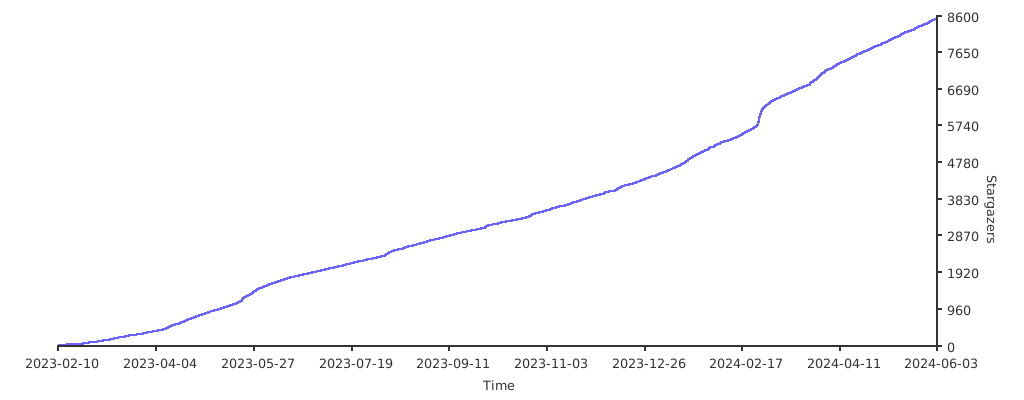](https://starchart.cc/MHSanaei/3x-ui)
|