 Daria Korenieva
0c405901d2
Daria Korenieva
0c405901d2
* feat(vector): add Valkey Search vector database backend

Add a new opt-in VectorDatabase backend backed by the Valkey Search module
(valkey/valkey-bundle), accessed via the official valkey-glide client's native
ft command namespace.

- Implements the full VectorDatabase ABC: VECTOR, FULL_TEXT and HYBRID search,
  all 8 metadata filter operators, and pagination with exact totals.
- HYBRID uses filter-then-KNN (no app-side weighted fusion); vector_weight is
  accepted for interface parity but NOT honored (docstring + one-time warning +
  docs caveat).
- Lazy connect so a down Valkey never blocks boot; mandatory
  client_name=langbot_vector_client; optional auth + TLS (never logged).
- Registered via a single elif branch in vector/mgr.py; disabled by default
  (vdb.use stays chroma) for toC compatibility.
- Adds valkey-glide>=2.4.1,<3.0.0; no protobuf/pydantic downgrade; no ORM
  change so no Alembic migration.
- Unit tests (fast lane, no server) + slow-gated integration tests
  (TEST_VALKEY_URL, valkey/valkey-bundle:9.1.0) + integration doc.

* fix(vector): paginate Valkey Search deletes and guard delete_by_filter

Address self-review follow-ups for the Valkey Search VDB backend:

- _search_keys now paginates through the full result set in batches of
  _DELETE_SCAN_BATCH instead of capping at a single hard-coded 10000-key
  page, so delete_by_file_id / delete_by_filter fully remove files and
  filters that match more than one page of chunks (no orphaned vectors).
- Add unit regression tests for the delete_by_filter mass-deletion guard:
  a filter referencing only non-indexed fields must skip and return 0
  (never fall back to match-all), and a supported filter still deletes
  matching keys.

* refactor(vector): harden Valkey Search backend and add adversarial tests

Address the self-review NICE-TO-HAVE items for the Valkey Search VDB backend:
- Guard the username-without-password credential edge (skip auth + warn
  instead of building ServerCredentials(password=None, ...), which glide
  rejects).
- Add an async close() teardown that closes the glide client and resets
  cached state (re-init is safe via the existing None guard).
- Hoist 'import json' to module top (was imported inside three methods).
- Document the FT TAG literal-brace limitation in _escape_tag (fails closed,
  never widens).

Tests:
- Add an adversarial-input integration test proving crafted file_id /
  query_text cannot break out of or widen a query (fail-closed on braces).
- Add unit tests for close() and the credential-build guard.

Signed-off-by: Daria Korenieva <[email protected]>

* fix(vector): make Valkey Search file_id TAG support arbitrary characters

Valkey Search's FT TAG query parser cannot handle '{', '}' or '*' even when
backslash-escaped, so a file_id containing those characters previously
produced an unparseable query (it failed closed / raised). Percent-encode
exactly those FT-unsafe characters (plus '%' for reversibility) in the
file_id TAG value, applied identically at write time and query time, so an
arbitrary file_id round-trips. For normal UUID/hash ids this is a no-op and
the stored value is unchanged; the original file_id is always preserved
verbatim in metadata_json.

Strengthen the adversarial integration test to assert a brace/star-bearing
file_id matches and deletes exactly its own row (no widening, no raise), and
add unit tests for _encode_file_id and the filter encoding.

Signed-off-by: Daria Korenieva <[email protected]>

* refactor(vector): address Valkey Search review feedback

- Add configurable request_timeout (default 5000ms; glide default 250ms is
  too low for KNN); expose in config.yaml + docs table
- Validate embedding dimension consistency in add_embeddings (fail fast on
  mixed lengths to avoid silent KNN corruption)
- Use ft.info (O(1)) instead of ft.list (O(n)) for index existence checks in
  the query hot path; also closes the check-then-create TOCTOU window
- Pipeline HSETs via a non-atomic Batch instead of N sequential awaits
- Extract shared _iter_reply_docs to deduplicate reply parsing between
  _reply_to_chroma and list_by_filter
- Parenthesize multi-condition pre-filters before the => KNN clause
- Fail closed when a username is configured without a password
- Catch only RequestError on ft.dropindex (let connection/auth errors surface)
- Bound the delete_collection SCAN loop with a safety cap
- Add VectorDatabase.close() (no-op default) + VectorDBManager.shutdown()
- Simplify _MATCH_ALL literal; normalize typing to builtin generics

* fix(vector/valkey_search): address round-2 review feedback

- Serialize lazy client creation with an asyncio.Lock (double-checked) so
  concurrent first-use callers don't construct and leak duplicate clients.
- Make the filter operator chain exhaustive: raise on an unhandled op rather
  than silently dropping the condition (which could widen delete_by_filter).
- Cast numeric range (///) values to float, failing closed on
  non-numeric input and pre-empting a future NUMERIC-field injection surface.

* refactor(vector): remove shutdown/close from base ABC per maintainer feedback Per maintainer request, interface changes to VectorDatabase ABC and VectorDBManager should be in a separate PR with implementation across all backends. The ValkeySearchVectorDatabase.close() method remains but does not override an ABC method.

Signed-off-by: Daria Korenieva <[email protected]>

* docs(test): list valkey_search in vdb coverage exclusions Add valkey_search to the documented vector/vdbs/ coverage-exclusion list, matching the existing chroma/milvus/pgvector/qdrant/seekdb entries. These adapters require a live database instance and are covered by env-gated integration tests instead of unit tests.

Signed-off-by: Daria Korenieva <[email protected]>

---------

Signed-off-by: Daria Korenieva <[email protected]>


Production-grade platform for building agentic IM bots.
Quickly build, debug, and ship AI bots to Slack, Discord, Telegram, WeChat, and more.
English / 简体中文 / 繁體中文 / 日本語 / Español / Français / 한국어 / Русский / Tiếng Việt




Website | Features | Docs | API | Cloud | Plugin Market | Roadmap
What is LangBot?
LangBot is an open-source, production-grade platform for building AI-powered instant messaging bots. It connects Large Language Models (LLMs) to any chat platform, enabling you to create intelligent agents that can converse, execute tasks, and integrate with your existing workflows.

Key Capabilities
- AI Conversations & Agents — Multi-turn dialogues, tool calling, multi-modal support, streaming output. Built-in RAG (knowledge base) with deep integration to Dify, Coze, n8n, Langflow, Deerflow, Weknora.
- Universal IM Platform Support — One codebase for Discord, Telegram, Slack, LINE, QQ, WeChat, WeCom, Lark, DingTalk, KOOK.
- Production-Ready — Access control, rate limiting, sensitive word filtering, comprehensive monitoring, and exception handling. Trusted by enterprises.
- Plugin Ecosystem — Hundreds of plugins, event-driven architecture, component extensions, and MCP protocol support.
- Web Management Panel — Configure, manage, and monitor your bots through an intuitive browser interface. No YAML editing required.
- Multi-Pipeline Architecture — Different bots for different scenarios, with comprehensive monitoring and exception handling.
→ Learn more about all features
📍 Practical guides: deploy a multi-platform AI bot in 5 minutes, connect DeepSeek to WeChat, Discord, and Telegram, run a Dify Agent in Discord, Telegram, and Slack, and build an n8n-powered chatbot.
😎 Stay Updated
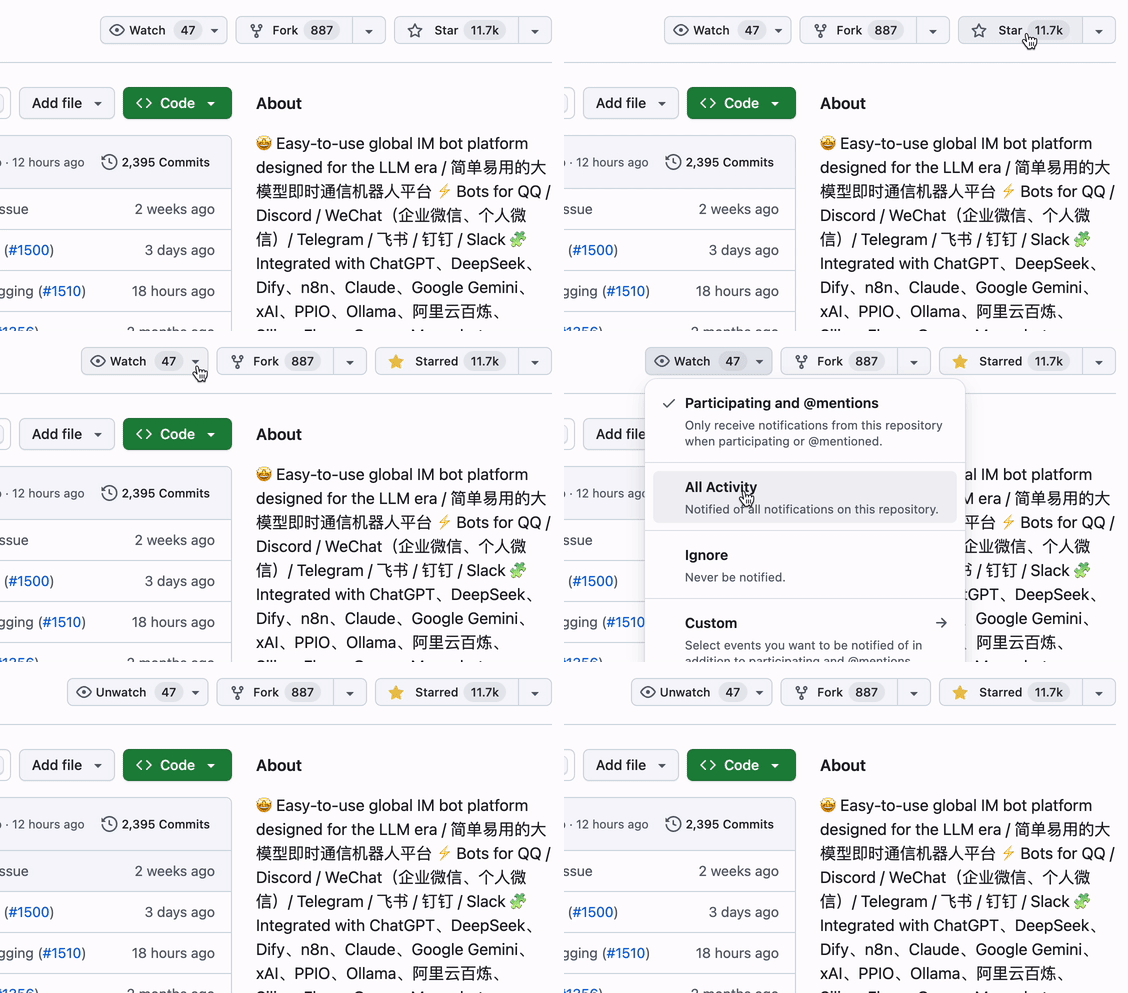
Click the Star and Watch buttons in the top-right corner of the repository to get the latest updates.
Quick Start
☁️ LangBot Cloud (Recommended)
LangBot Cloud — Zero deployment, ready to use.
One-Line Launch
uvx langbot
Requires uv. Visit http://localhost:5300 — done.
Docker Compose
git clone https://github.com/langbot-app/LangBot
cd LangBot/docker
docker compose --profile all up -d
One-Click Cloud Deploy


More options: Docker · Manual · BTPanel · Kubernetes
Supported Platforms
| Platform | Status | Notes |
|---|---|---|
| Discord | ✅ | Official |
| Telegram | ✅ | Official |
| Slack | ✅ | Official |
| LINE | ✅ | Official |
| ✅ | Personal & Official API (Channel, DM, Group) | |
| WeCom | ✅ | Enterprise WeChat, External CS, AI Bot |
| ✅ | Personal & Official Account | |
| Lark | ✅ | Official |
| DingTalk | ✅ | Official |
| KOOK | ✅ | Official |
| Satori | ✅ | |
| ✅ | Matrix, Satori | |
| Matrix | ✅ | Supports multiple bridged platforms such as Signal, WhatsApp, Messenger, iMessage, Mattermost, Google Chat, IRC, XMPP, Zulip, and more |
Supported LLMs & Integrations
| Provider | Type | Status |
|---|---|---|
| OpenAI | LLM | ✅ |
| Anthropic | LLM | ✅ |
| DeepSeek | LLM | ✅ |
| Google Gemini | LLM | ✅ |
| xAI | LLM | ✅ |
| Moonshot | LLM | ✅ |
| Zhipu AI | LLM | ✅ |
| Ollama | Local LLM | ✅ |
| LM Studio | Local LLM | ✅ |
| Dify | LLMOps | ✅ |
| MCP | Protocol | ✅ |
| SiliconFlow | Gateway | ✅ |
| Aliyun Bailian | Gateway | ✅ |
| Volc Engine Ark | Gateway | ✅ |
| ModelScope | Gateway | ✅ |
| GiteeAI | Gateway | ✅ |
| CompShare | GPU Platform | ✅ |
| PPIO | GPU Platform | ✅ |
| ShengSuanYun | GPU Platform | ✅ |
| 接口 AI | Gateway | ✅ |
| 302.AI | Gateway | ✅ |
| Qiniu | Gateway | ✅ |
Why LangBot?
| Use Case | How LangBot Helps |
|---|---|
| Customer Support | Deploy AI agents to Slack/Discord/Telegram that answer questions using your knowledge base |
| Internal Tools | Connect n8n/Dify workflows to WeCom/DingTalk for automated business processes |
| Community Management | Moderate QQ/Discord groups with AI-powered content filtering and interaction |
| Multi-Platform Presence | One bot, all platforms. Manage from a single dashboard |
Built for AI Agents 🤖
LangBot is agent-friendly by design — your coding agents (Claude Code, Codex, Copilot, Cursor, …) can operate, extend, and deploy LangBot with first-class support:
- MCP Server — LangBot exposes a built-in Model Context Protocol endpoint at
/mcp, mirroring the HTTP API so an agent can manage bots, pipelines, plugins, and models programmatically. Authenticate with the same API key (set a global key inconfig.yamlor use a per-user key) — no login flow required. Configure it in the Web panel's API & MCP tab. - In-repo Skills — The
skills/directory is the single source of truth for working with LangBot: plugin development, core development, end-to-end testing, deployment, and operating the LangBot / LangBot Space MCP servers. Point your agent at this directory and it knows how to build. - AGENTS.md — Every repo ships an
AGENTS.md(symlinked toCLAUDE.md) describing architecture, conventions, and the rule that API changes must keep the MCP server and skills in sync. llms.txt— Machine-readable project context for LLMs is published on the website.
Cloud / Marketplace: LangBot Space also exposes an MCP server so agents can search and inspect the plugin / MCP / skill marketplace, authenticated with a Personal Access Token.
Live Demo
Try it now: https://demo.langbot.dev/
- Email:
[email protected] - Password:
langbot123456
Note: Public demo environment. Do not enter sensitive information.
Community

Star History
Contributors
Thanks to all contributors who have helped make LangBot better: