 TyperBody
4535a21cb5
TyperBody
4535a21cb5
Marketplace cards now reflect whether an extension is already installed in
the current workspace, and the installed-extension list gains a search box.

Backend (stream install progress):
- _read_httpx_response_limited gains an optional task_context: it publishes
  download_total from Content-Length before the first chunk and updates
  download_current / download_speed per chunk. The marketplace download path
  previously had no progress reporting; it now matches the GitHub path.
- _marketplace_get forwards task_context to that helper.
- install_plugin resets the per-install counters so re-installing the same
  plugin cannot inherit stale metadata, and reports human-readable stages:
  preparing -> downloading -> inspecting -> storing -> installing
  dependencies -> launching -> waiting for plugin to become ready.

Frontend (installed state):
- New marketplace-installed helper normalises the sidebar identities
  (plugin: author/name, mcp: author__name, skill: bare name) into one
  type:author/name index and resolves a card's installed state from it.
  useMarketplaceInstalledIndex memoises on the sidebar lists, so a finished
  install (which refreshes the sidebar) re-evaluates the cards automatically.
- PluginMarketCardVO carries installed / hasUpdate. An installed extension
  turns its download affordance into a hollow green ring with a green check
  in place, instead of adding a separate badge; the count slot switches to
  the installed label. Cards with an available update use amber.
- PluginMarketComponent derives the annotated list and shares the index with
  RecommendationLists.

Frontend (install task UI):
- mapActionToStage matches the new connector stage strings. The pre-download
  stages are checked before the generic "install" match, because
  "preparing plugin install" also contains "install".
- Stage progress ranges are non-overlapping; overall progress interpolates on
  real byte counts while downloading and drifts monotonically elsewhere,
  capped at 99%.
- The progress dialog and task queue expose the launching stage.

Frontend (installed list search):
- The installed list had no search at all. A query box in the page header
  filters by label / name / author / description, case-insensitively, applied
  before grouping so grouped and flat views both honour it.
- Search misses and an empty list now show distinct empty states, with a
  clear action on a search miss.
- AsyncTask entity gains the optional created_at field.

i18n: new marketplace / install / search strings across all 8 locales.

Verified: ruff format + check, tsc --noEmit, prettier --check, eslint
(0 errors), and 89/89 frontend unit tests.


Production-grade platform for building agentic IM bots.
Quickly build, debug, and ship AI bots to Slack, Discord, Telegram, WeChat, and more.
English / 简体中文 / 繁體中文 / 日本語 / Español / Français / 한국어 / Русский / Tiếng Việt




Website | Features | Docs | API | Cloud | Plugin Market | Roadmap
What is LangBot?
LangBot is an open-source, production-grade platform for building AI-powered instant messaging bots. It connects Large Language Models (LLMs) to any chat platform, enabling you to create intelligent agents that can converse, execute tasks, and integrate with your existing workflows.

Key Capabilities
- AI Conversations & Agents — Multi-turn dialogues, tool calling, multi-modal support, streaming output. Built-in RAG (knowledge base) with deep integration to Dify, Coze, n8n, Langflow, Deerflow, Weknora.
- Universal IM Platform Support — One codebase for Discord, Telegram, Slack, LINE, QQ, WeChat, WeCom, Lark, DingTalk, KOOK.
- Production-Ready — Access control, rate limiting, sensitive word filtering, comprehensive monitoring, and exception handling. Trusted by enterprises.
- Plugin Ecosystem — Hundreds of plugins, event-driven architecture, component extensions, and MCP protocol support.
- Web Management Panel — Configure, manage, and monitor your bots through an intuitive browser interface. No YAML editing required.
- Multi-Pipeline Architecture — Different bots for different scenarios, with comprehensive monitoring and exception handling.
→ Learn more about all features
📍 Practical guides: deploy a multi-platform AI bot in 5 minutes, connect DeepSeek to WeChat, Discord, and Telegram, run a Dify Agent in Discord, Telegram, and Slack, and build an n8n-powered chatbot.
😎 Stay Updated
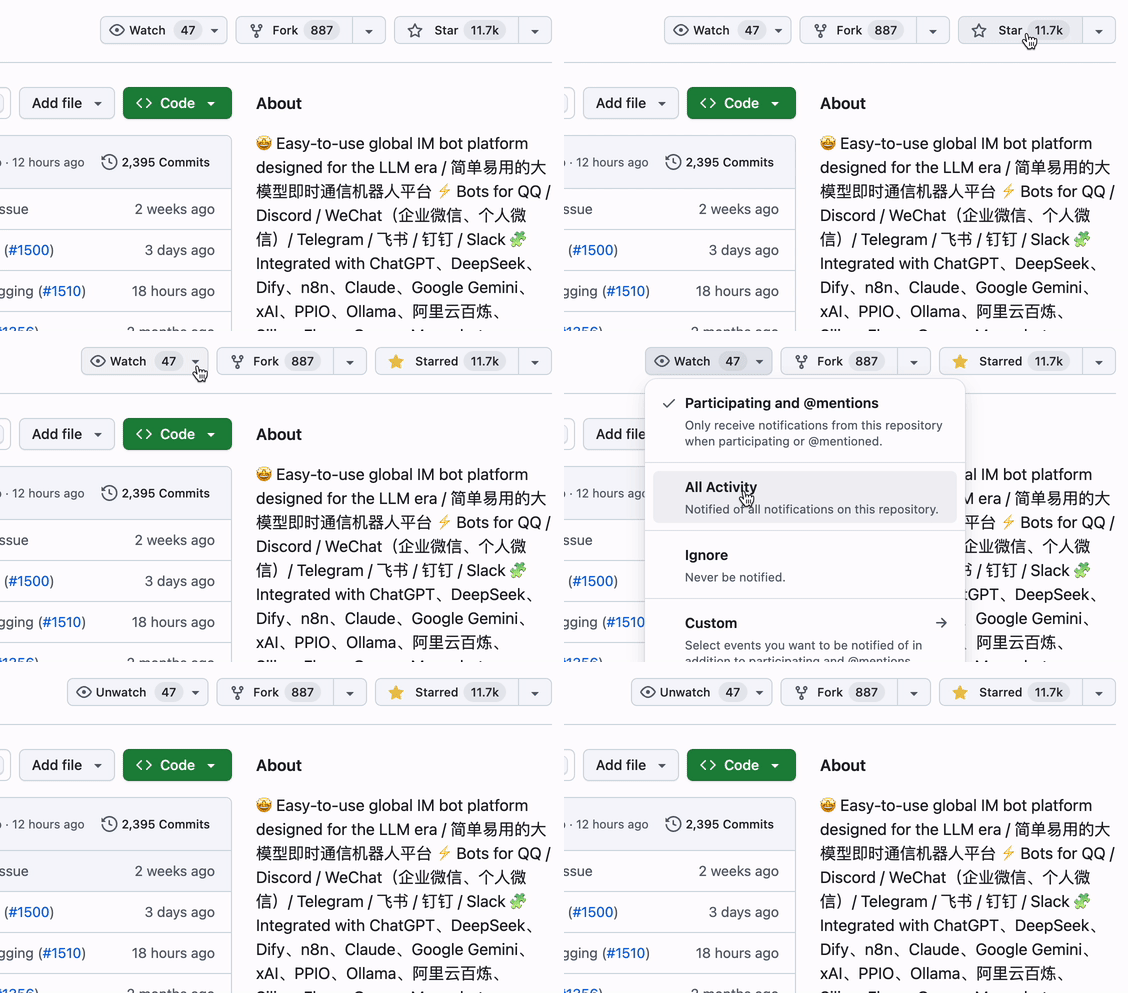
Click the Star and Watch buttons in the top-right corner of the repository to get the latest updates.
Quick Start
☁️ LangBot Cloud (Recommended)
LangBot Cloud — Zero deployment, ready to use.
One-Line Launch
uvx langbot
Requires uv. Visit http://localhost:5300 — done.
Docker Compose
git clone https://github.com/langbot-app/LangBot
cd LangBot/docker
docker compose --profile all up -d
One-Click Cloud Deploy


More options: Docker · Manual · BTPanel · Kubernetes
Supported Platforms
| Platform | Status | Notes |
|---|---|---|
| Discord | ✅ | Official |
| Telegram | ✅ | Official |
| Slack | ✅ | Official |
| LINE | ✅ | Official |
| ✅ | Personal & Official API (Channel, DM, Group) | |
| WeCom | ✅ | Enterprise WeChat, External CS, AI Bot |
| ✅ | Personal & Official Account | |
| Lark | ✅ | Official |
| DingTalk | ✅ | Official |
| KOOK | ✅ | Official |
| Satori | ✅ | |
| ✅ | Matrix, Satori | |
| Matrix | ✅ | Supports multiple bridged platforms such as Signal, WhatsApp, Messenger, iMessage, Mattermost, Google Chat, IRC, XMPP, Zulip, and more |
Supported LLMs & Integrations
| Provider | Type | Status |
|---|---|---|
| OpenAI | LLM | ✅ |
| Anthropic | LLM | ✅ |
| DeepSeek | LLM | ✅ |
| Google Gemini | LLM | ✅ |
| xAI | LLM | ✅ |
| Moonshot | LLM | ✅ |
| Zhipu AI | LLM | ✅ |
| Ollama | Local LLM | ✅ |
| LM Studio | Local LLM | ✅ |
| Dify | LLMOps | ✅ |
| MCP | Protocol | ✅ |
| SiliconFlow | Gateway | ✅ |
| Aliyun Bailian | Gateway | ✅ |
| Volc Engine Ark | Gateway | ✅ |
| ModelScope | Gateway | ✅ |
| GiteeAI | Gateway | ✅ |
| CompShare | GPU Platform | ✅ |
| PPIO | GPU Platform | ✅ |
| ShengSuanYun | GPU Platform | ✅ |
| 接口 AI | Gateway | ✅ |
| 302.AI | Gateway | ✅ |
| Qiniu | Gateway | ✅ |
Why LangBot?
| Use Case | How LangBot Helps |
|---|---|
| Customer Support | Deploy AI agents to Slack/Discord/Telegram that answer questions using your knowledge base |
| Internal Tools | Connect n8n/Dify workflows to WeCom/DingTalk for automated business processes |
| Community Management | Moderate QQ/Discord groups with AI-powered content filtering and interaction |
| Multi-Platform Presence | One bot, all platforms. Manage from a single dashboard |
Built for AI Agents 🤖
LangBot is agent-friendly by design — your coding agents (Claude Code, Codex, Copilot, Cursor, …) can operate, extend, and deploy LangBot with first-class support:
- MCP Server — LangBot exposes a built-in Model Context Protocol endpoint at
/mcp, mirroring the HTTP API so an agent can manage bots, pipelines, plugins, and models programmatically. Authenticate with the same API key (set a global key inconfig.yamlor use a per-user key) — no login flow required. Configure it in the Web panel's API & MCP tab. - In-repo Skills — The
skills/directory is the single source of truth for working with LangBot: plugin development, core development, end-to-end testing, deployment, and operating the LangBot / LangBot Space MCP servers. Point your agent at this directory and it knows how to build. - AGENTS.md — Every repo ships an
AGENTS.md(symlinked toCLAUDE.md) describing architecture, conventions, and the rule that API changes must keep the MCP server and skills in sync. llms.txt— Machine-readable project context for LLMs is published on the website.
Cloud / Marketplace: LangBot Space also exposes an MCP server so agents can search and inspect the plugin / MCP / skill marketplace, authenticated with a Personal Access Token.
Community

Contributors
Thanks to all contributors who have helped make LangBot better: