Rouzbeh†
0daedd3db9
Rouzbeh†
0daedd3db9
* feat: add support for subscription-based outbounds with auto-update

- New OutboundSubscription model (full support on both SQLite and PostgreSQL)
- Go subscription link parser (vmess/vless/trojan/ss/hysteria2/wireguard) matching frontend behavior
- Stable tag assignment across refreshes (designed for balancer + routing use)
- Runtime merge of subscription outbounds into Xray config (additive only)
- Full CRUD + manual refresh + preview API
- Background auto-update job (per-subscription interval)
- Frontend management UI in Outbounds tab (Subscriptions drawer) + tag integration in balancers/routing rules
- Proper dual-database support including CLI migration path

Review & hardening notes:
- Fixed merge logic bug that could drop manual outbounds
- Added SSRF/private-IP protection on subscription URLs using SanitizePublicHTTPURL
- Improved update interval UX (hours + minutes)
- Auto-fetch on first subscription creation
- Added detailed comments on tag stability strategy and balancer implications when servers are added/removed/rotated
- Updated migrationModels() for CLI migrate-db support

* fix: resolve frontend lint/type errors and Go build break

Frontend (eslint + tsc clean):
- Destructure subscriptionOutboundTags prop in RoutingTab and
  BalancersTab. It was declared in the interface and used in useMemo
  but never destructured, so it resolved as an unresolved global
  (react-hooks warning + tsc "Cannot find name"). The prop is passed
  by XrayPage, so the feature was silently inert.
- OutboundsTab: remove unused useEffect import, add an OutboundSub
  type to replace any[] state and the any/any table render signature,
  type the subscriptionOutbounds cast, and replace unused catch (e)
  bindings with parameter-less catch. Also type HttpUtil.post as
  OutboundSub so r.obj?.id type-checks.

Backend (go build clean):
- outbound_subscription_job: websocket.MessageTypeXray is undefined;
  use the existing MessageTypeOutbounds since the job refreshes
  outbound subscriptions.

* fix(xray): make outbound subscription creation work end-to-end

- Correct API paths from /panel/xray/outbound-subs to
  /panel/api/xray/outbound-subs. The controller is mounted under
  /panel/api, so the old paths hit the SPA page route (GET-only)
  and 404'd on POST.
- Send the create-subscription body as a plain object instead of
  URLSearchParams. The axios request interceptor serializes bodies
  with qs.stringify, which can't read URLSearchParams' internal
  storage and produced an empty body, so the backend rejected it
  with "subscription URL is required".
- Use message.useMessage() + context holder instead of the static
  antd message API (resolves the "Static function can not consume
  context" warning), matching XrayPage's pattern.
- Migrate the subscriptions Drawer to antd v6 props: width -> size,
  destroyOnClose -> destroyOnHidden, and Space direction -> orientation.

* feat(xray): show traffic/test for subscription outbounds; harden + test the feature

Display (the reported issue):
- Replace the flat read-only pills with a proper read-only table (desktop)
  and cards (mobile) in a new SubscriptionOutbounds component, showing
  Address, Protocol, Traffic (matched by tag — already collected by Xray),
  and a Test button with Latency. No edit/delete/move (read-only).
- Test subscription outbounds via the existing /testOutbound endpoint, with
  results keyed by tag (subscriptionTestStates + testSubscriptionOutbound in
  useXraySetting, wired through XrayPage). Generalize isTesting/testResult to
  a string|number key so the same helpers serve index- and tag-keyed states.

i18n:
- Replace all hardcoded English subscription strings with t() calls and add
  pages.xray.outboundSub.* keys to en-US.json (other locales fall back).

Backend hardening + tests:
- xray.go: drop the tautological `subSvc != nil` check.
- outbound_subscription: re-validate every redirect hop against private/
  internal addresses (CheckRedirect) and cap the redirect chain, closing an
  SSRF gap where only the initial host was checked.
- Extract assignStableTags as a pure function and add unit tests for tag
  stability and SSRF rejection (the feature previously had no tests).

Misc:
- gofmt util/link/outbound.go (it was not gofmt-clean).

* fix(xray): make outbound-subs feature pass CI (test compile, route docs, openapi)

- outbound_test.go: remove unused `inner`/`lines` variables that broke the
  `util/link` test build (declared and not used).
- Document the 7 outbound-subscription routes in endpoints.ts (list, create,
  update, delete, del alias, refresh, parse) so TestAPIRoutesDocumented passes.
- Regenerate frontend/public/openapi.json (npm run gen) to include the new
  endpoints, satisfying the codegen freshness check.

* feat(xray): per-subscription allow-private, gap-filled tags, UI tweaks, delete refresh

Backend:
- Add a per-subscription AllowPrivate flag (default off). Create/Update/refresh
  and the redirect check sanitize the URL with it, so localhost/LAN sources work
  only when explicitly opted in; the SSRF guard still blocks private targets by
  default. Controller reads the allowPrivate form field on create/update/parse.
- Default outbound tag prefix now uses the smallest free "subN-" number instead
  of the auto-increment id, so deleting a subscription frees its number for reuse
  (a fresh start gives sub1) while staying stable per subscription. Extracted a
  pure defaultPrefixNumber() with unit tests.
- deleteOutboundSub now signals SetToNeedRestart so xray drops the outbounds.

Frontend:
- "Allow private address" toggle in the add form (sends allowPrivate).
- Delete now refreshes the xray view immediately (no manual page reload).
- Subscriptions manager opens as a centered Modal instead of a right-side Drawer.
- Move Outbounds to a top-level sidebar item under Nodes (out of Xray Configs).
- Collapse WARP/NordVPN into a "more" dropdown.
- Document the allowPrivate param in endpoints.ts.

* i18n(xray): translate outbound-subscription UI into all locales

- Translate the pages.xray.outboundSub.* strings (and allowPrivate label/hint)
  into all 12 non-English locales, matching each file's existing terminology.
- Remove the unused outboundSub.add ("Add subscription") key from every locale.

* feat(xray): subscription manager — edit, reorder/priority, status, preview, refresh-all

Backend:
- Per-subscription Priority + Prepend: subscriptions are ordered by Priority and
  placed before (Prepend) or after the manual template outbounds in the merge, so
  a subscription server can become the default. New Move(up/down) endpoint
  re-normalizes priorities; merge split into prepend/template/append.
- List now returns a derived OutboundCount and orders by priority, and strips the
  heavy LastFetchedOutbounds/LinkIdentities blobs from the list payload.
- Create/Update accept the prepend flag; new subs append at the end of priority.

Frontend (Outbound Subscriptions modal):
- Edit existing subscriptions (reuses the form + Update endpoint).
- Inline enable/disable Switch, Status column (OK / error tooltip), Outbounds
  count column, per-row refresh spinner, "Refresh all" button.
- Reorder (move up/down) controls + a "Before manual outbounds" toggle.
- Preview button: fetch+parse a URL via /parse without saving.
- Document the move route + prepend param in endpoints.ts; regenerate openapi.json.

* i18n(xray): translate new subscription-manager strings into all locales

Add the prepend/prependHint, preview/previewEmpty, refreshAll, statusOk and
toastUpdated keys to all 12 non-English locales, matching each file's terminology.

---------

Co-authored-by: MHSanaei <ho3ein.sanaei@gmail.com>
English | فارسی | العربية | 中文 | Español | Русский





3X-UI is an advanced, open-source web control panel for managing Xray-core servers. It provides a clean, multi-language interface for deploying, configuring, and monitoring a wide range of proxy and VPN protocols — from a single VPS to multi-node deployments.
Built as an enhanced fork of the original X-UI project, 3X-UI adds broader protocol support, improved stability, per-client traffic accounting, and many quality-of-life features.
Important
This project is intended for personal use only. Please do not use it for illegal purposes or in a production environment.
Features
- Multi-protocol inbounds — VLESS, VMess, Trojan, Shadowsocks, WireGuard, Hysteria2, HTTP, SOCKS (Mixed), Dokodemo-door / Tunnel, and TUN.
- Modern transports & security — TCP (Raw), mKCP, WebSocket, gRPC, HTTPUpgrade, and XHTTP, secured with TLS, XTLS, and REALITY.
- Fallbacks — serve multiple protocols on a single port (e.g. VLESS and Trojan on 443) using Xray's fallback support.
- Per-client management — traffic quotas, expiry dates, IP limits, live online status, and one-click share links, QR codes, and subscriptions.
- Traffic statistics — per inbound, per client, and per outbound, with reset controls.
- Multi-node support — manage and scale across multiple servers from a single panel.
- Outbound & routing — WARP, NordVPN, custom routing rules, load balancers, and outbound proxy chaining.
- Built-in subscription server with multiple output formats.
- Telegram bot for remote monitoring and management.
- RESTful API with in-panel Swagger documentation.
- Flexible storage — SQLite (default) or PostgreSQL.
- 13 UI languages with dark and light themes.
- Fail2ban integration for enforcing per-client IP limits.
Screenshots
Click to expand


Quick Start
bash <(curl -Ls https://raw.githubusercontent.com/mhsanaei/3x-ui/master/install.sh)
During installation a random username, password, and access path are generated. After installation, run x-ui to open the management menu, where you can start/stop the service, view or reset your login credentials, manage SSL certificates, and more.
For full documentation, please visit the project Wiki.
Supported Platforms
Operating systems: Ubuntu, Debian, Armbian, Fedora, CentOS, RHEL, AlmaLinux, Rocky Linux, Oracle Linux, Amazon Linux, Virtuozzo, Arch, Manjaro, Parch, openSUSE (Tumbleweed / Leap), Alpine, and Windows.
Architectures: amd64 · 386 · arm64 (aarch64) · armv7 · armv6 · armv5 · s390x.
Database Options
3X-UI supports two backends, chosen during the install:
- SQLite (default) — a single file at
/etc/x-ui/x-ui.db. Zero setup, ideal for small and medium deployments. - PostgreSQL — recommended for high client counts or multi-node setups. The installer can install PostgreSQL locally for you, or accept a DSN to an existing server.
At runtime the backend is selected via environment variables (the installer writes these to /etc/default/x-ui for you):
XUI_DB_TYPE=postgres
XUI_DB_DSN=postgres://xui:password@127.0.0.1:5432/xui?sslmode=disable
Migrating an existing SQLite install to PostgreSQL
x-ui migrate-db --dsn "postgres://xui:password@127.0.0.1:5432/xui?sslmode=disable"
# then set XUI_DB_TYPE and XUI_DB_DSN in /etc/default/x-ui and restart:
systemctl restart x-ui
The source SQLite file is left untouched; remove it manually once you have verified the new backend.
Docker
The default docker compose up -d keeps using SQLite. To run with the bundled PostgreSQL service, uncomment the two XUI_DB_* env lines in docker-compose.yml and start with the profile:
docker compose --profile postgres up -d
The image bundles Fail2ban (enabled by default) to enforce per-client IP limits. Fail2ban bans offenders with iptables, which requires the NET_ADMIN capability. docker-compose.yml already grants it via cap_add; if you start the container with docker run instead, add the capabilities yourself, otherwise bans are logged but never applied:
docker run -d --cap-add=NET_ADMIN --cap-add=NET_RAW ... ghcr.io/mhsanaei/3x-ui
Environment Variables
| Variable | Description | Default |
|---|---|---|
XUI_DB_TYPE |
Database backend: sqlite or postgres |
sqlite |
XUI_DB_DSN |
PostgreSQL connection string (when XUI_DB_TYPE=postgres) |
— |
XUI_DB_FOLDER |
Directory for the SQLite database file | /etc/x-ui |
XUI_DB_MAX_OPEN_CONNS |
Maximum open connections (PostgreSQL pool) | — |
XUI_DB_MAX_IDLE_CONNS |
Maximum idle connections (PostgreSQL pool) | — |
XUI_ENABLE_FAIL2BAN |
Enable Fail2ban-based IP-limit enforcement | true |
XUI_LOG_LEVEL |
Log verbosity (debug, info, warning, error) |
info |
XUI_DEBUG |
Enable debug mode | false |
Supported Languages
The panel UI is available in 13 languages:
English · فارسی · العربية · 中文(简体) · 中文(繁體) · Español · Русский · Українська · Türkçe · Tiếng Việt · 日本語 · Bahasa Indonesia · Português (Brasil)
Contributing
Contributions are welcome. Please read the Contributing Guide before opening an issue or pull request.
A Special Thanks to
Acknowledgment
- Iran v2ray rules (License: GPL-3.0): Enhanced v2ray/xray and v2ray/xray-clients routing rules with built-in Iranian domains and a focus on security and adblocking.
- Russia v2ray rules (License: GPL-3.0): This repository contains automatically updated V2Ray routing rules based on data on blocked domains and addresses in Russia.
Community Tools
Tools and integrations built by the community around 3x-ui.
- terraform-provider-3x-ui (License: MIT): Manage inbounds, clients, panel settings, and Xray configuration as code with Terraform / OpenTofu.
Support project
If this project is helpful to you, you may wish to give it a🌟


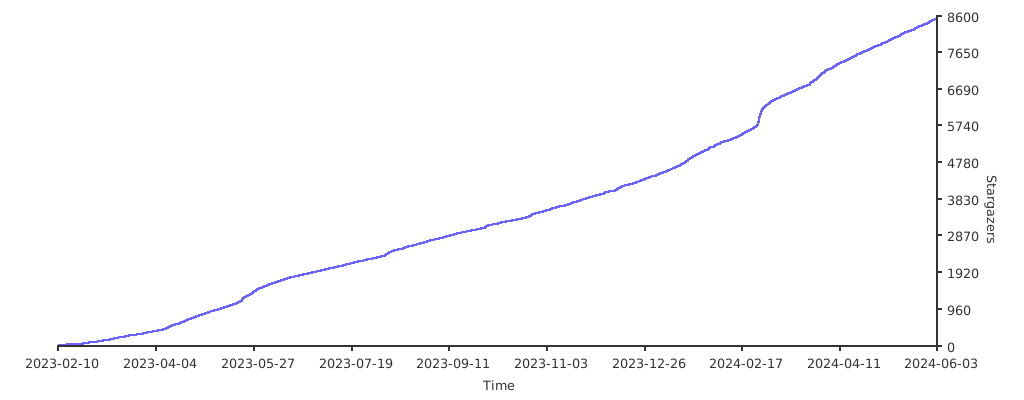
Stargazers over Time