Sanaei
37c5e0bfd2
Sanaei
37c5e0bfd2
* fix(api-docs): document clientIpsByGuid route

Restores a green `go test ./...` baseline: TestAPIRoutesDocumented
flagged POST /panel/api/clients/clientIpsByGuid (added in 9385b6c6)
as undocumented in endpoints.ts.

* test(node): characterize current node TLS + API auth behavior

Phase 0 regression net for the mTLS work. These pass on unchanged
production code and lock the pre-mTLS contracts so later phases can be
proven additive:

- tlsConfigForNode: skip -> InsecureSkipVerify (no VerifyConnection);
  pin -> VerifyConnection installed.
- checkAPIAuth: bearer match -> Next + api_authed; unauthenticated ->
  401 (XHR) / 404; valid session -> Next.
- panel HTTPS listener with no ClientAuth accepts a client that presents
  no client certificate (the browsers-keep-working invariant).

* feat(crypto): node-auth CA + client-cert minting (TDD)

Stdlib-only ECDSA P-256 helpers for the node mTLS work:
- GenerateNodeCA: self-signed CA (IsCA, CertSign, path len 0)
- IssueClientCert: client-auth leaf (ExtKeyUsageClientAuth) signed by CA
- LoadCAFromPEM: parse a CA cert+key for issuing / trust-pool building

Tests assert the contract (leaf verifies against the issuing CA with
ExtKeyUsageClientAuth), seen failing on the assertion before impl.

* feat(node): lazy node mTLS CA + client cert in settings (TDD)

SettingService gains opt-in mTLS material, all stored as Setting rows
with empty defaults and kept out of entity.AllSetting (so private keys
never reach the settings UI/export):
- EnsureNodeMtlsCA: mint+persist the node-auth CA once, reuse thereafter
- EnsureMasterClientCert: issue the master client cert from the CA, idempotent
- NodeMtlsClientCAPool: ClientCAs trust pool for the listener; nil when
  unconfigured so the no-mTLS path is unchanged

Tests assert idempotency and that the client cert verifies against the CA
for client auth; seen failing on the assertion before impl.

* feat(node): mtls client TLS config + master-cert provider (TDD)

tlsConfigForNode gains an 'mtls' branch that presents the master client
certificate and verifies the node server against system roots (no
InsecureSkipVerify, no custom RootCAs). The cert is supplied via an
injected MasterClientCertProvider so runtime need not import service;
it fails closed when unconfigured. skip/pin contracts unchanged.

* feat(node): allow tokenless mtls nodes in remote do() (TDD)

mtls nodes authenticate with a client certificate, so the bearer token
becomes optional for them: do() no longer rejects an empty ApiToken when
TlsVerifyMode is mtls, and the Authorization header is omitted when no
token is set. Every other mode still requires a token (regression kept).

* feat(node): authenticate verified client certs in checkAPIAuth (TDD)

A completed mTLS handshake (non-empty r.TLS.VerifiedChains) now
authenticates an API request, equivalent to a valid bearer token, and
sets api_authed so the CSRF middleware lets cert-authed mutations
through. Bearer/session/reject paths unchanged. The accept-path assert
was mutation-checked (guard flipped -> test red -> reverted).

* feat(node): opt-in mTLS on the panel listener (TDD; mutation-checked)

web.go now applies VerifyClientCertIfGiven + ClientCAs to the HTTPS
listener when a node trust CA is configured, and wires the master client
cert provider for outbound mtls calls. With no CA the listener is
byte-identical to before (browsers unaffected).

applyNodeMtls is covered end-to-end: no-cert client handshakes (browsers
keep working), a CA-signed client cert verifies, a foreign-CA cert is
rejected at the handshake. Mutation-checked:
- RequireAndVerifyClientCert -> no-cert client rejected (red) -> reverted
- drop ClientCAs -> master cert no longer trusted (red) -> reverted

* feat(node): accept mtls verify-mode + CA reveal endpoint (TDD)

- model.Node.TlsVerifyMode validator now accepts 'mtls'
- normalize() preserves mtls and requires the node scheme to be https
  (fail closed), instead of clamping mtls back to verify
- NodeService.NodeMtlsCaCert + POST /panel/api/nodes/mtls/ca return this
  panel's node-auth CA cert (public) to paste into a node, minting the CA
  + master client cert on first call
- endpoints.ts documents the new route (doc-sync test)

No model column added (enum is a string), so no migration/codegen.

* feat(node): node mTLS UI + trust-CA setter (TDD)

Backend:
- NodeService.SetNodeMtlsTrustCA + POST /panel/api/nodes/mtls/trustCA
  store the CA this panel trusts for incoming node-API client certs
  (validates PEM, empty clears); applied on next restart
- endpoints.ts + regenerated openapi.json document both mtls routes

Frontend:
- node form: 'mtls' TLS-verify option + setup hint (zod enum updated)
- Nodes page 'Node mTLS' card: copy this panel's CA, and paste/save the
  trusted parent CA
- en-US i18n keys (other locales fall back to en-US)

Gates green: go build (native+windows), vet, go test ./...; frontend
typecheck, lint, vitest (541).

* style(node): gofmt web_mtls_test doc comment

* feat(node): hashed+zstd reconcile transport (TDD, negotiated, mixed-version safe)

Adds an integrity + compression envelope to node config pushes:
- internal/util/wirecodec: shared zstd codec (bomb-capped decode) +
  SHA-256 hashing + the header/capability constants
- Remote.do(): always attaches X-Config-Sha256 of the uncompressed body;
  zstd-compresses only when the node advertised support (learned from its
  X-3x-Node-Caps response header) and the body is >=1KiB
- ConfigEnvelopeMiddleware on /panel/api: advertises the cap, decompresses
  and verifies the hash (handler not invoked on mismatch) before binding

Mixed-version safe: old nodes never advertise the cap -> plain bodies;
the hash header is verify-if-present so any panel/node mix interoperates
(existing reconcile tests stay green). klauspost/compress promoted to a
direct dep. Hash-mismatch reject was mutation-checked (compare defeated
-> test red -> reverted).

* feat(node): per-node network throughput metrics (TDD)

The node status response already carries gopsutil netIO.up/down (summed
non-virtual interfaces), so no node-side change is needed:
- probe() parses netIO.up/down into HeartbeatPatch.NetUp/NetDown
- Node gains net_up/net_down columns (AutoMigrate); UpdateHeartbeat
  persists them and appends netUp/netDown to the per-node metric history
- NodeMetricKeys whitelists netUp/netDown so the history endpoint serves them
- NodeHistoryPanel renders Net Up/Down sparklines (KB/s, no 0-100 clamp)
- regenerated frontend types + openapi.json for the new Node fields

* feat(node): move node mTLS controls into a toolbar button + modal

The Node mTLS panel was an always-visible card cluttering the nodes
page. Replace it with a 'Node mTLS' button beside 'Add node' that opens
a modal with the same copy-CA + trusted-parent-CA controls; the modal
closes on a successful save. No backend/i18n changes.

* i18n(node): translate mTLS + net-metrics keys for all locales

Adds the node mTLS strings (tlsMtls, mtlsFormHint, mtls.* dialog + the
saveMtls toast) and the netUp/netDown chart labels to all 12 non-English
catalogs (ar, es, fa, id, ja, pt, ru, tr, uk, vi, zh-CN, zh-TW), matching
each catalog's existing terminology. Technical tokens (mTLS/TLS/CA/API/
KB/s) kept verbatim.

* fix(node): address Copilot review on node-hardening PR

- setting_mtls: fail closed on a half-present CA/master-cert pair instead of
  silently regenerating (which would rotate the CA and break fleet trust).
- config_envelope: reject non-zstd Content-Encoding on the envelope path
  rather than hashing/forwarding a still-encoded body to the handler.
- node mTLS: support tokenless mTLS end-to-end — apiToken is now
  required_unless tlsVerifyMode=mtls (model) with matching conditional
  validation in NodeFormSchema, so the runtime allowance is actually reachable.
- NodesPage: add a catch block to onSaveTrustCa so save failures surface.
English | فارسی | العربية | 中文 | Español | Русский | Türkçe





3X-UI is an advanced, open-source web control panel for managing Xray-core servers. It provides a clean, multi-language interface for deploying, configuring, and monitoring a wide range of proxy and VPN protocols — from a single VPS to multi-node deployments.
Built as an enhanced fork of the original X-UI project, 3X-UI adds broader protocol support, improved stability, per-client traffic accounting, and many quality-of-life features.
Important
This project is intended for personal use only. Please do not use it for illegal purposes or in a production environment.
Features
- Multi-protocol inbounds — VLESS, VMess, Trojan, Shadowsocks, WireGuard, Hysteria2, HTTP, SOCKS (Mixed), Dokodemo-door / Tunnel, and TUN.
- Modern transports & security — TCP (Raw), mKCP, WebSocket, gRPC, HTTPUpgrade, and XHTTP, secured with TLS, XTLS, and REALITY.
- Fallbacks — serve multiple protocols on a single port (e.g. VLESS and Trojan on 443) using Xray's fallback support.
- Per-client management — traffic quotas, expiry dates, IP limits, live online status, and one-click share links, QR codes, and subscriptions.
- Traffic statistics — per inbound, per client, and per outbound, with reset controls.
- Multi-node support — manage and scale across multiple servers from a single panel.
- Outbound & routing — WARP, NordVPN, custom routing rules, load balancers, and outbound proxy chaining.
- Built-in subscription server with multiple output formats and custom page templates.
- Telegram bot for remote monitoring and management.
- RESTful API with in-panel Swagger documentation.
- Flexible storage — SQLite (default) or PostgreSQL.
- 13 UI languages with dark and light themes.
- Fail2ban integration for enforcing per-client IP limits.
Screenshots
Click to expand


Quick Start
bash <(curl -Ls https://raw.githubusercontent.com/mhsanaei/3x-ui/master/install.sh)
During installation a random username, password, and access path are generated. After installation, run x-ui to open the management menu, where you can start/stop the service, view or reset your login credentials, manage SSL certificates, and more.
For full documentation, please visit the project Wiki.
Unattended install & cloud images
The installer also runs non-interactively for cloud-init and golden images.
Set XUI_NONINTERACTIVE=1 (or pipe with no TTY) and it installs end-to-end with
zero prompts, generating random credentials and writing them to
/etc/x-ui/install-result.env. See deploy/ for:
- Cloud-init user-data — unattended install on any cloud (Hetzner/AWS/DO/Vultr/GCP/Azure/Oracle)
- Packer golden image — build an AWS EC2 AMI + qcow2 (amd64/arm64) with per-instance credentials generated on first boot
- Amazon Lightsail — launch script + reusable snapshot builder
- AWS Marketplace checklist
Supported Platforms
Operating systems: Ubuntu, Debian, Armbian, Fedora, CentOS, RHEL, AlmaLinux, Rocky Linux, Oracle Linux, Amazon Linux, Virtuozzo, Arch, Manjaro, Parch, openSUSE (Tumbleweed / Leap), Alpine, and Windows.
Architectures: amd64 · 386 · arm64 (aarch64) · armv7 · armv6 · armv5 · s390x.
Database Options
3X-UI supports two backends, chosen during the install:
- SQLite (default) — a single file at
/etc/x-ui/x-ui.db. Zero setup, ideal for small and medium deployments. - PostgreSQL — recommended for high client counts or multi-node setups. The installer can install PostgreSQL locally for you, or accept a DSN to an existing server.
At runtime the backend is selected via environment variables (the installer writes these to /etc/default/x-ui for you):
XUI_DB_TYPE=postgres
XUI_DB_DSN=postgres://xui:password@127.0.0.1:5432/xui?sslmode=disable
Migrating an existing SQLite install to PostgreSQL
x-ui migrate-db --dsn "postgres://xui:password@127.0.0.1:5432/xui?sslmode=disable"
# then set XUI_DB_TYPE and XUI_DB_DSN in /etc/default/x-ui and restart:
systemctl restart x-ui
The source SQLite file is left untouched; remove it manually once you have verified the new backend.
Docker
The default docker compose up -d keeps using SQLite. To run with the bundled PostgreSQL service, uncomment the two XUI_DB_* env lines in docker-compose.yml and start with the profile:
docker compose --profile postgres up -d
The image bundles Fail2ban (enabled by default) to enforce per-client IP limits. Fail2ban bans offenders with iptables, which requires the NET_ADMIN capability. docker-compose.yml already grants it via cap_add; if you start the container with docker run instead, add the capabilities yourself, otherwise bans are logged but never applied:
docker run -d --cap-add=NET_ADMIN --cap-add=NET_RAW ... ghcr.io/mhsanaei/3x-ui
Environment Variables
| Variable | Description | Default |
|---|---|---|
XUI_DB_TYPE |
Database backend: sqlite or postgres |
sqlite |
XUI_DB_DSN |
PostgreSQL connection string (when XUI_DB_TYPE=postgres) |
— |
XUI_DB_FOLDER |
Directory for the SQLite database file | /etc/x-ui |
XUI_DB_MAX_OPEN_CONNS |
Maximum open connections (PostgreSQL pool) | — |
XUI_DB_MAX_IDLE_CONNS |
Maximum idle connections (PostgreSQL pool) | — |
XUI_INIT_WEB_BASE_PATH |
The initial URI path for the web panel | / |
XUI_ENABLE_FAIL2BAN |
Enable Fail2ban-based IP-limit enforcement | true |
XUI_LOG_LEVEL |
Log verbosity (debug, info, warning, error) |
info |
XUI_DEBUG |
Enable debug mode | false |
Supported Languages
The panel UI is available in 13 languages:
English · فارسی · العربية · 中文(简体) · 中文(繁體) · Español · Русский · Українська · Türkçe · Tiếng Việt · 日本語 · Bahasa Indonesia · Português (Brasil)
Contributing
Contributions are welcome. Please read the Contributing Guide before opening an issue or pull request.
A Special Thanks to
Acknowledgment
- Iran v2ray rules (License: GPL-3.0): Enhanced v2ray/xray and v2ray/xray-clients routing rules with built-in Iranian domains and a focus on security and adblocking.
- Russia v2ray rules (License: GPL-3.0): This repository contains automatically updated V2Ray routing rules based on data on blocked domains and addresses in Russia.
Community Tools
Tools and integrations built by the community around 3x-ui.
- terraform-provider-3x-ui (License: MIT): Manage inbounds, clients, panel settings, and Xray configuration as code with Terraform / OpenTofu.
Support project
If this project is helpful to you, you may wish to give it a🌟


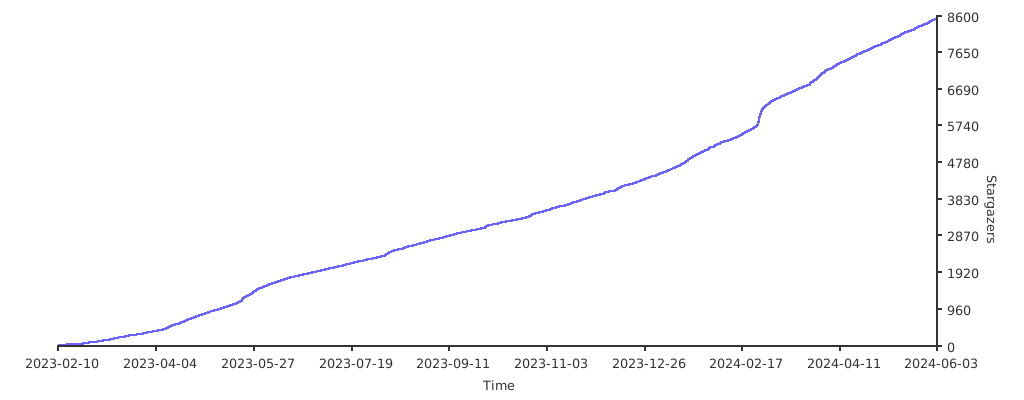
Stargazers over Time