Sanaei
61e12e4c29
Sanaei
61e12e4c29
* chore(frontend): add husky + lint-staged pre-commit gate

Wire a local pre-commit gate that runs eslint --fix on staged
frontend TypeScript via lint-staged. Because the only package.json
lives in frontend/ while the git root is one level up, the prepare
script installs husky hooks at frontend/.husky from the repo root
(cd .. && husky frontend/.husky), and the pre-commit hook cd's into
frontend/ before invoking lint-staged so node_modules resolves.

* test(frontend): add MSW request mocking

Add Mock Service Worker so tests can exercise the real http-init.ts
request pipeline (CSRF acquisition, 403 refetch-and-retry, body
parsing) instead of only stubbing HttpUtil. A node setupServer is
started for the vitest unit project with onUnhandledRequest bypass so
the existing HttpUtil spies and 55 component tests are untouched; the
browser worker is copied to public/ for Storybook and dev use.

* chore(frontend): add Storybook + component stories

Set up Storybook 10 on the React-Vite builder (compatible with the
pinned Vite 8.1.3 and React 19). The preview decorator mirrors the
vitest component harness: an Ant Design ConfigProvider with a
light/dark toolbar toggle and an en-US i18next instance. main.ts
neutralizes the app vite config bits that do not belong in a component
workshop (the three-entry rollup input, renderBuiltUrl, and the shared
dist outDir) so build-storybook can never clobber internal/web/dist.
Seeds stories across the presentational library (viz, ui, clients,
feedback). build-storybook is a local tool and is not wired into the
CI gate.

* feat(frontend): add React Hook Form primitives

Introduce the shared RHF layer that AntD inputs bind through, ahead of
migrating the forms off Ant Design's Form store:
- FormField wraps a Controller in an Ant Design Form.Item shell,
  reconciling the value/onChange shapes of Input, Switch, InputNumber,
  Select and friends via normalizeAntdOnChange, with input/output
  transforms and Zod-issue-key error messages resolved through t().
- useZodForm wires zodResolver (Zod 4) with the AntD-matching modes
  (validate on submit, then live) and shouldUnregister false so hidden
  and unmounted-tab fields keep their values.
- rhfZodValidate covers the rare per-field rule sites.
Covered by a FormField test exercising normalization, transforms, and
resolver error surfacing.

* refactor(frontend): migrate Pattern-B leaf forms to React Hook Form

Move the controlled-useState leaf forms onto RHF via the FormField
primitive, keeping Ant Design components and each form's exact submit
behaviour (same safeParse, same toast on the first Zod issue, same
payload building):
- clients: ClientBulkAdjustModal, BulkAddToGroupModal, ClientBulkAddModal
- xray: RuleFormModal, BalancerFormModal, WarpModal, NordModal

Multi-control widgets that don't fit a single input (inbound dual
select, subId regen, expiry branches, the balancer tag warning) stay as
explicit Controller/setValue. Derived visibility now reads live values
through useWatch. FormField gains a required prop so migrated fields keep
their required-asterisk affordance.

Settings tabs are intentionally excluded: they are control-panel
components that live-patch a parent AllSetting via SettingListItem, not
Ant Design Form submit-forms.

* refactor(frontend): migrate LoginPage to React Hook Form

Replace the Ant Design Form store + antdRule per-field validation with
useForm + FormField. The AntD Form stays as the layout/submit wrapper,
now driving methods.handleSubmit(onSubmit) via onFinish. Username and
password validate through rhfZodValidate(LoginFormSchema.shape.*); the
two-factor field keeps its conditional required rule (only registered
when 2FA is enabled). Submit posts the same values to /login.

* refactor(frontend): migrate ClientFormModal to React Hook Form

Move the client add/edit form off controlled useState onto RHF while
preserving exact submit behaviour (same ClientFormSchema /
ClientCreateFormSchema safeParse, same toast, same payload + attach/
detach diff + external-links build). expiryDate is stored as an epoch
number (never a Dayjs) to survive RHF's value cloning, converted at the
DateTimePicker boundary. externalLinks uses useFieldArray with stable
ids. inboundIds and the derived show*/ss2022 visibility read live via
useWatch. Space.Compact button-group widgets stay manual Controllers so
the joined borders keep working.

* refactor(frontend): migrate Node and DNS modals to React Hook Form

Both are self-contained Pattern-A forms (no shared fragments). Replace
Form.useForm with useForm + FormProvider, Form.useWatch with useWatch,
setFieldValue with setValue, and partial validateFields([...]) with
methods.trigger([...]). Per-field antdRule becomes rhfZodValidate rules;
the Node scheme->tlsVerify cascade moves to FormField onAfterChange; the
DNS domains/expectIPs/unexpectIPs string arrays are driven by
useWatch + setValue. Submit runs through handleSubmit on the modal OK
button, preserving each form's exact validation, payload build, and
save/onConfirm behaviour.

* refactor(frontend): migrate HostFormModal to React Hook Form

The host external-proxy editor's outer form moves to useForm +
FormProvider. Security/tab visibility reads via useWatch; the three
json-form editors (HostMuxForm/HostSockoptForm/HostFinalMaskForm) are
bound as value/onChange black boxes through a Controller (their own
internal forms are unchanged). remark/inboundId keep their validation
via rhfZodValidate; submit runs through handleSubmit and builds the
same payload (isDisabled = !enable) and save call.

* refactor(frontend): migrate OutboundFormModal + fragments to React Hook Form

Move the outbound form cluster off Ant Design's Form store onto RHF.
The parent uses useForm + FormProvider with a watch() subscription for
the protocol reseed cascade and setValue-based network/security/xmux
cascades; the JSON<->Basic bridge and the formValuesToWirePayload
submit are preserved exactly. Every outbound transport/protocol/security
fragment now binds through FormField/useWatch via context.

The shared config editors stay untouched and are bound through small
value/onChange adapters (src/lib/xray/forms/fields: FinalMaskField,
SniffingField, SockoptCustomField) via Controller; HeaderMapEditor binds
directly. The host json-form wrappers that reuse the outbound MuxForm/
SockoptForm (HostMuxForm, HostSockoptForm, OutboundSubtreeJsonForm) move
to a local RHF provider to match. Outbound render/link tests pass
unchanged.

* refactor(frontend): migrate InboundFormModal + fragments to React Hook Form

Move the inbound add/edit form (the largest form in the panel) and its
transport/protocol/security fragments off Ant Design's Form store onto
RHF, mirroring the outbound migration. The parent uses useForm +
FormProvider with a watch() subscription for the protocol reseed
cascade (type==='change' guard so programmatic resets don't reseed) and
setValue-based network/security cascades; useSecurityActions drives the
TLS/Reality keypair + scan through setValue. Hidden pass-through
Form.Items are dropped (their values ride in the reset object and
survive via shouldUnregister:false), so getValues() still returns the
settings.clients subtree untouched. accounts / certificates / tun lists
use useFieldArray; the shared FinalMask/Sniffing/Sockopt editors bind
through the value/onChange adapters.

Submit keeps the manual InboundFormSchema.safeParse + formatInboundValidation
toast + formValuesToWirePayload exactly. The golden link/full fixtures
pass byte-for-byte, confirming identical wire output. inbound-form-blocks
test harness rewritten from a Form.useForm harness to an RHF provider.

* refactor(frontend): retire antdRule; document the RHF form pattern

All forms now build on React Hook Form, so the AntD-Form Zod adapter
antdRule (src/utils/zodForm.ts) has no remaining callers — remove it.
Update frontend/CLAUDE.md: forms use useZodForm + FormField from
components/form/rhf with zodResolver/rhfZodValidate validation; AntD
<Form> is layout-only; the shared FinalMask/Sniffing/Sockopt editors
stay AntD islands wrapped as value/onChange adapters bound via a
Controller.

* chore(frontend): cover esbuild in the allowScripts allowlist

esbuild (pulled in transitively by Vite/Vitest/Storybook) ships a
postinstall that npm's allow-scripts flags as uncovered on every
install. Its platform binary is delivered through the @esbuild/<platform>
optionalDependencies, so the postinstall isn't needed here; deny it like
the other entries to silence the warning.

* fix(frontend): restore label layout in Sniffing/FinalMask field adapters

The value/onChange adapters that wrap the shared SniffingFields and
FinalMaskForm editors put them in their own isolated AntD Form, but that
Form was missing the label layout the fields used to inherit from the
inbound/outbound parent form. Their labels rendered full-width instead
of the compact right-aligned column, so the Sniffing tab and the TCP
Masks / QUIC Params sections looked broken. Give both adapter forms the
same colon=false, labelCol/wrapperCol span 8/14, labelWrap layout.

* ci: add least-privilege permissions to Docs CI workflow

The docs-ci workflow had no explicit permissions block, so it inherited
the repository default for GITHUB_TOKEN. The build job only checks out
and builds the docs, so restrict it to contents: read, resolving the
CodeQL actions/missing-workflow-permissions alert.
English | فارسی | العربية | 中文 | Español | Русский | Türkçe





3X-UI is an advanced, open-source web control panel for managing Xray-core servers. It provides a clean, multi-language interface for deploying, configuring, and monitoring a wide range of proxy and VPN protocols — from a single VPS to multi-node deployments.
Built as an enhanced fork of the original X-UI project, 3X-UI adds broader protocol support, improved stability, per-client traffic accounting, and many quality-of-life features.
Important
This project is intended for personal use only. Please do not use it for illegal purposes or in a production environment.
Features
- Multi-protocol inbounds — VLESS, VMess, Trojan, Shadowsocks, WireGuard, Hysteria2, HTTP, SOCKS (Mixed), Dokodemo-door / Tunnel, and TUN.
- Modern transports & security — TCP (Raw), mKCP, WebSocket, gRPC, HTTPUpgrade, and XHTTP, secured with TLS, XTLS, and REALITY.
- Fallbacks — serve multiple protocols on a single port (e.g. VLESS and Trojan on 443) using Xray's fallback support.
- Per-client management — traffic quotas, expiry dates, IP limits, live online status, and one-click share links, QR codes, and subscriptions.
- Traffic statistics — per inbound, per client, and per outbound, with reset controls.
- Multi-node support — manage and scale across multiple servers from a single panel.
- Outbound & routing — WARP, NordVPN, custom routing rules, load balancers, and outbound proxy chaining.
- Built-in subscription server with multiple output formats and custom page templates.
- Telegram bot for remote monitoring and management.
- RESTful API with in-panel Swagger documentation.
- Flexible storage — SQLite (default) or PostgreSQL.
- 13 UI languages with dark and light themes.
- Fail2ban integration for enforcing per-client IP limits.
Screenshots
Click to expand


Quick Start
bash <(curl -Ls https://raw.githubusercontent.com/mhsanaei/3x-ui/master/install.sh)
To install a specific version, append its tag (e.g. v3.4.0):
bash <(curl -Ls https://raw.githubusercontent.com/mhsanaei/3x-ui/master/install.sh) v3.4.0
To install the rolling dev build (latest per-commit pre-release from main, not a stable release), pass dev-latest:
bash <(curl -Ls https://raw.githubusercontent.com/mhsanaei/3x-ui/master/install.sh) dev-latest
During installation a random username, password, and access path are generated. After installation, run x-ui to open the management menu, where you can start/stop the service, view or reset your login credentials, manage SSL certificates, and more.
For full documentation, please visit the project Wiki.
Unattended install
The installer also runs non-interactively for cloud-init.
Set XUI_NONINTERACTIVE=1 (or pipe with no TTY) and it installs end-to-end with
zero prompts, generating random credentials and writing them to
/etc/x-ui/install-result.env. See deploy/ for:
- Cloud-init user-data — unattended install on any cloud (Hetzner/AWS/DO/Vultr/GCP/Azure/Oracle)
- Hetzner Cloud notes — cloud-init deployment on Hetzner
Supported Platforms
Operating systems: Ubuntu, Debian, Armbian, Fedora, CentOS, RHEL, AlmaLinux, Rocky Linux, Oracle Linux, Amazon Linux, Virtuozzo, Arch, Manjaro, Parch, openSUSE (Tumbleweed / Leap), Alpine, and Windows.
Architectures: amd64 · 386 · arm64 (aarch64) · armv7 · armv6 · armv5 · s390x.
Database Options
3X-UI supports two backends, chosen during the install:
- SQLite (default) — a single file at
/etc/x-ui/x-ui.db. Zero setup, ideal for small and medium deployments. - PostgreSQL — recommended for high client counts or multi-node setups. The installer can install PostgreSQL locally for you, or accept a DSN to an existing server.
At runtime the backend is selected via environment variables (the installer writes these to /etc/default/x-ui for you):
XUI_DB_TYPE=postgres
XUI_DB_DSN=postgres://xui:[email protected]:5432/xui?sslmode=disable
Migrating an existing SQLite install to PostgreSQL
x-ui migrate-db --dsn "postgres://xui:[email protected]:5432/xui?sslmode=disable"
# then set XUI_DB_TYPE and XUI_DB_DSN in /etc/default/x-ui and restart:
systemctl restart x-ui
The source SQLite file is left untouched; remove it manually once you have verified the new backend.
Docker
The default docker compose up -d keeps using SQLite. To run with the bundled PostgreSQL service, uncomment the two XUI_DB_* env lines in docker-compose.yml and start with the profile:
docker compose --profile postgres up -d
The image bundles Fail2ban (enabled by default) to enforce per-client IP limits. Fail2ban bans offenders with iptables, which requires the NET_ADMIN capability. docker-compose.yml already grants it via cap_add; if you start the container with docker run instead, add the capabilities yourself, otherwise bans are logged but never applied:
docker run -d --cap-add=NET_ADMIN --cap-add=NET_RAW ... ghcr.io/mhsanaei/3x-ui
Environment Variables
| Variable | Description | Default |
|---|---|---|
XUI_DB_TYPE |
Database backend: sqlite or postgres |
sqlite |
XUI_DB_DSN |
PostgreSQL connection string (when XUI_DB_TYPE=postgres) |
— |
XUI_DB_FOLDER |
Directory for the SQLite database file | /etc/x-ui |
XUI_DB_MAX_OPEN_CONNS |
Maximum open connections (PostgreSQL pool) | — |
XUI_DB_MAX_IDLE_CONNS |
Maximum idle connections (PostgreSQL pool) | — |
XUI_INIT_WEB_BASE_PATH |
The initial URI path for the web panel | / |
XUI_ENABLE_FAIL2BAN |
Enable Fail2ban-based IP-limit enforcement | true |
XUI_LOG_LEVEL |
Log verbosity (debug, info, warning, error) |
info |
XUI_DEBUG |
Enable debug mode | false |
XUI_TUNNEL_HEALTH_MONITOR |
Enable the tunnel health monitor (probes a URL and restarts xray after repeated failures; a restart drops all clients) | false |
XUI_TUNNEL_HEALTH_PROXY |
Proxy the probe is sent through; point it at a local xray inbound so the probe tests the tunnel (e.g. socks5://127.0.0.1:1080). Empty means the probe only checks host connectivity |
— |
XUI_TUNNEL_HEALTH_URL |
URL probed for tunnel health | https://www.cloudflare.com/cdn-cgi/trace |
XUI_TUNNEL_HEALTH_INTERVAL |
Interval between probes | 30s |
XUI_TUNNEL_HEALTH_TIMEOUT |
Per-probe timeout | 10s |
XUI_TUNNEL_HEALTH_FAILURES |
Consecutive failures before a restart is triggered | 3 |
XUI_TUNNEL_HEALTH_COOLDOWN |
Minimum delay between consecutive restarts | 5m |
Supported Languages
The panel UI is available in 13 languages:
English · فارسی · العربية · 中文(简体) · 中文(繁體) · Español · Русский · Українська · Türkçe · Tiếng Việt · 日本語 · Bahasa Indonesia · Português (Brasil)
Contributing
Contributions are welcome. Please read the Contributing Guide before opening an issue or pull request.
A Special Thanks to
Acknowledgment
- Iran v2ray rules (License: GPL-3.0): Enhanced v2ray/xray and v2ray/xray-clients routing rules with built-in Iranian domains and a focus on security and adblocking.
- Russia v2ray rules (License: GPL-3.0): This repository contains automatically updated V2Ray routing rules based on data on blocked domains and addresses in Russia.
Community Tools
Tools and integrations built by the community around 3x-ui.
- terraform-provider-3x-ui (License: MIT): Manage inbounds, clients, panel settings, and Xray configuration as code with Terraform / OpenTofu.
Support project
If this project is helpful to you, you may wish to give it a🌟


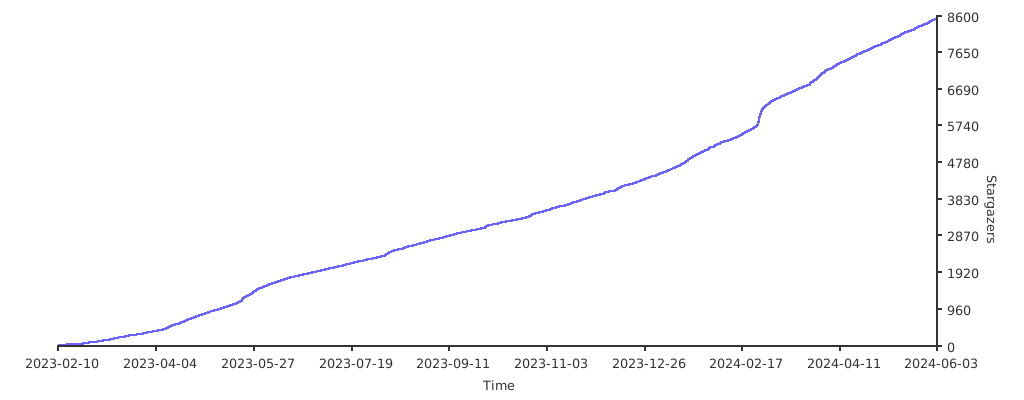
Stargazers over Time