nima1024m
71aca2018a
nima1024m
71aca2018a
* feat(a11y): label list, toolbar & dashboard actions for screen readers

Phase 1 of #5486 (Android TalkBack support). Icon-only controls across
the management surfaces previously announced only their untranslated
icon name (e.g. "edit", "ellipsis") or nothing at all.

- Add aria-label to icon-only row-action and toolbar buttons across
  inbounds, clients, groups, hosts, nodes and xray
  (outbounds/routing/dns/balancers) lists, plus the dashboard cards.
- Make clickable bare icons and AntD Card actions keyboard-operable via
  role/tabIndex + Enter/Space (new activateOnKey helper); convert mobile
  dropdown triggers to buttons so they open from the keyboard.
- Fix the sidebar hamburger's mislabeled aria-label (was the dashboard
  label) and translate previously-hardcoded outbound menu labels.

New i18n keys in all 13 locales: sort, menu.openMenu,
pages.xray.outbound.moveToTop.

* feat(a11y): label modal, QR and copy/download controls for screen readers

Phase 2 of #5486. Modal and overlay controls relied on tooltips (not a
reliable accessible name) or were bare clickable icons with no keyboard
or screen-reader support.

- Add aria-label to copy/QR/download/info icon buttons in the inbound and
  client info modals, sub-links modal, QR panel, backup/log modals, and
  to the bare search/select inputs of the attach/detach client modals.
- Make click-to-copy QR codes and the IP-log refresh/clear, geofile
  reload and log refresh icons keyboard-operable (role/tabIndex +
  Enter/Space) with translated labels.
- Label the 2FA code input; drop the QrPanel download-image string
  fallback now that the key exists.

New i18n key in all 13 locales: downloadImage.

* feat(a11y): label form fields and shared form components for screen readers

Phase 3 of #5486. Form controls and shared form widgets were largely
unlabelled, and several remove controls were not keyboard-operable.

- SettingListItem now ties its title to the control via aria-labelledby,
  giving accessible names to the ~90 settings-tab inputs at once.
- InputAddon gains button semantics (role/tabIndex/Enter+Space) and an
  ariaLabel prop when used as an interactive remove control.
- Sparkline charts expose a role="img" summary of their latest values.
- Add aria-label to add/remove/regenerate icon buttons and bare
  inputs/selects across inbound, client and xray (dns/routing/balancer/
  outbound) forms; make clickable remove icons keyboard-operable; mark
  decorative help/target icons aria-hidden; label the JSON editor,
  date-time clear button, header-map remove, notification select-all and
  remark token chips.

New i18n keys in all 13 locales: regenerate, jsonEditor,
pages.xray.balancer.{costMatch,costValue,costRegexp}.

* chore(a11y): add eslint-plugin-jsx-a11y harness and fix flagged interactions

Phase 4 of #5486. Adds eslint-plugin-jsx-a11y (recommended ruleset,
scoped to .tsx) so screen-reader/keyboard regressions fail lint.

- Make the mobile node-card header a proper keyboard disclosure
  (role=button, aria-expanded, Enter/Space activation that ignores
  clicks on the nested action buttons) and drop the now-redundant
  stop-propagation click handlers the linter flagged on card-action
  wrappers in the node, client and inbound mobile cards.
- Disable jsx-a11y/no-autofocus: the autofocus on the login field and
  modal primary inputs is intentional focus management that helps
  screen-reader and keyboard users land on the right control.

make lint passes with the a11y ruleset enforced.

* feat(a11y): cover remaining deferred spots (settings tabs, sockopt, API docs)

Completes the panel sweep for #5486 by labelling the spots previously
left out of phases 1-4:

- NotifyTimeField (Telegram notifications): the mode, interval, unit and
  custom-cron inputs now carry aria-labels.
- The Sockopt toggle in transport options.
- Settings category tabs in icons-only (mobile) mode now expose the tab
  name as the icon's aria-label instead of the raw icon name.
- The Swagger API-docs view is wrapped in a labelled region landmark.

New i18n keys in all 13 locales: pages.settings.notifyTime.{interval,unit}.

* feat(a11y): label shared xray form components and remark field

Code review surfaced frontend/src/lib/xray/forms/ — shared form components
used by the host and inbound JSON forms — which the initial audit missed.

- FinalMaskForm (TCP/UDP final-mask editor): label the icon-only add and
  regenerate buttons and make all six remove icons keyboard-operable
  (role/tabIndex/Enter+Space); adds useTranslation to its sub-components.
- CustomSockoptList: the remove icon is now keyboard-operable.
- SniffingFields: aria-label on the otherwise label-less destOverride select.
- RemarkTemplateField: aria-label on the remark-variable picker button.

New i18n key in all 13 locales: pages.inbounds.sniffingDestOverride.

* feat(a11y): label client info modal and WireGuard config block

After rebasing onto the WireGuard client-config feature, re-apply the
ClientInfoModal copy/QR/IP-log aria-labels (the modal was restructured
upstream, so the original labels did not carry over) and label the new
ConfigBlock component's copy/download/QR actions. ConfigBlock's action
wrapper keeps its stop-propagation handler (a non-interactive guard for
the Collapse header) under a scoped jsx-a11y exception.

* fix(frontend): let npm install jsx-a11y under ESLint 10

[email protected].2 declares a peer range that stops at ESLint 9,
but the panel is on ESLint 10, so `npm ci` aborts with ERESOLVE even though
the plugin runs fine on ESLint 10 with flat config. Add an npm override so
jsx-a11y accepts the project's ESLint version. This keeps normal peer
resolution (recharts' react-is peer still auto-installs) — no global
legacy-peer-deps and no manual react-is pin needed.

* fix(a11y): size mobile row triggers and move node expand role to chevron

Address automated review on #5652:
- add size="small" to the inbound/client/node mobile-card "more" dropdown
  triggers so they match the adjacent small Switch and the established
  desktop RowActions pattern.
- move the node card-head disclosure semantics (role/tabIndex/aria-expanded/
  keyboard) onto the chevron affordance so the expand control is no longer a
  role="button" wrapping the Switch, info button and dropdown. Mouse
  click-anywhere-to-expand is preserved on the header div.
English | فارسی | العربية | 中文 | Español | Русский | Türkçe





3X-UI is an advanced, open-source web control panel for managing Xray-core servers. It provides a clean, multi-language interface for deploying, configuring, and monitoring a wide range of proxy and VPN protocols — from a single VPS to multi-node deployments.
Built as an enhanced fork of the original X-UI project, 3X-UI adds broader protocol support, improved stability, per-client traffic accounting, and many quality-of-life features.
Important
This project is intended for personal use only. Please do not use it for illegal purposes or in a production environment.
Features
- Multi-protocol inbounds — VLESS, VMess, Trojan, Shadowsocks, WireGuard, Hysteria2, HTTP, SOCKS (Mixed), Dokodemo-door / Tunnel, and TUN.
- Modern transports & security — TCP (Raw), mKCP, WebSocket, gRPC, HTTPUpgrade, and XHTTP, secured with TLS, XTLS, and REALITY.
- Fallbacks — serve multiple protocols on a single port (e.g. VLESS and Trojan on 443) using Xray's fallback support.
- Per-client management — traffic quotas, expiry dates, IP limits, live online status, and one-click share links, QR codes, and subscriptions.
- Traffic statistics — per inbound, per client, and per outbound, with reset controls.
- Multi-node support — manage and scale across multiple servers from a single panel.
- Outbound & routing — WARP, NordVPN, custom routing rules, load balancers, and outbound proxy chaining.
- Built-in subscription server with multiple output formats and custom page templates.
- Telegram bot for remote monitoring and management.
- RESTful API with in-panel Swagger documentation.
- Flexible storage — SQLite (default) or PostgreSQL.
- 13 UI languages with dark and light themes.
- Fail2ban integration for enforcing per-client IP limits.
Screenshots
Click to expand


Quick Start
bash <(curl -Ls https://raw.githubusercontent.com/mhsanaei/3x-ui/master/install.sh)
To install a specific version, append its tag (e.g. v3.4.0):
bash <(curl -Ls https://raw.githubusercontent.com/mhsanaei/3x-ui/master/install.sh) v3.4.0
To install the rolling dev build (latest per-commit pre-release from main, not a stable release), pass dev-latest:
bash <(curl -Ls https://raw.githubusercontent.com/mhsanaei/3x-ui/master/install.sh) dev-latest
During installation a random username, password, and access path are generated. After installation, run x-ui to open the management menu, where you can start/stop the service, view or reset your login credentials, manage SSL certificates, and more.
For full documentation, please visit the project Wiki.
Unattended install
The installer also runs non-interactively for cloud-init.
Set XUI_NONINTERACTIVE=1 (or pipe with no TTY) and it installs end-to-end with
zero prompts, generating random credentials and writing them to
/etc/x-ui/install-result.env. See deploy/ for:
- Cloud-init user-data — unattended install on any cloud (Hetzner/AWS/DO/Vultr/GCP/Azure/Oracle)
- Hetzner Cloud notes — cloud-init deployment on Hetzner
Supported Platforms
Operating systems: Ubuntu, Debian, Armbian, Fedora, CentOS, RHEL, AlmaLinux, Rocky Linux, Oracle Linux, Amazon Linux, Virtuozzo, Arch, Manjaro, Parch, openSUSE (Tumbleweed / Leap), Alpine, and Windows.
Architectures: amd64 · 386 · arm64 (aarch64) · armv7 · armv6 · armv5 · s390x.
Database Options
3X-UI supports two backends, chosen during the install:
- SQLite (default) — a single file at
/etc/x-ui/x-ui.db. Zero setup, ideal for small and medium deployments. - PostgreSQL — recommended for high client counts or multi-node setups. The installer can install PostgreSQL locally for you, or accept a DSN to an existing server.
At runtime the backend is selected via environment variables (the installer writes these to /etc/default/x-ui for you):
XUI_DB_TYPE=postgres
XUI_DB_DSN=postgres://xui:[email protected]:5432/xui?sslmode=disable
Migrating an existing SQLite install to PostgreSQL
x-ui migrate-db --dsn "postgres://xui:[email protected]:5432/xui?sslmode=disable"
# then set XUI_DB_TYPE and XUI_DB_DSN in /etc/default/x-ui and restart:
systemctl restart x-ui
The source SQLite file is left untouched; remove it manually once you have verified the new backend.
Docker
The default docker compose up -d keeps using SQLite. To run with the bundled PostgreSQL service, uncomment the two XUI_DB_* env lines in docker-compose.yml and start with the profile:
docker compose --profile postgres up -d
The image bundles Fail2ban (enabled by default) to enforce per-client IP limits. Fail2ban bans offenders with iptables, which requires the NET_ADMIN capability. docker-compose.yml already grants it via cap_add; if you start the container with docker run instead, add the capabilities yourself, otherwise bans are logged but never applied:
docker run -d --cap-add=NET_ADMIN --cap-add=NET_RAW ... ghcr.io/mhsanaei/3x-ui
Environment Variables
| Variable | Description | Default |
|---|---|---|
XUI_DB_TYPE |
Database backend: sqlite or postgres |
sqlite |
XUI_DB_DSN |
PostgreSQL connection string (when XUI_DB_TYPE=postgres) |
— |
XUI_DB_FOLDER |
Directory for the SQLite database file | /etc/x-ui |
XUI_DB_MAX_OPEN_CONNS |
Maximum open connections (PostgreSQL pool) | — |
XUI_DB_MAX_IDLE_CONNS |
Maximum idle connections (PostgreSQL pool) | — |
XUI_INIT_WEB_BASE_PATH |
The initial URI path for the web panel | / |
XUI_ENABLE_FAIL2BAN |
Enable Fail2ban-based IP-limit enforcement | true |
XUI_LOG_LEVEL |
Log verbosity (debug, info, warning, error) |
info |
XUI_DEBUG |
Enable debug mode | false |
XUI_TUNNEL_HEALTH_MONITOR |
Enable the tunnel health monitor (probes a URL and restarts xray after repeated failures; a restart drops all clients) | false |
XUI_TUNNEL_HEALTH_PROXY |
Proxy the probe is sent through; point it at a local xray inbound so the probe tests the tunnel (e.g. socks5://127.0.0.1:1080). Empty means the probe only checks host connectivity |
— |
XUI_TUNNEL_HEALTH_URL |
URL probed for tunnel health | https://www.cloudflare.com/cdn-cgi/trace |
XUI_TUNNEL_HEALTH_INTERVAL |
Interval between probes | 30s |
XUI_TUNNEL_HEALTH_TIMEOUT |
Per-probe timeout | 10s |
XUI_TUNNEL_HEALTH_FAILURES |
Consecutive failures before a restart is triggered | 3 |
XUI_TUNNEL_HEALTH_COOLDOWN |
Minimum delay between consecutive restarts | 5m |
Supported Languages
The panel UI is available in 13 languages:
English · فارسی · العربية · 中文(简体) · 中文(繁體) · Español · Русский · Українська · Türkçe · Tiếng Việt · 日本語 · Bahasa Indonesia · Português (Brasil)
Contributing
Contributions are welcome. Please read the Contributing Guide before opening an issue or pull request.
A Special Thanks to
Acknowledgment
- Iran v2ray rules (License: GPL-3.0): Enhanced v2ray/xray and v2ray/xray-clients routing rules with built-in Iranian domains and a focus on security and adblocking.
- Russia v2ray rules (License: GPL-3.0): This repository contains automatically updated V2Ray routing rules based on data on blocked domains and addresses in Russia.
Community Tools
Tools and integrations built by the community around 3x-ui.
- terraform-provider-3x-ui (License: MIT): Manage inbounds, clients, panel settings, and Xray configuration as code with Terraform / OpenTofu.
Support project
If this project is helpful to you, you may wish to give it a🌟


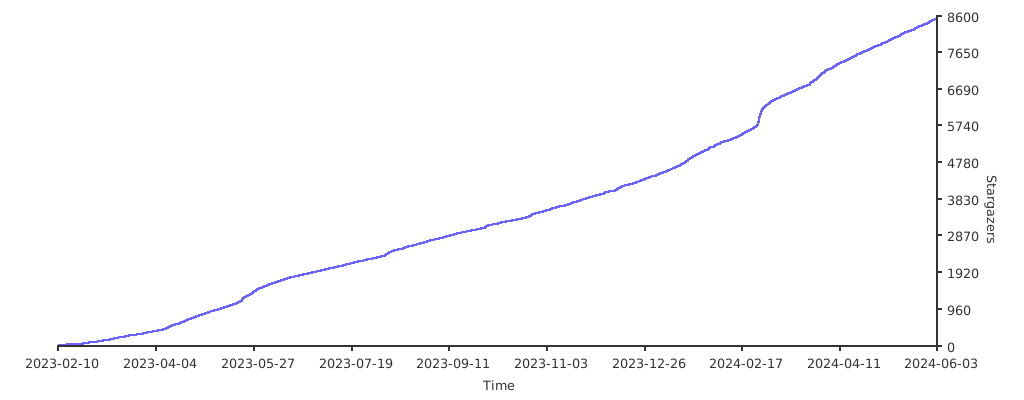
Stargazers over Time