Sanaei
892c06c8bc
Sanaei
892c06c8bc
* fix(xray): block private-range egress in default freedom finalRules (#6037)

With domainStrategy AsIs the router never resolves domains, so a domain
with a private A record (e.g. 127-0-0-1.nip.io) sails past the
geoip:private routing block and freedom's allow-all finalRules let it
reach loopback services such as the xray gRPC API and metrics listener.

Prepend a block rule for geoip:private to the default template and add
the FreedomFinalRulesPrivateEgressBlock seeder so existing installs
still carrying the stock allow-only (or legacy private-only-allow)
finalRules are upgraded in place; customized rules are left untouched.

* fix(sub): version-gate unencrypted-outbound drops in outbound subscriptions (#6033)

Commit d38c912d taught CheckXrayConfig to keep unencrypted vless/trojan
outbounds when the running core predates the v26.7.11 rejection, but
filterOutboundsRejectedByCore still consulted the embedded validator
unconditionally, so outbound subscriptions kept silently dropping those
outbounds even on downgraded cores.

Apply the same shouldSkipLegacyUnencryptedOutboundRejection gate when
filtering fetched subscription outbounds.

* fix(xray): resolve geodata assets before building outbound configs (#5928)

Saving routing or template settings validates each outbound through the
embedded config loader, and a freedom outbound whose finalRules
reference geoip:private opens geoip.dat during that build. Unlike
ApplyRoutingConfig, ValidateOutboundConfig and AddOutbound never pointed
the in-process loader at the bin folder, so xray-core resolved the file
relative to the panel executable and saving failed with
'stat /usr/local/x-ui/geoip.dat: no such file or directory'.

Call ensureXrayAssetLocation before both build paths.

* fix(api): use a real i18n key in the client get handler (#5911)

The client fetch endpoint localized its error prefix with the bare key
'get', which exists in no translation file, so every lookup of a deleted
client's email logged 'message "get" not found in language ...' noise
alongside the expected record-not-found warning. Reuse the same
pages.inbounds.toasts.obtain key the sibling list handler uses.

* fix(sub): carry host record Host header and path into Clash/JSON output (#5944)

The raw-link path overrides the host/path share params from a Host
record via applyEndpointHostPath, but the Clash and JSON renderers read
the transport settings object, which applyHostStreamOverrides never
touched — so a Host record's WebSocket Host header (and path) silently
vanished from Clash/Mihomo and JSON subscriptions whenever the inbound's
own ws settings left them empty.

Inject hostHeader/path into the ws/httpupgrade/xhttp settings of the
per-host stream, mirroring the raw-link override.

* fix(metrics): accept Unicode outbound tags in the observatory (#5972)

The observatory validator whitelisted ASCII word characters, so any
outbound whose tag carries a flag emoji or other non-ASCII text was
silently dropped from the metrics snapshot, delay history, and health
notifications. The history store is an in-process map, so the strict
charset bought nothing.

Validate tags as non-empty, bounded, control-character-free UTF-8
instead, keeping spaces and emoji while still rejecting garbage input on
the query path.

* fix(database): default sqlite to WAL to stop background-job lock storms (#6057, #6068)

With journal_mode=DELETE every write serializes the whole database and
blocks readers, so under normal multi-job load (traffic sampling, node
sync, mtproto reconcile) transactions regularly outwaited the 10s busy
timeout and jobs failed with 'database is locked'.

Move to WAL by default: readers no longer block writers and vice versa,
which removes the observed contention while writer-writer access still
serializes safely. The single-file-at-rest property is preserved where
it matters — Checkpoint() now issues wal_checkpoint(TRUNCATE), so panel
and Telegram backups read a complete main file, and sqlite folds the WAL
back into the db on clean shutdown. XUI_DB_JOURNAL_MODE=DELETE restores
the previous behavior for setups that copy the live file directly.

* fix(database): strip finalmask.tcp from REALITY inbounds on upgrade (#6038)

validateFinalMaskRealityCombo blocks saving finalmask.tcp together with
REALITY because that combination crashes Xray-core 26.7.11 on the first
connection (XTLS/Xray-core#6453), but it only runs on add/update. An
inbound saved before the validator existed sailed through the upgrade
untouched and took the core down at boot.

Add the InboundRealityFinalmaskTcpStrip seeder: one-time scan that
removes finalmask.tcp from REALITY inbounds (other finalmask transports
survive), so upgraded panels start cleanly.

* fix(xray): stop deleting hand-written direct routing rules on save (#6056)

The DNS allow-rule sync recognized 'its' rules purely by shape
(type=field, ip, port, outboundTag=direct, nothing else), so any manual
rule of that shape — e.g. routing a LAN CIDR to a NAS port over direct —
was silently stripped on every settings save.

Mark managed rules with ruleTag=xui-dns-allow (round-tripped untouched
by both xray-core and the Routing tab editor) and only strip rules that
carry the tag. Untagged legacy managed rules are adopted when their
exact ip-set/port matches a currently configured private DNS endpoint;
anything else is left alone. A stale pre-tag managed rule whose DNS
server was removed now lingers until deleted manually — the safe side of
the trade against eating user rules.

* fix(clients): resolve email lookups through client_inbounds after a move (#6059)

GetClientInboundByEmail trusted the client_traffics.inbound_id pointer
whenever that inbound still existed, but a client moved between inbounds
leaves the row pointing at its old (still existing) inbound. The lookup
then searched the wrong inbound's clients and failed with 'Client Not
Found In Inbound For Email', which broke the Telegram bot's link and QR
generation for moved clients.

When the pointed-at inbound no longer carries the email, re-resolve
through the authoritative client_inbounds link to the inbound that
actually hosts the client.

* fix(nodes): replicate inbound fallbacks to nodes (#5963)

Fallbacks live in the inbound_fallbacks table and were only merged into
settings by the master's local config builder; the runtime inbound
pushed to nodes rebuilt settings without them, and the reconcile job
additionally fingerprinted the raw DB row, so fallback edits neither
reached nodes nor triggered a re-push.

Inject settings.fallbacks in buildRuntimeInboundForAPI (mirroring the
local builder, gated on inboundCanHostFallbacks) and make ReconcileNode
push and fingerprint that same runtime-built payload, aligning the
interactive and reconcile paths.

* fix(database): survive PostgreSQL outages without a runaway restart loop (#6023)

A PostgreSQL that was down or still starting made InitDB fail instantly;
the process exited with a generic startup error and systemd restarted it
every 5s forever, flooding the journal.

Retry the initial postgres connection with backoff (~70s total) and log
the real driver error on every attempt, and cap the systemd units with
StartLimitIntervalSec/StartLimitBurst so a persistently unreachable
database stops the unit instead of looping indefinitely.

* fix(xray): force a full restart when REALITY stream settings change (#6010)

A changed inbound is normally hot-swapped over gRPC as RemoveInbound +
AddInbound, but xray-core does not reliably rebuild a REALITY listener's
authenticator on a runtime re-add — key or shortId edits appeared
applied yet clients kept authenticating against the old parameters until
someone restarted the core manually, on nodes in particular.

Treat any non-client change to an inbound that uses (or starts using)
REALITY as not hot-appliable so the panel restarts the core instead.
Client-only edits on REALITY inbounds keep flowing through the per-user
AlterInbound path and still avoid restarts.

* feat(sub): allow insecure TLS for outbound subscription fetches (#6067)

An outbound subscription served over HTTPS with a self-signed or
private-CA certificate could never be fetched: the fetch client had no
TLS options, so refreshes died with 'x509: certificate signed by unknown
authority' and there was nothing the admin could toggle.

Add a per-subscription 'Allow insecure' switch (persisted as
allow_insecure, default off) that sets InsecureSkipVerify on the fetch
transport — including when the fetch is routed through the panel egress
proxy. The SSRF-guarded dialer and redirect re-validation stay in force
either way.

* fix(reality): send PROXY protocol header in the target scanner when xver is set (#6082)

The REALITY target scanner always probed with a plain TLS handshake, so
a target fronted by an Nginx listener that requires the PROXY protocol
(matching the inbound's xver>=1) reset the connection and the panel
reported a false 'TLS handshake failed'.

Thread the inbound's xver into the scan request and, when it is >=1,
lead with the matching PROXY protocol header (v1 for xver 1, binary v2
for xver 2) built from the dialed connection's own address pair. Batch
candidate scans against public sites are unaffected (xver 0).

* fix(frontend): default sockopt fields when editing a stored inbound (#5956)

Opening an existing inbound ran rawInboundToFormValues over the raw DB
row, and only xhttpSettings was re-parsed through its Zod schema to fill
defaults. A sockopt object saved before the TProxy control existed has
no tproxy key, so the Select rendered blank; picking Off didn't help
because the wire normalizer drops tproxy=off, recreating the missing
key on the next edit.

Re-parse streamSettings.sockopt through SockoptStreamSettingsSchema on
load, mirroring the xhttpSettings handling, so absent keys (tproxy,
tcpcongestion, …) get their schema defaults every time the form opens.
English | فارسی | العربية | 中文 | Español | Русский | Türkçe





3X-UI is an advanced, open-source web control panel for managing Xray-core servers. It provides a clean, multi-language interface for deploying, configuring, and monitoring a wide range of proxy and VPN protocols — from a single VPS to multi-node deployments.
Built as an enhanced fork of the original X-UI project, 3X-UI adds broader protocol support, improved stability, per-client traffic accounting, and many quality-of-life features.
Important
This project is intended for personal use only. Please do not use it for illegal purposes or in a production environment.
Features
- Multi-protocol inbounds — VLESS, VMess, Trojan, Shadowsocks, WireGuard, Hysteria2, HTTP, SOCKS (Mixed), Dokodemo-door / Tunnel, and TUN.
- Modern transports & security — TCP (Raw), mKCP, WebSocket, gRPC, HTTPUpgrade, and XHTTP, secured with TLS, XTLS, and REALITY.
- Fallbacks — serve multiple protocols on a single port (e.g. VLESS and Trojan on 443) using Xray's fallback support.
- Per-client management — traffic quotas, expiry dates, IP limits, live online status, and one-click share links, QR codes, and subscriptions.
- Traffic statistics — per inbound, per client, and per outbound, with reset controls.
- Multi-node support — manage and scale across multiple servers from a single panel.
- Outbound & routing — WARP, NordVPN, custom routing rules, load balancers, and outbound proxy chaining.
- Built-in subscription server with multiple output formats and custom page templates.
- Telegram bot for remote monitoring and management.
- RESTful API with in-panel Swagger documentation.
- Flexible storage — SQLite (default) or PostgreSQL.
- 13 UI languages with dark and light themes.
- Fail2ban integration for enforcing per-client IP limits.
Screenshots
Click to expand


Quick Start
bash <(curl -Ls https://raw.githubusercontent.com/mhsanaei/3x-ui/master/install.sh)
To install a specific version, append its tag (e.g. v3.4.0):
bash <(curl -Ls https://raw.githubusercontent.com/mhsanaei/3x-ui/master/install.sh) v3.4.0
To install the rolling dev build (latest per-commit pre-release from main, not a stable release), pass dev-latest:
bash <(curl -Ls https://raw.githubusercontent.com/mhsanaei/3x-ui/master/install.sh) dev-latest
During installation a random username, password, and access path are generated. After installation, run x-ui to open the management menu, where you can start/stop the service, view or reset your login credentials, manage SSL certificates, and more.
For full documentation, please visit the project Wiki.
Unattended install
The installer also runs non-interactively for cloud-init.
Set XUI_NONINTERACTIVE=1 (or pipe with no TTY) and it installs end-to-end with
zero prompts, generating random credentials and writing them to
/etc/x-ui/install-result.env. See deploy/ for:
- Cloud-init user-data — unattended install on any cloud (Hetzner/AWS/DO/Vultr/GCP/Azure/Oracle)
- Hetzner Cloud notes — cloud-init deployment on Hetzner
Supported Platforms
Operating systems: Ubuntu, Debian, Armbian, Fedora, CentOS, RHEL, AlmaLinux, Rocky Linux, Oracle Linux, Amazon Linux, Virtuozzo, Arch, Manjaro, Parch, openSUSE (Tumbleweed / Leap), Alpine, and Windows.
Architectures: amd64 · 386 · arm64 (aarch64) · armv7 · armv6 · armv5 · s390x.
Database Options
3X-UI supports two backends, chosen during the install:
- SQLite (default) — a single file at
/etc/x-ui/x-ui.db. Zero setup, ideal for small and medium deployments. - PostgreSQL — recommended for high client counts or multi-node setups. The installer can install PostgreSQL locally for you, or accept a DSN to an existing server.
At runtime the backend is selected via environment variables (the installer writes these to /etc/default/x-ui for you):
XUI_DB_TYPE=postgres
XUI_DB_DSN=postgres://xui:[email protected]:5432/xui?sslmode=disable
Migrating an existing SQLite install to PostgreSQL
x-ui migrate-db --dsn "postgres://xui:[email protected]:5432/xui?sslmode=disable"
# then set XUI_DB_TYPE and XUI_DB_DSN in /etc/default/x-ui and restart:
systemctl restart x-ui
The source SQLite file is left untouched; remove it manually once you have verified the new backend.
Docker
The default docker compose up -d keeps using SQLite. To run with the bundled PostgreSQL service, uncomment the two XUI_DB_* env lines in docker-compose.yml and start with the profile:
docker compose --profile postgres up -d
The image bundles Fail2ban (enabled by default) to enforce per-client IP limits. Fail2ban bans offenders with iptables, which requires the NET_ADMIN capability. docker-compose.yml already grants it via cap_add; if you start the container with docker run instead, add the capabilities yourself, otherwise bans are logged but never applied:
docker run -d --cap-add=NET_ADMIN --cap-add=NET_RAW ... ghcr.io/mhsanaei/3x-ui
Environment Variables
| Variable | Description | Default |
|---|---|---|
XUI_DB_TYPE |
Database backend: sqlite or postgres |
sqlite |
XUI_DB_DSN |
PostgreSQL connection string (when XUI_DB_TYPE=postgres) |
— |
XUI_DB_FOLDER |
Directory for the SQLite database file | /etc/x-ui |
XUI_DB_MAX_OPEN_CONNS |
Maximum open connections (PostgreSQL pool) | — |
XUI_DB_MAX_IDLE_CONNS |
Maximum idle connections (PostgreSQL pool) | — |
XUI_INIT_WEB_BASE_PATH |
The initial URI path for the web panel | / |
XUI_ENABLE_FAIL2BAN |
Enable Fail2ban-based IP-limit enforcement | true |
XUI_LOG_LEVEL |
Log verbosity (debug, info, warning, error) |
info |
XUI_DEBUG |
Enable debug mode | false |
XUI_TUNNEL_HEALTH_MONITOR |
Enable the tunnel health monitor (probes a URL and restarts xray after repeated failures; a restart drops all clients) | false |
XUI_TUNNEL_HEALTH_PROXY |
Proxy the probe is sent through; point it at a local xray inbound so the probe tests the tunnel (e.g. socks5://127.0.0.1:1080). Empty means the probe only checks host connectivity |
— |
XUI_TUNNEL_HEALTH_URL |
URL probed for tunnel health | https://www.cloudflare.com/cdn-cgi/trace |
XUI_TUNNEL_HEALTH_INTERVAL |
Interval between probes | 30s |
XUI_TUNNEL_HEALTH_TIMEOUT |
Per-probe timeout | 10s |
XUI_TUNNEL_HEALTH_FAILURES |
Consecutive failures before a restart is triggered | 3 |
XUI_TUNNEL_HEALTH_COOLDOWN |
Minimum delay between consecutive restarts | 5m |
Supported Languages
The panel UI is available in 13 languages:
English · فارسی · العربية · 中文(简体) · 中文(繁體) · Español · Русский · Українська · Türkçe · Tiếng Việt · 日本語 · Bahasa Indonesia · Português (Brasil)
Contributing
Contributions are welcome. Please read the Contributing Guide before opening an issue or pull request.
A Special Thanks to
Acknowledgment
- Iran v2ray rules (License: GPL-3.0): Enhanced v2ray/xray and v2ray/xray-clients routing rules with built-in Iranian domains and a focus on security and adblocking.
- Russia v2ray rules (License: GPL-3.0): This repository contains automatically updated V2Ray routing rules based on data on blocked domains and addresses in Russia.
Community Tools
Tools and integrations built by the community around 3x-ui.
- terraform-provider-3x-ui (License: MIT): Manage inbounds, clients, panel settings, and Xray configuration as code with Terraform / OpenTofu.
Support project
If this project is helpful to you, you may wish to give it a🌟


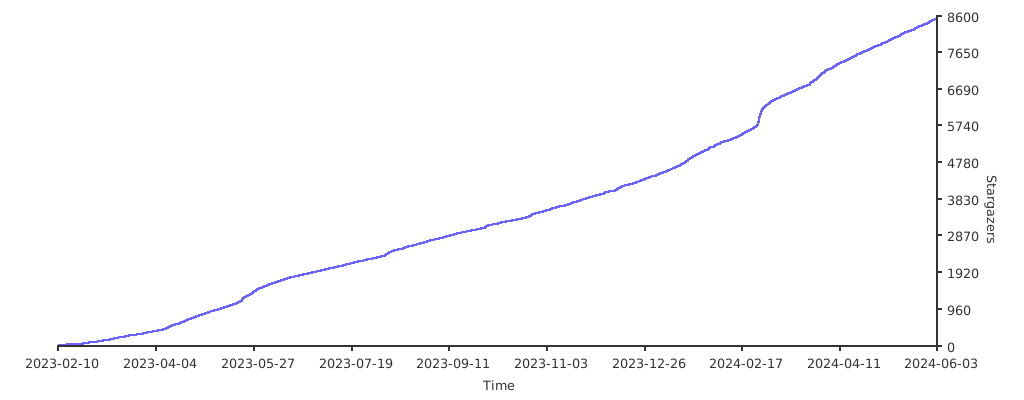
Stargazers over Time