jason zhangandMHSanaei
abd320994a
jason zhangandMHSanaei
abd320994a
* Add enable toggle for external client links

* Document external link enable API fields

* Extend external client link metadata

* Fix external subscription cache status updates

* fix(sub): address the review on per-client external link controls

Blocking: the expiry filter dropped legacy rows. expiry_time was added
without a default, so AutoMigrate makes it nullable and backfills NULL,
and `expiry_time = 0 OR expiry_time > ?` is false for NULL under
three-valued logic — every external link written before the upgrade
vanished from all subscriptions. Add `default:0` on expiry_time and
last_fetch_at, make the predicate NULL-tolerant, and backfill the NULLs
a pre-fix build could already have written.

Rework fetch-status recording. It ran inside the singleflight in-flight
window, so every goroutine parked on the shared fetch waited for a DB
write to commit on the public, unauthenticated subscription path — and
because it was keyed on the row id, waiters and cache hits recorded
nothing, leaving rows that lost the race stuck on "Not fetched yet"
forever. fetchSubscriptionLinks now reports whether it did the network
fetch and expandEntry records afterwards, off the serving path, keyed on
kind+value so every row sharing the URL is stamped by the one fetch.
Keying on value also closes the recycled-rowid hazard: saves delete and
re-insert rows, and SQLite reuses rowids, so an in-flight write could
land on an unrelated client's row. The write no longer discards its
error either.

Drop the inert id round-trip. The panel never sent it, and the byId
branch was guarded by the exact kind+value equality that byKindValue
already keys on, so it could not change an outcome. Matching on
kind+value alone is what actually preserves fetch status across saves.

Reject a negative expiryTime instead of storing a row that is silently
invisible in every subscription — elsewhere a negative expiryTime means
"a duration from first use", so an API caller reusing that convention
got no error and no links.

Drop the ~50 lines of .client-form-* / .client-inbounds-field CSS that
no component renders; it is leftover from the WireGuard PR this one was
split from.

i18n: reuse the already-translated pages.inbounds.leaveBlankToNeverExpire
instead of shipping an English duplicate under pages.clients, and
translate namePrefix, lastFetchAt, lastFetchError and neverFetched into
all 12 non-English locales.

Cover the persistence path that had no test: the fetch-status writer over
a real DB against a failing then a succeeding server, a cache hit writing
nothing, and the negative-expiry rejection.

---------

Co-authored-by: MHSanaei <[email protected]>
English | فارسی | العربية | 中文 | Español | Русский | Türkçe





3X-UI is an advanced, open-source web control panel for managing Xray-core servers. It provides a clean, multi-language interface for deploying, configuring, and monitoring a wide range of proxy and VPN protocols — from a single VPS to multi-node deployments.
Built as an enhanced fork of the original X-UI project, 3X-UI adds broader protocol support, improved stability, per-client traffic accounting, and many quality-of-life features.
Important
This project is intended for personal use only. Please do not use it for illegal purposes or in a production environment.
Features
- Multi-protocol inbounds — VLESS, VMess, Trojan, Shadowsocks, WireGuard, Hysteria2, HTTP, SOCKS (Mixed), Dokodemo-door / Tunnel, and TUN.
- Modern transports & security — TCP (Raw), mKCP, WebSocket, gRPC, HTTPUpgrade, and XHTTP, secured with TLS, XTLS, and REALITY.
- Fallbacks — serve multiple protocols on a single port (e.g. VLESS and Trojan on 443) using Xray's fallback support.
- Per-client management — traffic quotas, expiry dates, IP limits, live online status, and one-click share links, QR codes, and subscriptions.
- Traffic statistics — per inbound, per client, and per outbound, with reset controls.
- Multi-node support — manage and scale across multiple servers from a single panel.
- Outbound & routing — WARP, NordVPN, custom routing rules, load balancers, and outbound proxy chaining.
- Built-in subscription server with multiple output formats and custom page templates.
- Telegram bot for remote monitoring and management.
- RESTful API with in-panel Swagger documentation.
- Flexible storage — SQLite (default) or PostgreSQL.
- 13 UI languages with dark and light themes.
- Fail2ban integration for enforcing per-client IP limits.
Screenshots
Click to expand


Quick Start
bash <(curl -Ls https://raw.githubusercontent.com/mhsanaei/3x-ui/master/install.sh)
To install a specific version, append its tag (e.g. v3.4.0):
bash <(curl -Ls https://raw.githubusercontent.com/mhsanaei/3x-ui/master/install.sh) v3.4.0
To install the rolling dev build (latest per-commit pre-release from main, not a stable release), pass dev-latest:
bash <(curl -Ls https://raw.githubusercontent.com/mhsanaei/3x-ui/master/install.sh) dev-latest
During installation a random username, password, and access path are generated. After installation, run x-ui to open the management menu, where you can start/stop the service, view or reset your login credentials, manage SSL certificates, and more.
For full documentation, please visit the project Wiki.
Unattended install
The installer also runs non-interactively for cloud-init.
Set XUI_NONINTERACTIVE=1 (or pipe with no TTY) and it installs end-to-end with
zero prompts, generating random credentials and writing them to
/etc/x-ui/install-result.env. See deploy/ for:
- Cloud-init user-data — unattended install on any cloud (Hetzner/AWS/DO/Vultr/GCP/Azure/Oracle)
- Hetzner Cloud notes — cloud-init deployment on Hetzner
Supported Platforms
Operating systems: Ubuntu, Debian, Armbian, Fedora, CentOS, RHEL, AlmaLinux, Rocky Linux, Oracle Linux, Amazon Linux, Virtuozzo, Arch, Manjaro, Parch, openSUSE (Tumbleweed / Leap), Alpine, and Windows.
Architectures: amd64 · 386 · arm64 (aarch64) · armv7 · armv6 · armv5 · s390x.
Database Options
3X-UI supports two backends, chosen during the install:
- SQLite (default) — a single file at
/etc/x-ui/x-ui.db. Zero setup, ideal for small and medium deployments. - PostgreSQL — recommended for high client counts or multi-node setups. The installer can install PostgreSQL locally for you, or accept a DSN to an existing server.
At runtime the backend is selected via environment variables (the installer writes these to /etc/default/x-ui for you):
XUI_DB_TYPE=postgres
XUI_DB_DSN=postgres://xui:[email protected]:5432/xui?sslmode=disable
Migrating an existing SQLite install to PostgreSQL
x-ui migrate-db --dsn "postgres://xui:[email protected]:5432/xui?sslmode=disable"
# then set XUI_DB_TYPE and XUI_DB_DSN in /etc/default/x-ui and restart:
systemctl restart x-ui
The source SQLite file is left untouched; remove it manually once you have verified the new backend.
Docker
The default docker compose up -d keeps using SQLite. To run with the bundled PostgreSQL service, uncomment the two XUI_DB_* env lines in docker-compose.yml and start with the profile:
docker compose --profile postgres up -d
The image bundles Fail2ban (enabled by default) to enforce per-client IP limits. Fail2ban bans offenders with iptables, which requires the NET_ADMIN capability. docker-compose.yml already grants it via cap_add; if you start the container with docker run instead, add the capabilities yourself, otherwise bans are logged but never applied:
docker run -d --cap-add=NET_ADMIN --cap-add=NET_RAW ... ghcr.io/mhsanaei/3x-ui
Environment Variables
| Variable | Description | Default |
|---|---|---|
XUI_DB_TYPE |
Database backend: sqlite or postgres |
sqlite |
XUI_DB_DSN |
PostgreSQL connection string (when XUI_DB_TYPE=postgres) |
— |
XUI_DB_FOLDER |
Directory for the SQLite database file | /etc/x-ui |
XUI_DB_MAX_OPEN_CONNS |
Maximum open connections (PostgreSQL pool) | — |
XUI_DB_MAX_IDLE_CONNS |
Maximum idle connections (PostgreSQL pool) | — |
XUI_INIT_WEB_BASE_PATH |
The initial URI path for the web panel | / |
XUI_ENABLE_FAIL2BAN |
Enable Fail2ban-based IP-limit enforcement | true |
XUI_LOG_LEVEL |
Log verbosity (debug, info, warning, error) |
info |
XUI_DEBUG |
Enable debug mode | false |
XUI_TUNNEL_HEALTH_MONITOR |
Enable the tunnel health monitor (probes a URL and restarts xray after repeated failures; a restart drops all clients) | false |
XUI_TUNNEL_HEALTH_PROXY |
Proxy the probe is sent through; point it at a local xray inbound so the probe tests the tunnel (e.g. socks5://127.0.0.1:1080). Empty means the probe only checks host connectivity |
— |
XUI_TUNNEL_HEALTH_URL |
URL probed for tunnel health | https://www.cloudflare.com/cdn-cgi/trace |
XUI_TUNNEL_HEALTH_INTERVAL |
Interval between probes | 30s |
XUI_TUNNEL_HEALTH_TIMEOUT |
Per-probe timeout | 10s |
XUI_TUNNEL_HEALTH_FAILURES |
Consecutive failures before a restart is triggered | 3 |
XUI_TUNNEL_HEALTH_COOLDOWN |
Minimum delay between consecutive restarts | 5m |
Supported Languages
The panel UI is available in 13 languages:
English · فارسی · العربية · 中文(简体) · 中文(繁體) · Español · Русский · Українська · Türkçe · Tiếng Việt · 日本語 · Bahasa Indonesia · Português (Brasil)
Contributing
Contributions are welcome. Please read the Contributing Guide before opening an issue or pull request.
A Special Thanks to
Acknowledgment
- Iran v2ray rules (License: GPL-3.0): Enhanced v2ray/xray and v2ray/xray-clients routing rules with built-in Iranian domains and a focus on security and adblocking.
- Russia v2ray rules (License: GPL-3.0): This repository contains automatically updated V2Ray routing rules based on data on blocked domains and addresses in Russia.
Community Tools
Tools and integrations built by the community around 3x-ui.
- terraform-provider-3x-ui (License: MIT): Manage inbounds, clients, panel settings, and Xray configuration as code with Terraform / OpenTofu.
Support project
If this project is helpful to you, you may wish to give it a🌟


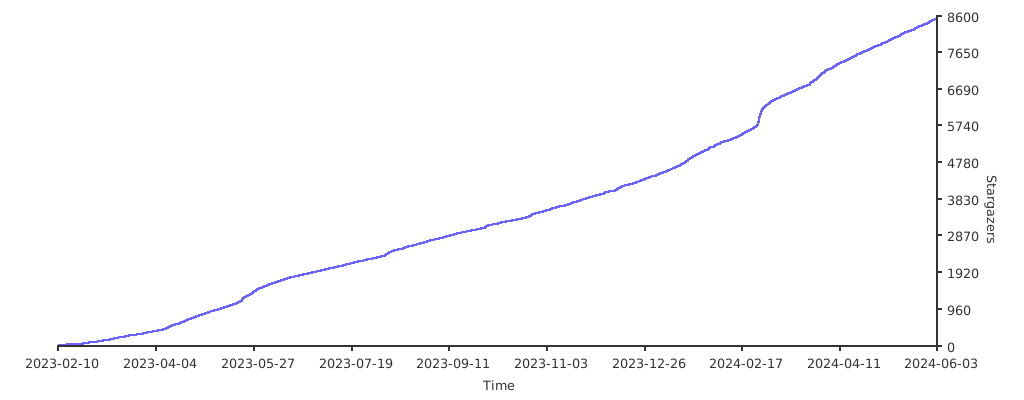
Stargazers over Time