Sanaei
be5ee3e0e1
Sanaei
be5ee3e0e1
Half-close. Both TCP relays -- RelayTCP into Xray's SOCKS5 inbound and
relayTCPForward into a peer's tunnel address -- waited on a single `done`
receive and then closed both sides. A client that finished sending and shut
down its write side therefore had the connection torn down before the
response came back. pipeBothWays now runs both directions to completion and
propagates the half-close via CloseWrite (which *net.TCPConn and
*gonet.TCPConn both implement), falling back to a full Close for anything
that does not.

Waiting for both directions reintroduces the risk the old single-receive was
implicitly avoiding: a peer that vanishes mid-transfer would pin the pair
forever. guardedReader bounds that, but as an idle window rather than a
total one -- the deadline is re-armed on every read once armed -- so a slow
transfer is never cut, while a silent peer is. Two minutes matches the idle
window UDPRelay.pump and portForwardUDPIdleTimeout already use.

UDP session retirement. pump's teardown deleted the map entry by key alone,
so a session that lost a create race evicted whichever session currently
held that source, orphaning a live flow. It now retires only its own entry,
and Handle keeps the already-published session when it loses the race. The
map is keyed on netip.AddrPort rather than src.String(), matching
udpForwardListener next door and dropping one allocation per relayed
datagram.

SOCKS5 reply decoding. bytesReader had a value receiver, so each Read
restarted at the head of the slice, and receive never advanced past a
domain-form address because its switch only handled ATYP 0x01 and 0x04 -- a
0x03 reply decoded to a wrong source, port and payload. splitSocks5Addr
replaces it: all three address forms, length-checked at every step, with the
domain form accepting only a literal. Resolving there would have put a
blocking DNS lookup on the receive path, and a datagram's own source is an
address already. Unreachable against Xray's own inbound, which always
answers with an IP, so this is a latent-bug fix rather than an observed one.
English | فارسی | العربية | 中文 | Español | Русский | Türkçe






3X-UI is an advanced, open-source web control panel for managing Xray-core servers. It provides a clean, multi-language interface for deploying, configuring, and monitoring a wide range of proxy and VPN protocols — from a single VPS to multi-node deployments.
Built as an enhanced fork of the original X-UI project, 3X-UI adds broader protocol support, improved stability, per-client traffic accounting, and many quality-of-life features.
Important
This project is intended for personal use only. Please do not use it for illegal purposes or in a production environment.
Features
- Multi-protocol inbounds — VLESS, VMess, Trojan, Shadowsocks, WireGuard, AmneziaWG, Hysteria2, MTProto, HTTP, SOCKS (Mixed), Dokodemo-door / Tunnel, and TUN.
- Modern transports & security — TCP (Raw), mKCP, WebSocket, gRPC, HTTPUpgrade, and XHTTP, secured with TLS, XTLS, and REALITY.
- AmneziaWG built in — DPI-resistant WireGuard runs inside the panel on a userspace network stack, with no kernel module, DKMS, or extra packages to install.
- MTProto proxies — per-client FakeTLS secrets, ad-tags, and quotas, applied live without dropping existing connections.
- Fallbacks — serve multiple protocols on a single port (e.g. VLESS and Trojan on 443) using Xray's fallback support.
- Per-client management — traffic quotas, expiry dates, IP limits with trusted-address exemptions, HWID device limits, scheduled renewal cycles, live online status, and one-click share links, QR codes, and subscriptions.
- Traffic statistics — per inbound, per client, and per outbound, with reset controls.
- Multi-node support — manage and scale across multiple servers from a single panel, including cloning inbounds onto other nodes.
- Outbound & routing — WARP, NordVPN, PIA, custom routing rules, load balancers with balancer-to-balancer fallback, and outbound proxy chaining. Bundled geosite and geoip categories are browsable straight from the rule editor.
- Built-in subscription server — raw, JSON, and Clash output, auto-selected from the client's User-Agent, plus custom page templates.
- Telegram bot for remote monitoring and management.
- RESTful API with scoped, optionally expiring tokens and an in-panel API reference.
- Installable panel (PWA) — pin 3X-UI to a desktop or phone home screen.
- Flexible storage — SQLite (default) or PostgreSQL.
- 13 UI languages with dark and light themes.
- Fail2ban integration for enforcing per-client IP limits.
Screenshots
Click to expand


Quick Start
bash <(curl -Ls https://raw.githubusercontent.com/mhsanaei/3x-ui/master/install.sh)
To install a specific version, append its tag (e.g. v3.7.0):
bash <(curl -Ls https://raw.githubusercontent.com/mhsanaei/3x-ui/master/install.sh) v3.7.0
To install the rolling dev build (latest per-commit pre-release from main, not a stable release), pass dev-latest:
bash <(curl -Ls https://raw.githubusercontent.com/mhsanaei/3x-ui/master/install.sh) dev-latest
During installation a random username, password, and access path are generated. After installation, run x-ui to open the management menu, where you can start/stop the service, view or reset your login credentials, manage SSL certificates, and more.
Every release asset is published with a .sha256 sum next to it. Both install.sh and the updater verify the archive against that sum and abort on a mismatch.
For full documentation — installation, configuration, operations, and the complete API reference — visit docs.sanaei.dev.
Unattended install
The installer also runs non-interactively for cloud-init.
Set XUI_NONINTERACTIVE=1 (or pipe with no TTY) and it installs end-to-end with
zero prompts, generating random credentials and writing them to
/etc/x-ui/install-result.env. See deploy/ for:
- Cloud-init user-data — unattended install on any cloud (Hetzner/AWS/DO/Vultr/GCP/Azure/Oracle)
- Hetzner Cloud notes — cloud-init deployment on Hetzner
Supported Platforms
Operating systems: Ubuntu, Debian, Armbian, Fedora, CentOS, RHEL, AlmaLinux, Rocky Linux, Oracle Linux, Amazon Linux, Virtuozzo, Arch, Manjaro, Parch, openSUSE (Tumbleweed / Leap), Alpine, and Windows.
Architectures: amd64 · 386 · arm64 (aarch64) · armv7 · armv6 · armv5 · s390x.
Database Options
3X-UI supports two backends, chosen during the install:
- SQLite (default) — a single file at
/etc/x-ui/x-ui.db. Zero setup, ideal for small and medium deployments. - PostgreSQL — recommended for high client counts or multi-node setups. The installer can install PostgreSQL locally for you, or accept a DSN to an existing server.
At runtime the backend is selected via environment variables (the installer writes these to /etc/default/x-ui for you):
XUI_DB_TYPE=postgres
XUI_DB_DSN=postgres://xui:[email protected]:5432/xui?sslmode=disable
Migrating an existing SQLite install to PostgreSQL
x-ui migrate-db --dsn "postgres://xui:[email protected]:5432/xui?sslmode=disable"
# then set XUI_DB_TYPE and XUI_DB_DSN in /etc/default/x-ui and restart:
systemctl restart x-ui
The source SQLite file is left untouched; remove it manually once you have verified the new backend.
Docker
The default docker compose up -d keeps using SQLite. To run with the bundled PostgreSQL service, uncomment the two XUI_DB_* env lines in docker-compose.yml and start with the profile:
docker compose --profile postgres up -d
The image bundles Fail2ban (enabled by default) to enforce per-client IP limits. Fail2ban bans offenders with iptables, which requires the NET_ADMIN capability. docker-compose.yml already grants it via cap_add; if you start the container with docker run instead, add the capabilities yourself, otherwise bans are logged but never applied:
docker run -d --cap-add=NET_ADMIN --cap-add=NET_RAW ... ghcr.io/mhsanaei/3x-ui
Environment Variables
| Variable | Description | Default |
|---|---|---|
XUI_DB_TYPE |
Database backend: sqlite or postgres |
sqlite |
XUI_DB_DSN |
PostgreSQL connection string (when XUI_DB_TYPE=postgres) |
— |
XUI_DB_FOLDER |
Directory for the SQLite database file | /etc/x-ui |
XUI_DB_MAX_OPEN_CONNS |
Maximum open connections (PostgreSQL pool) | — |
XUI_DB_MAX_IDLE_CONNS |
Maximum idle connections (PostgreSQL pool) | — |
XUI_INIT_WEB_BASE_PATH |
The initial URI path for the web panel | / |
XUI_ENABLE_FAIL2BAN |
Enable Fail2ban-based IP-limit enforcement | true |
XUI_LOG_LEVEL |
Log verbosity (debug, info, warning, error) |
info |
XUI_DEBUG |
Enable debug mode | false |
XUI_TUNNEL_HEALTH_MONITOR |
Enable the tunnel health monitor (probes a URL and restarts xray after repeated failures; a restart drops all clients) | false |
XUI_TUNNEL_HEALTH_PROXY |
Proxy the probe is sent through; point it at a local xray inbound so the probe tests the tunnel (e.g. socks5://127.0.0.1:1080). Empty means the probe only checks host connectivity |
— |
XUI_TUNNEL_HEALTH_URL |
URL probed for tunnel health | https://www.cloudflare.com/cdn-cgi/trace |
XUI_TUNNEL_HEALTH_INTERVAL |
Interval between probes | 30s |
XUI_TUNNEL_HEALTH_TIMEOUT |
Per-probe timeout | 10s |
XUI_TUNNEL_HEALTH_FAILURES |
Consecutive failures before a restart is triggered | 3 |
XUI_TUNNEL_HEALTH_COOLDOWN |
Minimum delay between consecutive restarts | 5m |
NODE_TOKEN_ENCRYPTION |
Encryption at rest for node API tokens: off, migration, or required (note: no XUI_ prefix) |
off |
XUI_NODE_TOKEN_KEY_FILE |
JSON keyring (mode 0600) holding the active key id and its base64 32-byte keys |
/etc/x-ui/node_token_key.json |
XUI_NODE_TOKEN_KEY |
A single base64 32-byte key, used only when the key file cannot be loaded | — |
The complete list is on the environment variables reference.
Supported Languages
The panel UI is available in 13 languages:
English · فارسی · العربية · 中文(简体) · 中文(繁體) · Español · Русский · Українська · Türkçe · Tiếng Việt · 日本語 · Bahasa Indonesia · Português (Brasil)
Contributing
Contributions are welcome. Please read the Contributing Guide before opening an issue or pull request.
A Special Thanks to
Acknowledgment
- Iran v2ray rules (License: GPL-3.0): Enhanced v2ray/xray and v2ray/xray-clients routing rules with built-in Iranian domains and a focus on security and adblocking.
- Russia v2ray rules (License: GPL-3.0): This repository contains automatically updated V2Ray routing rules based on data on blocked domains and addresses in Russia.
Community Tools
Tools and integrations built by the community around 3x-ui.
- terraform-provider-3x-ui (License: MIT): Manage inbounds, clients, panel settings, and Xray configuration as code with Terraform / OpenTofu.
Support project
If this project is helpful to you, you may wish to give it a🌟


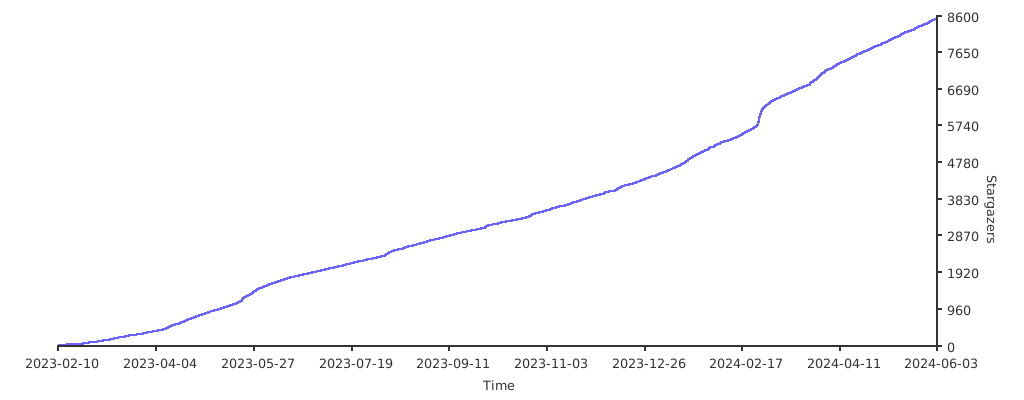
Stargazers over Time