w3struk
d01d9867e4
w3struk
d01d9867e4
* fix(sub): preserve non-default scMinPostsIntervalMs in inbound wire payload

The frontend wire normalizer unconditionally deleted scMinPostsIntervalMs
from inbound configs before persisting to the database, so JSON
subscriptions could never include it — even when the admin set a
non-default value like "50-150".

Only strip the xray-core default ("30") or empty values. The literal
"30" is a known DPI fingerprint (#5141) and must still be removed, but
custom tuning knobs must survive the round-trip so that buildXhttpExtra
and the JSON subscription generator can propagate them to clients.

Add tests for non-default preservation and empty-value stripping.

* fix(sub): use per-inbound xmux instead of global subJsonMux in JSON subscriptions

The JSON subscription generator always used the global subJsonMux panel
setting for outbound.Mux, even when the inbound carried per-inbound xmux
inside xhttpSettings. This meant XHTTP outbounds that configured their own
multiplexing via xmux still got the legacy mux.cool block injected — and
the inbound's own xmux was silently ignored.

Now getConfig() checks whether xmux is present in the inbound's
xhttpSettings. When it is, the per-inbound xmux handles multiplexing
and the legacy outbound.Mux is suppressed. When xmux is absent, the
global subJsonMux is used as before.

The mux selection is threaded through genVless, genVnext, genServer,
and genHy as an explicit parameter so each protocol handler can decide
independently.

Add tests:
- xmux present → outbound.Mux suppressed, xmux survives streamData()
- no xmux → global subJsonMux used as outbound.Mux

* feat(ui): add scMinPostsIntervalMs to inbound XHTTP form

The inbound XHTTP form was missing scMinPostsIntervalMs, making it impossible
for admins to configure this client-only tuning knob through the panel. The
field already existed in the Zod schema and outbound form, and the wire
normalizer (PR #5393) now preserves non-default values for subscription
propagation.

Add Form.Item for scMinPostsIntervalMs in the packet-up section of the
inbound XHTTP form, after scMaxEachPostBytes. Use the existing translation
key and a placeholder that shows the range format without endorsing the
DPI-fingerprinted default (30).

Update the Zod schema comment to clarify that scMinPostsIntervalMs is now
preserved on inbound for subscriptions, while uplinkChunkSize and
noGRPCHeader remain outbound-only.

Add two integration tests:
- Non-default value (50-150) preserved through formValuesToWirePayload
- Default value (30) stripped through the full pipeline

* fix(ui): show packet-up fields for auto mode in inbound XHTTP form

When mode is 'auto', the server accepts all three XHTTP modes including
packet-up. The packet-up-specific fields (scMaxBufferedPosts,
scMaxEachPostBytes, scMinPostsIntervalMs) are therefore relevant and
should be configurable.

Change the conditional from 'packet-up' only to
'packet-up || auto' so admins using the default 'auto' mode can
configure these fields.

* fix(outbound): show scMinPostsIntervalMs for auto mode, update placeholder

- Show scMinPostsIntervalMs field when mode is 'auto' in addition
  to 'packet-up', since auto+TLS resolves to packet-up client-side
- Change placeholder from '30' (DPI fingerprint) to 'e.g. 50-150'
  for consistency with inbound form

* fix(inbound): show scMaxEachPostBytes for all modes, gate scMaxBufferedPosts behind packet-up/auto

scMaxEachPostBytes is used by xray-core in every mode (both handlePacketUp
and handleStreamUp validate it) and must be visible regardless of mode.

scMaxBufferedPosts is only used by handlePacketUp, so it remains gated
behind the packet-up/auto conditional.

Also show scMinPostsIntervalMs for auto mode in outbound form and change
placeholder from '30' (DPI fingerprint) to 'e.g. 50-150'.

Update snapshot to reflect the new field order.

* fix(inbound): correct XHTTP field visibility per xray-core source verification

- scMaxEachPostBytes: move behind packet-up/auto gate (server only checks
  it in handlePacketUp, not handleStreamUp)
- scMaxBufferedPosts: show for packet-up, stream-up, and auto (server
  uses uploadQueue in both handlePacketUp and handleStreamUp)
- scStreamUpServerSecs: already correct (stream-up only)

Verified against xray-core hub.go and dialer.go source code.

---------

Co-authored-by: w3struk <w3struk@gmail.com>
Co-authored-by: MHSanaei <ho3ein.sanaei@gmail.com>
English | فارسی | العربية | 中文 | Español | Русский | Türkçe





3X-UI is an advanced, open-source web control panel for managing Xray-core servers. It provides a clean, multi-language interface for deploying, configuring, and monitoring a wide range of proxy and VPN protocols — from a single VPS to multi-node deployments.
Built as an enhanced fork of the original X-UI project, 3X-UI adds broader protocol support, improved stability, per-client traffic accounting, and many quality-of-life features.
Important
This project is intended for personal use only. Please do not use it for illegal purposes or in a production environment.
Features
- Multi-protocol inbounds — VLESS, VMess, Trojan, Shadowsocks, WireGuard, Hysteria2, HTTP, SOCKS (Mixed), Dokodemo-door / Tunnel, and TUN.
- Modern transports & security — TCP (Raw), mKCP, WebSocket, gRPC, HTTPUpgrade, and XHTTP, secured with TLS, XTLS, and REALITY.
- Fallbacks — serve multiple protocols on a single port (e.g. VLESS and Trojan on 443) using Xray's fallback support.
- Per-client management — traffic quotas, expiry dates, IP limits, live online status, and one-click share links, QR codes, and subscriptions.
- Traffic statistics — per inbound, per client, and per outbound, with reset controls.
- Multi-node support — manage and scale across multiple servers from a single panel.
- Outbound & routing — WARP, NordVPN, custom routing rules, load balancers, and outbound proxy chaining.
- Built-in subscription server with multiple output formats and custom page templates.
- Telegram bot for remote monitoring and management.
- RESTful API with in-panel Swagger documentation.
- Flexible storage — SQLite (default) or PostgreSQL.
- 13 UI languages with dark and light themes.
- Fail2ban integration for enforcing per-client IP limits.
Screenshots
Click to expand


Quick Start
bash <(curl -Ls https://raw.githubusercontent.com/mhsanaei/3x-ui/master/install.sh)
During installation a random username, password, and access path are generated. After installation, run x-ui to open the management menu, where you can start/stop the service, view or reset your login credentials, manage SSL certificates, and more.
For full documentation, please visit the project Wiki.
Unattended install & cloud images
The installer also runs non-interactively for cloud-init and golden images.
Set XUI_NONINTERACTIVE=1 (or pipe with no TTY) and it installs end-to-end with
zero prompts, generating random credentials and writing them to
/etc/x-ui/install-result.env. See deploy/ for:
- Cloud-init user-data — unattended install on any cloud (Hetzner/AWS/DO/Vultr/GCP/Azure/Oracle)
- Packer golden image — build an AWS EC2 AMI + qcow2 (amd64/arm64) with per-instance credentials generated on first boot
- Amazon Lightsail — launch script + reusable snapshot builder
- AWS Marketplace checklist
Supported Platforms
Operating systems: Ubuntu, Debian, Armbian, Fedora, CentOS, RHEL, AlmaLinux, Rocky Linux, Oracle Linux, Amazon Linux, Virtuozzo, Arch, Manjaro, Parch, openSUSE (Tumbleweed / Leap), Alpine, and Windows.
Architectures: amd64 · 386 · arm64 (aarch64) · armv7 · armv6 · armv5 · s390x.
Database Options
3X-UI supports two backends, chosen during the install:
- SQLite (default) — a single file at
/etc/x-ui/x-ui.db. Zero setup, ideal for small and medium deployments. - PostgreSQL — recommended for high client counts or multi-node setups. The installer can install PostgreSQL locally for you, or accept a DSN to an existing server.
At runtime the backend is selected via environment variables (the installer writes these to /etc/default/x-ui for you):
XUI_DB_TYPE=postgres
XUI_DB_DSN=postgres://xui:password@127.0.0.1:5432/xui?sslmode=disable
Migrating an existing SQLite install to PostgreSQL
x-ui migrate-db --dsn "postgres://xui:password@127.0.0.1:5432/xui?sslmode=disable"
# then set XUI_DB_TYPE and XUI_DB_DSN in /etc/default/x-ui and restart:
systemctl restart x-ui
The source SQLite file is left untouched; remove it manually once you have verified the new backend.
Docker
The default docker compose up -d keeps using SQLite. To run with the bundled PostgreSQL service, uncomment the two XUI_DB_* env lines in docker-compose.yml and start with the profile:
docker compose --profile postgres up -d
The image bundles Fail2ban (enabled by default) to enforce per-client IP limits. Fail2ban bans offenders with iptables, which requires the NET_ADMIN capability. docker-compose.yml already grants it via cap_add; if you start the container with docker run instead, add the capabilities yourself, otherwise bans are logged but never applied:
docker run -d --cap-add=NET_ADMIN --cap-add=NET_RAW ... ghcr.io/mhsanaei/3x-ui
Environment Variables
| Variable | Description | Default |
|---|---|---|
XUI_DB_TYPE |
Database backend: sqlite or postgres |
sqlite |
XUI_DB_DSN |
PostgreSQL connection string (when XUI_DB_TYPE=postgres) |
— |
XUI_DB_FOLDER |
Directory for the SQLite database file | /etc/x-ui |
XUI_DB_MAX_OPEN_CONNS |
Maximum open connections (PostgreSQL pool) | — |
XUI_DB_MAX_IDLE_CONNS |
Maximum idle connections (PostgreSQL pool) | — |
XUI_INIT_WEB_BASE_PATH |
The initial URI path for the web panel | / |
XUI_ENABLE_FAIL2BAN |
Enable Fail2ban-based IP-limit enforcement | true |
XUI_LOG_LEVEL |
Log verbosity (debug, info, warning, error) |
info |
XUI_DEBUG |
Enable debug mode | false |
Supported Languages
The panel UI is available in 13 languages:
English · فارسی · العربية · 中文(简体) · 中文(繁體) · Español · Русский · Українська · Türkçe · Tiếng Việt · 日本語 · Bahasa Indonesia · Português (Brasil)
Contributing
Contributions are welcome. Please read the Contributing Guide before opening an issue or pull request.
A Special Thanks to
Acknowledgment
- Iran v2ray rules (License: GPL-3.0): Enhanced v2ray/xray and v2ray/xray-clients routing rules with built-in Iranian domains and a focus on security and adblocking.
- Russia v2ray rules (License: GPL-3.0): This repository contains automatically updated V2Ray routing rules based on data on blocked domains and addresses in Russia.
Community Tools
Tools and integrations built by the community around 3x-ui.
- terraform-provider-3x-ui (License: MIT): Manage inbounds, clients, panel settings, and Xray configuration as code with Terraform / OpenTofu.
Support project
If this project is helpful to you, you may wish to give it a🌟


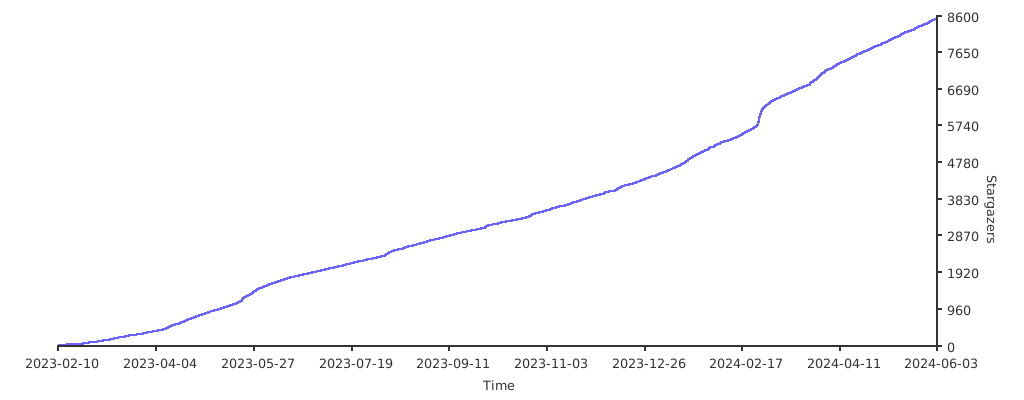
Stargazers over Time