da01b7637d
* feat(sub): add SubBalancer model and migration

Client-side JSON-subscription balancer row: remark, strategy, member inbound ids, sort order, enabled. Registered in allModels and migrationModels so AutoMigrate and SQLite->Postgres copy pick it up.

* feat(sub): add SubBalancer service

List/Get/Create/Update/Delete over the sub_balancers table with remark trim, strategy allowlist (leastLoad/leastPing/random) and sort-order floor. Rows are read per request by the subscription builder, so mutations need no xray restart.

* feat(sub): add SubBalancer API controller and routes

GET/POST /panel/api/sub-balancers, POST /:id (update), DELETE /:id and POST /:id/del alias. inboundIds bind from repeated form keys. Mounted under the /panel/api group so the existing API token + CSRF middleware cover it.

* feat(sub): emit client-side balancers in JSON subscription

For each enabled balancer, append one config document whose outbounds are the selected inbounds' proxy outbounds retagged under a per-balancer prefix, with routing.balancers + burstObservatory selecting it. Balancer entries interleave with inbound entries by sort order; on equal numbers the balancer follows the inbound. Skipped when disabled or no member outbound is present.

* test(sub): cover SubBalancer service and JSON output

Service: validation gates (remark/strategy/inbound ids/sort order) and CRUD round-trip. JSON: balancer document shape, sort interleaving with inbounds, disabled/empty skip, and member tag dedup.

* feat(sub): add sub-balancers i18n keys

pages.settings.subBalancers.* block (menu, title, add, desc, field labels, strategy names, sort-order help, validation messages) added to all 13 locales.

* feat(sub): add SubBalancer schema and API queries

Zod schema (entity + form, strategy enum, validation messages wired to i18n keys), react-query hooks for list/create/update/delete, and the sub-balancers query key.

* feat(sub): add subscription balancers settings tab

SubscriptionBalancersTab lists balancers (sort order, remark, strategy, inbound count, enabled toggle, edit/delete) with a form modal (remark, strategy, sort order, multi-select inbounds filtered to multi-client protocols, enabled). Wired into SettingsPage under #subscription-balancers, and the sidebar shows the entry only when JSON subscription is enabled.

* test(sub): add SubBalancer form modal test

Covers add-mode (no validation errors, confirm with parsed values) and edit-mode (seeds from the balancer, preserves strategy/sort order/enabled).

* feat(sub): register sub-balancers in API docs and OpenAPI

Adds the sub-balancers endpoint group to endpoints.ts (list/create/update/delete + POST del alias) and regenerates frontend/public/openapi.json from it.

* docs: sync openapi.json with frontend

docs/public/openapi.json had fallen behind frontend/public/openapi.json (fewer paths/schemas). Copy the current frontend spec so the docs site renders the full API.

* docs: add subscription balancers API reference

Registers the sub-balancers page (generated MDX) and adds the sub-balancers paths to docs/public/openapi.json so the page renders the list/create/update/delete operations.

* feat(sub): accept roundRobin balancer strategy

Add roundRobin to the model oneof tag and the service strategy allowlist, alongside leastLoad/leastPing/random. Covered by a service-level create test that fails on the old allowlist.

* feat(sub): add roundRobin strategy label

pages.settings.subBalancers.strategyRoundRobin added to all 13 locales.

* feat(sub): expose roundRobin in balancer form

Zod strategy enum, form modal label key, and table strategy colour for roundRobin.

* docs(sub): list roundRobin in strategy description

The create/update strategy param description now mentions roundRobin alongside the other three.

* feat(sub): add subJsonObservatory setting

Panel-wide JSON string carrying the burstObservatory ping config (destination, connectivity, interval, sampling, timeout, httpMethod) emitted into client-side balancer docs. Stored like subJsonMux/Rules/FinalMask.

* feat(sub): wire observatory config through sub controller

WithSUBJsonObservatory option; the controller calls SubJsonService.SetObservatoryConfig after construction.

* feat(sub): emit observatory conditionally with configurable probes

burstObservatory is emitted only for leastPing/leastLoad; random/roundRobin get none (no fallback, so an observatory would only probe for nothing). Probe params come from the subJsonObservatory setting, falling back to the built-in defaults when empty or partial. Test covers the conditional emit and the override.

* feat(sub): add subJsonObservatory to AllSetting model

Frontend AllSetting model and Zod schema carry the new panel-wide observatory config string.

* feat(sub): add balancer observatory config card

New Sub Formats tab editing destination/connectivity/interval/sampling/timeout/httpMethod, stored as JSON in subJsonObservatory. Toggle off clears the setting; the backend then falls back to defaults.

* fix(sub): hide save/restart header on sub-balancers tab

Sub-balancer mutations are incremental (own CRUD API, no Save, no restart), so the page-wide 'every change needs to be saved / restart the panel' banner is misleading there. The in-tab alert already explains it correctly.

* feat(sub): add observatory config i18n keys

pages.settings.subBalancers.observatory.* (title, desc, probe field labels and help texts) added to all 13 locales.

* feat(sub): regenerate openapi for subJsonObservatory

openapigen picks up the new AllSetting field; openapi.json synced into docs.

* feat(sub): add observatory tab to sub-balancers

Mirrors the Xray Balancers page: two tabs (Balancers + Observatory).
Wires allSetting/updateSetting into the tab and adds tabBalancers /
tabObservatory labels to all locales. The page Save header is shown
again on this tab so the observatory config can be saved.

* refactor(sub): drop observatory tab from sub-formats

Now that the observatory config lives under sub-balancers, remove the
duplicate tab plus its state and defaults from sub-formats.

* fix(sub): add missing inboundsCount i18n key

The sub-balancers table rendered the raw key path in the Inbounds
column because pages.settings.subBalancers.inboundsCount was not
defined. Added it to all 13 locales.

* test(sub): pin disabled-inbound exclusion from balancer

The balancer builds its members from the subscriber's already-filtered
entry set, so an inbound disabled for that user can never surface as a
member. Adds tests for both shapes (one of several disabled, and the
only selected one disabled).

* fix(sub): make observatory toggle honest, default connectivity off, add balancer fallback

Three coupled defects on the balancer observatory surface, flagged in PR review:

- The Observatory Switch wrote '' which the Go side treats as "use built-in defaults", so leastPing/leastLoad still shipped a burstObservatory the admin could no longer see or edit. The observatory is mandatory for these strategies (Xray refuses to start leastPing/leastLoad without one — verified against Xray 26.7), so the switch is relabelled to "customise probe parameters vs built-in defaults" rather than on/off: '' keeps the defaults, a stored JSON overrides them. An info Alert explains this.

- Connectivity defaulted to http://www.google.com/generate_204 and an explicit {"connectivity":""} restored it, so the UI's "Leave empty to skip" was unreachable and the direct pre-check was dead on arrival on censored client networks. Default to "" and honour an explicit empty value.

- routing.balancers had no fallbackTag, so a leastPing/leastLoad balancer whose probes all fail selects nothing and dispatch fails. Emit fallbackTag pointing at the first member so a probe outage degrades instead of breaking.

Also skip balancer entries (kind!=0) in the member scan so a balancer can never match another balancer's row id. Tests cover each fix and fail without it.

* fix(sub-balancer): localize controller toasts and reject malformed ids

Route the new controller's user-facing messages through I18nWeb so non-English admins get localized toasts like every other controller, and switch parseID to strconv.Atoi rejecting ids < 1 so "12abc" and negative ids no longer coerce to a silent no-op delete that reports success.

* fix(sub-balancer): enforce remark length cap server-side

The model's validate:"max=256" tag was never enforced (parseSubBalancerForm binds an ad-hoc struct without validate.Struct), so a scripted API client could store an unbounded remark that is emitted verbatim as the remarks field of every affected subscriber's config. Reject len > 256 in validate() to match the frontend Zod cap.

* fix(sub-balancer): exclude mtproto from balancer member picker

SubJsonService.getConfig has no mtproto case, so an mtproto inbound's first outbound is "direct" and the buildBalancerConfig "tag != proxy" guard drops it — an admin could select it, save without error, and get a balancer that silently omits it (or no document at all). Drop it from the picker and fix the comment.

* docs(sub-balancers): add nav entry, fix tab pointer, note mirror scope

- Add "subscription-balancers" to the en reference/api meta.json pages array so the new MDX page is reachable from the sidebar (fa/ru/zh have no MDX — gen-openapi.ts emits into en only).

- Fix the endpoints.ts section description from "Settings -> Subscription" to "Settings -> Sub Balancers" (the feature's own tab) and regenerate the OpenAPI spec + MDX.

- Note in docs/lib/xray/subscription.ts that balancer documents are intentionally out of scope for that mirror.

* style(model): trim SubBalancer comment to 2-line cap

CLAUDE.md caps committed Go comment blocks at 2 lines; this one was 3.

* fix(sub-balancer): parse enabled explicitly and preserve it on partial update

parseSubBalancerForm treated any non-"false" value as true (so "bogus"
silently enabled) and always overwrote Enabled on update, so a PATCH that
omitted the toggle reset a disabled balancer back to enabled. Parse the
field with strconv.ParseBool and return *bool: absent means "no change"
on update and "true" on create; a malformed value is rejected as 400.
Update keeps the stored Enabled when the pointer is nil.

* fix(sub-balancer): clear deleted inbound from sub_balancers.InboundIds

DelInbound cascaded hosts but left the deleted inbound id in every
sub_balancers.InboundIds, so the balancer kept emitting a member no
subscriber could resolve — a dangling outbound tag with no proxy behind it.
Strip the id inside the existing delete transaction (same shape as the hosts
cascade, #5648); with the last member gone the balancer stops emitting.

* fix(sub-balancer): return not-found when deleting a missing balancer

Delete returned the gorm result error only, which is nil when no row matched,
so the controller reported success:true for an id that never existed — a stale
UI row looked like a clean delete. Check RowsAffected and return a not-found
error on 0 so the toast reflects reality.

* style(sub): shorten leastPing/leastLoad observatory comments

The observatory-emission guard comment and its test comment ran a few
lines long; trim them to a couple of lines each without dropping the
invariant that leastPing/leastLoad require a burst observatory.

* fix(sub): validate observatory setting instead of silently dropping it

SetObservatoryConfig applied whatever survived json.Unmarshal with no checks,
so a bad probe URL ("not-a-url"), non-duration interval/timeout, or even
unparseable JSON was either silently applied or silently ignored. Validate
each field: parse durations with time.ParseDuration, require http(s) URLs for
destination/connectivity, and log a warning naming the field and the bad value
on every fallback — including the unmarshal error, which was a quiet return.
Bad values now keep the built-in defaults instead of leaking into the emitted
burstObservatory.

* fix(sub): deduplicate burst-observatory defaults across Go and frontend

The burst-observatory ping defaults lived in three places that had drifted:
Go defaultSubBalancerObservatoryConfig (http probe, sampling 3), the Zod
PingConfigSchema, and DEFAULT_BURST_OBSERVATORY (both with a connectivity
pre-check URL). Align them to one set: https probe destination, sampling 2,
and empty connectivity (skip the direct pre-check). The settings tab now
parses the stored JSON through PingConfigSchema and seeds its default from
DEFAULT_BURST_OBSERVATORY instead of carrying its own literal.

* refactor(sub): extract proxy outbounds once before the balancer loop

buildBalancerConfig unmarshalled every inbound document and re-extracted its
first outbound on each balancer, so with B balancers and N inbound docs the
same document was parsed B*N times. Pull each doc's proxy outbound in a single
pre-pass over the entries and cache it per entry; buildBalancerConfig now
clones the cached map before retagging, so one parse serves every balancer.
Output is byte-for-byte unchanged.

* fix(sub): form balancer member tags from the inbound protocol, not tcp→vless

balancerTransport derived the bal-N tag suffix from the outbound's transport
network and hard-coded tcp→vless, so a vmess/tcp or trojan/tcp member was
mislabelled "vless" in every client config — the tag lied about the proxy
type. Use the outbound's real protocol as the suffix (bal-1-vmess, bal-1-vless,
bal-1-trojan, …) so the tag names the actual proxy; the selector prefix and
dedup suffix are unchanged. Update the existing tag assertions and add a vmess
case that fails under the old mapping.

* fix(sub-balancer): default strategy to random in the create form

The create-balancer form seeded strategy to 'leastLoad', but the service
validate() defaults an empty strategy to 'random' and the API docs say the
default is 'random' — so a freshly opened form showed leastLoad while saving
without touching the field silently stored random. Align the form default to
'random' so what the admin sees is what gets persisted.

* feat(api-docs): document the SubBalancer response schema

The five sub-balancer endpoints carried no responseSchema, so the API docs
page rendered them without a typed example. Add example: tags to every
SubBalancer field, allow the struct through openapigen, and point the list
(responseSchemaArray) and single-row endpoints at 'SubBalancer'. Regenerate
the Zod/JSON schemas and OpenAPI doc and mirror openapi.json into docs/.

* style(sub-balancer): drop whitespace-only separator lines, add final newline

subBalancer.ts and SubBalancerFormModal.tsx used single-space blank lines as
separators between statements and had no trailing newline. Replace them with
clean empty blank lines and end each file with a newline.

* fix(i18n): translate sub-balancer toasts and observatory note

The sub-balancer toast messages (list/create/update/delete/invalidId) and
the observatory note were left in English across 11 non-English locales
(ar, es, fa, id, ja, pt-BR, tr, uk, vi, zh-CN, zh-TW) while every other key
in the subBalancers block was already translated. Translate them to match the
meaning and terminology of the surrounding keys in each file; the JSON
structure and keys are unchanged.

* fix(sub-balancer): hide disabled inbounds from the member picker

The picker offered every protocol-eligible inbound regardless of its enable
flag, but getInboundsBySubId filters `AND inbounds.enable = true`. A disabled
member is therefore dropped from every subscriber's entries, and when it was
the balancer's only member the balancer document silently stops being emitted
— with nothing in the UI explaining why. TestSubJson_BalancerSkippedWhenAll
MembersDisabled already documents that backend behavior.

Filter the way the sibling client picker has since #5645: hide disabled
inbounds, but keep one that is already selected so editing an existing
balancer cannot silently drop a member.

Drop the `?? []` on the useWatch result so the new useMemo dependency stays
referentially stable.

* style(sub): trim the balancerMemberSuffix comment to the 2-line cap

Comment blocks in committed Go are capped at 2 lines; the name already carries
what the function picks, so keep only the why.

---------

Co-authored-by: Sanaei <[email protected]>
Co-authored-by: claude[bot] <41898282+claude[bot]@users.noreply.github.com>
English | فارسی | العربية | 中文 | Español | Русский | Türkçe





3X-UI is an advanced, open-source web control panel for managing Xray-core servers. It provides a clean, multi-language interface for deploying, configuring, and monitoring a wide range of proxy and VPN protocols — from a single VPS to multi-node deployments.
Built as an enhanced fork of the original X-UI project, 3X-UI adds broader protocol support, improved stability, per-client traffic accounting, and many quality-of-life features.
Important
This project is intended for personal use only. Please do not use it for illegal purposes or in a production environment.
Features
- Multi-protocol inbounds — VLESS, VMess, Trojan, Shadowsocks, WireGuard, Hysteria2, HTTP, SOCKS (Mixed), Dokodemo-door / Tunnel, and TUN.
- Modern transports & security — TCP (Raw), mKCP, WebSocket, gRPC, HTTPUpgrade, and XHTTP, secured with TLS, XTLS, and REALITY.
- Fallbacks — serve multiple protocols on a single port (e.g. VLESS and Trojan on 443) using Xray's fallback support.
- Per-client management — traffic quotas, expiry dates, IP limits, live online status, and one-click share links, QR codes, and subscriptions.
- Traffic statistics — per inbound, per client, and per outbound, with reset controls.
- Multi-node support — manage and scale across multiple servers from a single panel.
- Outbound & routing — WARP, NordVPN, custom routing rules, load balancers, and outbound proxy chaining.
- Built-in subscription server with multiple output formats and custom page templates.
- Telegram bot for remote monitoring and management.
- RESTful API with in-panel Swagger documentation.
- Flexible storage — SQLite (default) or PostgreSQL.
- 13 UI languages with dark and light themes.
- Fail2ban integration for enforcing per-client IP limits.
Screenshots
Click to expand


Quick Start
bash <(curl -Ls https://raw.githubusercontent.com/mhsanaei/3x-ui/master/install.sh)
To install a specific version, append its tag (e.g. v3.4.0):
bash <(curl -Ls https://raw.githubusercontent.com/mhsanaei/3x-ui/master/install.sh) v3.4.0
To install the rolling dev build (latest per-commit pre-release from main, not a stable release), pass dev-latest:
bash <(curl -Ls https://raw.githubusercontent.com/mhsanaei/3x-ui/master/install.sh) dev-latest
During installation a random username, password, and access path are generated. After installation, run x-ui to open the management menu, where you can start/stop the service, view or reset your login credentials, manage SSL certificates, and more.
For full documentation, please visit the project Wiki.
Unattended install
The installer also runs non-interactively for cloud-init.
Set XUI_NONINTERACTIVE=1 (or pipe with no TTY) and it installs end-to-end with
zero prompts, generating random credentials and writing them to
/etc/x-ui/install-result.env. See deploy/ for:
- Cloud-init user-data — unattended install on any cloud (Hetzner/AWS/DO/Vultr/GCP/Azure/Oracle)
- Hetzner Cloud notes — cloud-init deployment on Hetzner
Supported Platforms
Operating systems: Ubuntu, Debian, Armbian, Fedora, CentOS, RHEL, AlmaLinux, Rocky Linux, Oracle Linux, Amazon Linux, Virtuozzo, Arch, Manjaro, Parch, openSUSE (Tumbleweed / Leap), Alpine, and Windows.
Architectures: amd64 · 386 · arm64 (aarch64) · armv7 · armv6 · armv5 · s390x.
Database Options
3X-UI supports two backends, chosen during the install:
- SQLite (default) — a single file at
/etc/x-ui/x-ui.db. Zero setup, ideal for small and medium deployments. - PostgreSQL — recommended for high client counts or multi-node setups. The installer can install PostgreSQL locally for you, or accept a DSN to an existing server.
At runtime the backend is selected via environment variables (the installer writes these to /etc/default/x-ui for you):
XUI_DB_TYPE=postgres
XUI_DB_DSN=postgres://xui:[email protected]:5432/xui?sslmode=disable
Migrating an existing SQLite install to PostgreSQL
x-ui migrate-db --dsn "postgres://xui:[email protected]:5432/xui?sslmode=disable"
# then set XUI_DB_TYPE and XUI_DB_DSN in /etc/default/x-ui and restart:
systemctl restart x-ui
The source SQLite file is left untouched; remove it manually once you have verified the new backend.
Docker
The default docker compose up -d keeps using SQLite. To run with the bundled PostgreSQL service, uncomment the two XUI_DB_* env lines in docker-compose.yml and start with the profile:
docker compose --profile postgres up -d
The image bundles Fail2ban (enabled by default) to enforce per-client IP limits. Fail2ban bans offenders with iptables, which requires the NET_ADMIN capability. docker-compose.yml already grants it via cap_add; if you start the container with docker run instead, add the capabilities yourself, otherwise bans are logged but never applied:
docker run -d --cap-add=NET_ADMIN --cap-add=NET_RAW ... ghcr.io/mhsanaei/3x-ui
Environment Variables
| Variable | Description | Default |
|---|---|---|
XUI_DB_TYPE |
Database backend: sqlite or postgres |
sqlite |
XUI_DB_DSN |
PostgreSQL connection string (when XUI_DB_TYPE=postgres) |
— |
XUI_DB_FOLDER |
Directory for the SQLite database file | /etc/x-ui |
XUI_DB_MAX_OPEN_CONNS |
Maximum open connections (PostgreSQL pool) | — |
XUI_DB_MAX_IDLE_CONNS |
Maximum idle connections (PostgreSQL pool) | — |
XUI_INIT_WEB_BASE_PATH |
The initial URI path for the web panel | / |
XUI_ENABLE_FAIL2BAN |
Enable Fail2ban-based IP-limit enforcement | true |
XUI_LOG_LEVEL |
Log verbosity (debug, info, warning, error) |
info |
XUI_DEBUG |
Enable debug mode | false |
XUI_TUNNEL_HEALTH_MONITOR |
Enable the tunnel health monitor (probes a URL and restarts xray after repeated failures; a restart drops all clients) | false |
XUI_TUNNEL_HEALTH_PROXY |
Proxy the probe is sent through; point it at a local xray inbound so the probe tests the tunnel (e.g. socks5://127.0.0.1:1080). Empty means the probe only checks host connectivity |
— |
XUI_TUNNEL_HEALTH_URL |
URL probed for tunnel health | https://www.cloudflare.com/cdn-cgi/trace |
XUI_TUNNEL_HEALTH_INTERVAL |
Interval between probes | 30s |
XUI_TUNNEL_HEALTH_TIMEOUT |
Per-probe timeout | 10s |
XUI_TUNNEL_HEALTH_FAILURES |
Consecutive failures before a restart is triggered | 3 |
XUI_TUNNEL_HEALTH_COOLDOWN |
Minimum delay between consecutive restarts | 5m |
Supported Languages
The panel UI is available in 13 languages:
English · فارسی · العربية · 中文(简体) · 中文(繁體) · Español · Русский · Українська · Türkçe · Tiếng Việt · 日本語 · Bahasa Indonesia · Português (Brasil)
Contributing
Contributions are welcome. Please read the Contributing Guide before opening an issue or pull request.
A Special Thanks to
Acknowledgment
- Iran v2ray rules (License: GPL-3.0): Enhanced v2ray/xray and v2ray/xray-clients routing rules with built-in Iranian domains and a focus on security and adblocking.
- Russia v2ray rules (License: GPL-3.0): This repository contains automatically updated V2Ray routing rules based on data on blocked domains and addresses in Russia.
Community Tools
Tools and integrations built by the community around 3x-ui.
- terraform-provider-3x-ui (License: MIT): Manage inbounds, clients, panel settings, and Xray configuration as code with Terraform / OpenTofu.
Support project
If this project is helpful to you, you may wish to give it a🌟


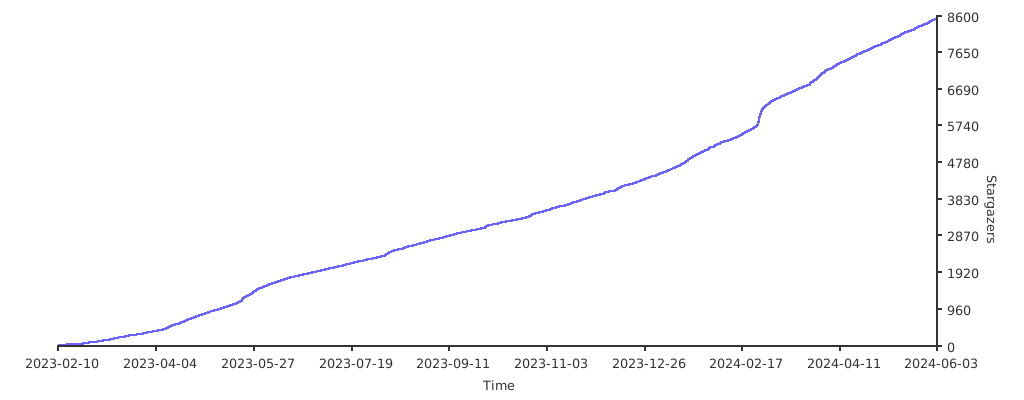
Stargazers over Time