Sentiago
eec030f86f
Sentiago
eec030f86f
* feat(notifications): event bus architecture with Telegram and SMTP subscribers

- Event bus core with buffered channel, fan-out, panic recovery
- Telegram subscriber with HTML formatting and rate limiting
- Email subscriber with SMTP/TLS/STARTTLS support and stage diagnostics
- 5 event types: outbound.down/up, xray.crash, cpu.high, login.attempt
- CPU threshold checks per subscriber (tgCpu for TG, smtpCpu for Email)
- SystemMetricData struct for raw metric values in events
- i18n keys for en-US, ru-RU, and English defaults for other locales

* fix

* fix(notifications): repair crash/CPU alerts, harden secrets, add node alerts

Bug fixes:
- Xray crash notifications were permanently suppressed after the first crash:
  XrayStateTracker latched state="down" with no reset and no recovery event,
  so only the first crash per process lifetime ever notified. Removed the
  tracker; the existing 1/min rate limiter already dedupes crash-loop spam.
- Email CPU alerts could never fire unless Telegram was also enabled, because
  the CPU job was registered only inside the tgbot block. Register it whenever
  either Telegram or SMTP wants cpu.high (new cpuAlarmWanted gate) and relax
  the cadence to @every 1m (cpu.Percent already samples over a full minute).
- SMTP password (and, pre-existing, all other secrets) were shipped to the
  browser in plaintext: GetAllSettingView was dead code and /setting/all
  returned the raw model. Wire getAllSetting -> GetAllSettingView, redact
  smtpPassword with a hasSmtpPassword presence flag, and preserve it on blank
  save. Closes the leak for tgBotToken/ldapPassword/2FA token too.

Polish:
- email Send: use nil SMTP auth when no credentials (Go refuses PlainAuth over
  the unencrypted "none" transport).
- Remove unused EventClientDepleted; fix inaccurate bus.go doc comments; drop
  stale tgBotLoginNotify from the frontend schema; gofmt alignment.

Feature - node online/offline alerts:
- Emit node.down/node.up from the heartbeat job on a real status transition
  (with a startup-spam guard), reusing NodeHealthData. Formatted by both the
  Telegram and email subscribers and selectable in the settings UI.

Regenerated frontend types (hasSmtpPassword). New i18n keys added to en-US;
other locales fall back to English (bundle default) until translated.

* fix(settings): use antd Space orientation instead of deprecated direction

Ant Design 6 deprecated Space's `direction` prop in favor of `orientation`,
which logged a console warning from the Telegram/Email notification tabs. Brings
these two tabs in line with the rest of the codebase, which already uses
`orientation`.

* i18n(notifications): translate the notification feature into all locales

The notifications PR shipped ~99 new strings (SMTP settings, event labels,
Telegram/email message templates) as English placeholders in every non-English
locale. Translate them — plus the node-alert keys added during this review —
into all 12 locales: Arabic, Spanish, Persian, Indonesian, Japanese,
Portuguese-BR, Russian, Turkish, Ukrainian, Vietnamese, and Simplified/
Traditional Chinese.

Go-template placeholders ({{ .Tag }}, {{ .Name }}, etc.) are preserved exactly;
tgbot message values carry no leading status emoji (the bot/email code adds
those, so an emoji in the value would duplicate it); product/protocol names
(SMTP, STARTTLS, TLS, CPU, Xray, Telegram) are kept as-is.

---------

Co-authored-by: Sanaei <ho3ein.sanaei@gmail.com>
English | فارسی | العربية | 中文 | Español | Русский | Türkçe





3X-UI is an advanced, open-source web control panel for managing Xray-core servers. It provides a clean, multi-language interface for deploying, configuring, and monitoring a wide range of proxy and VPN protocols — from a single VPS to multi-node deployments.
Built as an enhanced fork of the original X-UI project, 3X-UI adds broader protocol support, improved stability, per-client traffic accounting, and many quality-of-life features.
Important
This project is intended for personal use only. Please do not use it for illegal purposes or in a production environment.
Features
- Multi-protocol inbounds — VLESS, VMess, Trojan, Shadowsocks, WireGuard, Hysteria2, HTTP, SOCKS (Mixed), Dokodemo-door / Tunnel, and TUN.
- Modern transports & security — TCP (Raw), mKCP, WebSocket, gRPC, HTTPUpgrade, and XHTTP, secured with TLS, XTLS, and REALITY.
- Fallbacks — serve multiple protocols on a single port (e.g. VLESS and Trojan on 443) using Xray's fallback support.
- Per-client management — traffic quotas, expiry dates, IP limits, live online status, and one-click share links, QR codes, and subscriptions.
- Traffic statistics — per inbound, per client, and per outbound, with reset controls.
- Multi-node support — manage and scale across multiple servers from a single panel.
- Outbound & routing — WARP, NordVPN, custom routing rules, load balancers, and outbound proxy chaining.
- Built-in subscription server with multiple output formats and custom page templates.
- Telegram bot for remote monitoring and management.
- RESTful API with in-panel Swagger documentation.
- Flexible storage — SQLite (default) or PostgreSQL.
- 13 UI languages with dark and light themes.
- Fail2ban integration for enforcing per-client IP limits.
Screenshots
Click to expand


Quick Start
bash <(curl -Ls https://raw.githubusercontent.com/mhsanaei/3x-ui/master/install.sh)
During installation a random username, password, and access path are generated. After installation, run x-ui to open the management menu, where you can start/stop the service, view or reset your login credentials, manage SSL certificates, and more.
For full documentation, please visit the project Wiki.
Unattended install & cloud images
The installer also runs non-interactively for cloud-init and golden images.
Set XUI_NONINTERACTIVE=1 (or pipe with no TTY) and it installs end-to-end with
zero prompts, generating random credentials and writing them to
/etc/x-ui/install-result.env. See deploy/ for:
- Cloud-init user-data — unattended install on any cloud (Hetzner/AWS/DO/Vultr/GCP/Azure/Oracle)
- Packer golden image — build an AWS EC2 AMI + qcow2 (amd64/arm64) with per-instance credentials generated on first boot
- Amazon Lightsail — launch script + reusable snapshot builder
- AWS Marketplace checklist
Supported Platforms
Operating systems: Ubuntu, Debian, Armbian, Fedora, CentOS, RHEL, AlmaLinux, Rocky Linux, Oracle Linux, Amazon Linux, Virtuozzo, Arch, Manjaro, Parch, openSUSE (Tumbleweed / Leap), Alpine, and Windows.
Architectures: amd64 · 386 · arm64 (aarch64) · armv7 · armv6 · armv5 · s390x.
Database Options
3X-UI supports two backends, chosen during the install:
- SQLite (default) — a single file at
/etc/x-ui/x-ui.db. Zero setup, ideal for small and medium deployments. - PostgreSQL — recommended for high client counts or multi-node setups. The installer can install PostgreSQL locally for you, or accept a DSN to an existing server.
At runtime the backend is selected via environment variables (the installer writes these to /etc/default/x-ui for you):
XUI_DB_TYPE=postgres
XUI_DB_DSN=postgres://xui:password@127.0.0.1:5432/xui?sslmode=disable
Migrating an existing SQLite install to PostgreSQL
x-ui migrate-db --dsn "postgres://xui:password@127.0.0.1:5432/xui?sslmode=disable"
# then set XUI_DB_TYPE and XUI_DB_DSN in /etc/default/x-ui and restart:
systemctl restart x-ui
The source SQLite file is left untouched; remove it manually once you have verified the new backend.
Docker
The default docker compose up -d keeps using SQLite. To run with the bundled PostgreSQL service, uncomment the two XUI_DB_* env lines in docker-compose.yml and start with the profile:
docker compose --profile postgres up -d
The image bundles Fail2ban (enabled by default) to enforce per-client IP limits. Fail2ban bans offenders with iptables, which requires the NET_ADMIN capability. docker-compose.yml already grants it via cap_add; if you start the container with docker run instead, add the capabilities yourself, otherwise bans are logged but never applied:
docker run -d --cap-add=NET_ADMIN --cap-add=NET_RAW ... ghcr.io/mhsanaei/3x-ui
Environment Variables
| Variable | Description | Default |
|---|---|---|
XUI_DB_TYPE |
Database backend: sqlite or postgres |
sqlite |
XUI_DB_DSN |
PostgreSQL connection string (when XUI_DB_TYPE=postgres) |
— |
XUI_DB_FOLDER |
Directory for the SQLite database file | /etc/x-ui |
XUI_DB_MAX_OPEN_CONNS |
Maximum open connections (PostgreSQL pool) | — |
XUI_DB_MAX_IDLE_CONNS |
Maximum idle connections (PostgreSQL pool) | — |
XUI_INIT_WEB_BASE_PATH |
The initial URI path for the web panel | / |
XUI_ENABLE_FAIL2BAN |
Enable Fail2ban-based IP-limit enforcement | true |
XUI_LOG_LEVEL |
Log verbosity (debug, info, warning, error) |
info |
XUI_DEBUG |
Enable debug mode | false |
Supported Languages
The panel UI is available in 13 languages:
English · فارسی · العربية · 中文(简体) · 中文(繁體) · Español · Русский · Українська · Türkçe · Tiếng Việt · 日本語 · Bahasa Indonesia · Português (Brasil)
Contributing
Contributions are welcome. Please read the Contributing Guide before opening an issue or pull request.
A Special Thanks to
Acknowledgment
- Iran v2ray rules (License: GPL-3.0): Enhanced v2ray/xray and v2ray/xray-clients routing rules with built-in Iranian domains and a focus on security and adblocking.
- Russia v2ray rules (License: GPL-3.0): This repository contains automatically updated V2Ray routing rules based on data on blocked domains and addresses in Russia.
Community Tools
Tools and integrations built by the community around 3x-ui.
- terraform-provider-3x-ui (License: MIT): Manage inbounds, clients, panel settings, and Xray configuration as code with Terraform / OpenTofu.
Support project
If this project is helpful to you, you may wish to give it a🌟


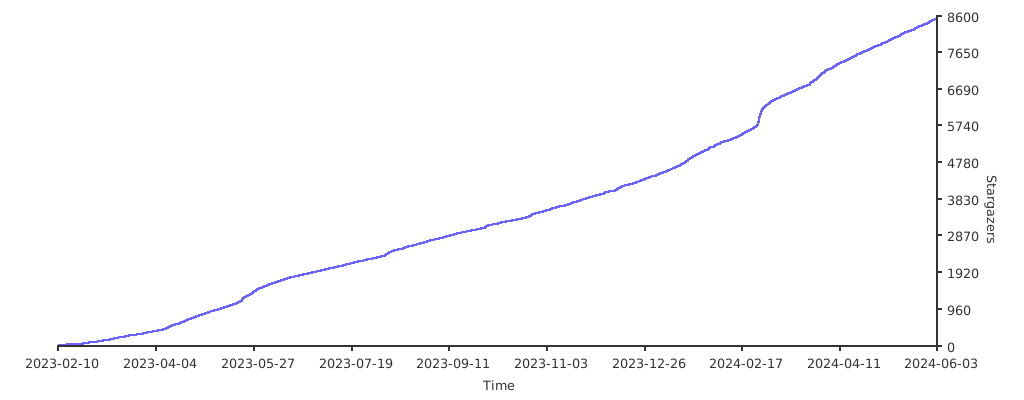
Stargazers over Time